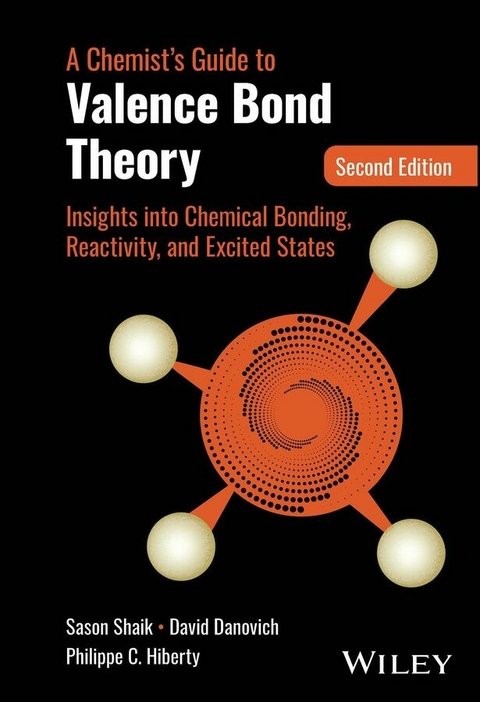
A Chemist's Guide to Valence Bond Theory (eBook)
481 Seiten
Wiley (Verlag)
978-1-394-23880-4 (ISBN)
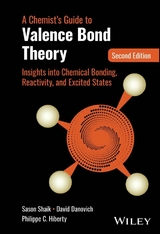
Updated resource on theoretical aspects and applications of valence bond methods to chemical calculations
A Chemist's Guide to Valence Bond Theory explains how to use valence bond theory to think concisely and rigorously and how to use VB computations. It familiarizes the reader with the various VB-based computational tools and methods available today and their use for a given chemical problem and provides samples of inputs/outputs that instruct the reader on how to interpret the results. The book also covers the theoretical basis of Valence Bond (VB) theory and its applications to chemistry in the ground- and excited-states. Applications discussed in the book include sets of exercises and corresponding answers on bonding problems, organic reactions, inorganic/organometallic reactions, and bioinorganic/ biochemical reactions.
This Second Edition contains a new chapter on chemical bonds which includes sections on covalent, ionic, and charge-shift bonds as well as triplet bond pairs, a new chapter on the Breathing-Orbital VB method with its application to molecular excited states, and several new sections discussing recent developments such as DFT-based methods and solvent effects via the Polarizable Continuum Model (PCM).
A Chemist's Guide to Valence Bond Theory includes information on:
- Writing and representing valence bond wave functions, overlaps between determinants, and valence bond formalism using the exact Hamiltonian
- Generating a set of valence bond structures and mapping a molecular orbital-configuration interaction wave function into a valence bond wave function
- The alleged 'failures' of valence bond theory, such as the triplet ground state of dioxygen, and whether or not these failures are 'real'
- Spin Hamiltonian valence bond theory and its applications to organic radicals, diradicals, and polyradicals
A Chemist's Guide to Valence Bond Theory is an essential reference on the subject for chemists who are not necessarily experts on theory but have some background in quantum chemistry. The text is also appropriate for upper undergraduate and graduate students in advanced courses on valence bond theory.
Sason Shaik is a Saerree K. and Louis P. Fiedler Emeritus Professor of Chemistry at the Hebrew University. He has developed a number of new paradigms and concepts using valence bond theory and participated in the initiation of various valence bond methods.
David Danovich is a senior computational chemist at the Institute of Chemistry in the Hebrew University, and an expert on VB calculations
Philippe C. Hiberty is an Emeritus Director of Research at the Centre National de la Recherche Scientifique in the Université Paris-Saclay. He has developed the Breathing-Orbital VB method.
| Erscheint lt. Verlag | 24.12.2025 |
|---|---|
| Sprache | englisch |
| Themenwelt | Naturwissenschaften ► Chemie ► Physikalische Chemie |
| Schlagworte | Breathing-Orbital VB • Charge-Shift Bonds • covalent bonds • DFT-based methods • ionic Bonds • Molecular Excited States • organic reactions • organometallic reactions • origins of energy barriers • Polarizable Continuum Model (PCM) • Triplet Bond Pairs |
| ISBN-10 | 1-394-23880-0 / 1394238800 |
| ISBN-13 | 978-1-394-23880-4 / 9781394238804 |
| Informationen gemäß Produktsicherheitsverordnung (GPSR) | |
| Haben Sie eine Frage zum Produkt? |
 PDF (Adobe DRM)
Kopierschutz: Adobe-DRM
Adobe-DRM ist ein Kopierschutz, der das eBook vor Mißbrauch schützen soll. Dabei wird das eBook bereits beim Download auf Ihre persönliche Adobe-ID autorisiert. Lesen können Sie das eBook dann nur auf den Geräten, welche ebenfalls auf Ihre Adobe-ID registriert sind.
Details zum Adobe-DRM
Dateiformat: PDF (Portable Document Format)
Mit einem festen Seitenlayout eignet sich die PDF besonders für Fachbücher mit Spalten, Tabellen und Abbildungen. Eine PDF kann auf fast allen Geräten angezeigt werden, ist aber für kleine Displays (Smartphone, eReader) nur eingeschränkt geeignet.
Systemvoraussetzungen:
PC/Mac: Mit einem PC oder Mac können Sie dieses eBook lesen. Sie benötigen eine
eReader: Dieses eBook kann mit (fast) allen eBook-Readern gelesen werden. Mit dem amazon-Kindle ist es aber nicht kompatibel.
Smartphone/Tablet: Egal ob Apple oder Android, dieses eBook können Sie lesen. Sie benötigen eine
Geräteliste und zusätzliche Hinweise
Buying eBooks from abroad
For tax law reasons we can sell eBooks just within Germany and Switzerland. Regrettably we cannot fulfill eBook-orders from other countries.
aus dem Bereich