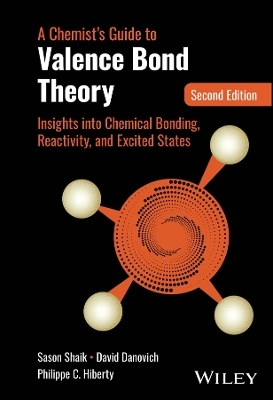
A Chemist's Guide to Valence Bond Theory
John Wiley & Sons Inc (Verlag)
978-1-394-23879-8 (ISBN)
- Noch nicht erschienen (ca. März 2026)
- Versandkostenfrei
- Auch auf Rechnung
- Artikel merken
A Chemist’s Guide to Valence Bond Theory explains how to use valence bond theory to think concisely and rigorously and how to use VB computations. It familiarizes the reader with the various VB-based computational tools and methods available today and their use for a given chemical problem and provides samples of inputs/outputs that instruct the reader on how to interpret the results. The book also covers the theoretical basis of Valence Bond (VB) theory and its applications to chemistry in the ground- and excited-states. Applications discussed in the book include sets of exercises and corresponding answers on bonding problems, organic reactions, inorganic/organometallic reactions, and bioinorganic/ biochemical reactions.
This Second Edition contains a new chapter on chemical bonds which includes sections on covalent, ionic, and charge-shift bonds as well as triplet bond pairs, a new chapter on the Breathing-Orbital VB method with its application to molecular excited states, and several new sections discussing recent developments such as DFT-based methods and solvent effects via the Polarizable Continuum Model (PCM).
A Chemist’s Guide to Valence Bond Theory includes information on:
Writing and representing valence bond wave functions, overlaps between determinants, and valence bond formalism using the exact Hamiltonian
Generating a set of valence bond structures and mapping a molecular orbital-configuration interaction wave function into a valence bond wave function
The alleged “failures” of valence bond theory, such as the triplet ground state of dioxygen, and whether or not these failures are “real”
Spin Hamiltonian valence bond theory and its applications to organic radicals, diradicals, and polyradicals
A Chemist’s Guide to Valence Bond Theory is an essential reference on the subject for chemists who are not necessarily experts on theory but have some background in quantum chemistry. The text is also appropriate for upper undergraduate and graduate students in advanced courses on valence bond theory.
Sason Shaik is a Saerree K. and Louis P. Fiedler Emeritus Professor of Chemistry at the Hebrew University. He has developed a number of new paradigms and concepts using valence bond theory and participated in the initiation of various valence bond methods. David Danovich is a senior computational chemist at the Institute of Chemistry in the Hebrew University, and an expert on VB calculations Philippe C. Hiberty is an Emeritus Director of Research at the Centre National de la Recherche Scientifique in the Université Paris-Saclay. He has developed the Breathing-Orbital VB method.
PREFACE
1 A Brief Story of Valence Bond Theory, Its Rivalry with
Molecular Orbital Theory, Its Demise, and Resurgence 1
1.1 Roots of VB Theory 2
1.2 Origins of MO Theory and the Roots of VB–MO Rivalry 5
1.3 One Theory is Up the Other is Down 7
1.4 Mythical Failures of VB Theory: More Ground is
Gained by MO Theory 8
1.5 Are the Failures of VB Theory Real? 12
1.5.1 The O2 Failure 12
1.5.2 The C4H4 Failure 13
1.5.3 The C5H5+ Failure 13
1.5.4 The Failure Associated with the Photoelectron Spectroscopy of CH4 13
1.6 Valence Bond is a Legitimate Theory Alongside
Molecular Orbital Theory 14
1.7 Modern VB Theory: Valence Bond Theory is Coming
of Age 14
2 A Brief Tour Through Some Valence Bond Outputs
and Terminology 26
2.1 Valence Bond Output for the H2 Molecule 26
2.2 Valence Bond Mixing Diagrams 32
2.3 Valence Bond Output for the HF Molecule 33
3 Basic Valence Bond Theory 40
3.1 Writing and Representing Valence Bond Wave Functions 40
3.1.1 VB Wave Functions with Localized Atomic
Orbitals 40
3.1.2 Valence Bond Wave Functions with
Semilocalized AOs 41
3.1.3 Valence Bond Wave Functions with
Fragment Orbitals 42
3.1.4 Writing Valence Bond Wave Functions
Beyond the 2e/2c Case 43
3.1.5 Pictorial Representation of Valence Bond
Wave Functions by Bond Diagrams 45
3.2 Overlaps between Determinants 45
3.3 Valence Bond Formalism Using the Exact Hamiltonian 46
3.3.1 Purely Covalent Singlet and Triplet
Repulsive States 47
3.3.2 Configuration Interaction Involving Ionic
Terms 49
3.4 Valence Bond Formalism Using an Effective
Hamiltonian 49
3.5 Some Simple Formulas for Elementary Interactions 51
3.5.1 The Two-Electron Bond 51
3.5.2 Repulsive Interactions in Valence Bond
Theory 52
3.5.3 Mixing of Degenerate Valence Bond
Structures 53
3.5.4 Nonbonding Interactions in Valence Bond
Theory 54
3.6 Structural Coefficients and Weights of Valence Bond
Wave Functions 56
3.7 Bridges between Molecular Orbital and Valence Bond
Theories 56
3.7.1 Comparison of Qualitative Valence Bond
and Molecular Orbital Theories 57
3.7.2 The Relationship between Molecular Orbital
and Valence Bond Wave Functions 58
3.7.3 Localized Bond Orbitals: A Pictorial Bridge
between Molecular Orbital and Valence Bond
Wave Functions 60
Appendix 65
3.A.1 Normalization Constants, Energies, Overlaps, and
Matrix Elements of Valence Bond Wave Functions 65
3.A.1.1 Energy and Self-Overlap of an Atomic
Orbital- Based Determinant 66
3.A.1.2 Hamiltonian Matrix Elements and Overlaps
between Atomic Orbital-Based Determinants 68
3.A.2 Simple Guidelines for Valence Bond Mixing 68
Exercises 70
Answers 74
4 Mapping Molecular Orbital—Configuration
Interaction to Valence Bond Wave Functions 81
4.1 Generating a Set of Valence Bond Structures 81
4.2 Mapping a Molecular Orbital–Configuration Interaction
Wave Function into a Valence Bond Wave Function 83
4.2.1 Expansion of Molecular Orbital Determinants
in Terms of Atomic Orbital Determinants 83
4.2.2 Projecting the Molecular Orbital–Configuration
Interaction Wave Function onto the Rumer
Basis of Valence Bond Structures 85
4.2.3 An Example: The Hartree–Fock Wave
Function of Butadiene 86
4.3 Using Half-Determinants to Calculate Overlaps
between Valence Bond Structures 88
Exercises 89
Answers 90
5 Are the ‘‘Failures’’ of Valence Bond Theory Real? 94
5.1 Introduction 94
5.2 The Triplet Ground State of Dioxygen 94
5.3 Aromaticity–Antiaromaticity in Ionic Rings CnHn+/- 97
5.4 Aromaticity/Antiaromaticity in Neutral Rings 100
5.5 The Valence Ionization Spectrum of CH4 104
5.6 The Valence Ionization Spectrum of H2O and the
‘‘Rabbit-Ear’’ Lone Pairs 106
5.7 A Summary 109
Exercises 111
Answers 112
6 Valence Bond Diagrams for Chemical Reactivity 116
6.1 Introduction 116
6.2 Two Archetypal Valence Bond Diagrams 116
6.3 The Valence Bond State Correlation Diagram Model
and Its General Outlook on Reactivity 117
6.4 Construction of Valence Bond State Correlation
Diagrams for Elementary Processes 119
6.4.1 Valence Bond State Correlation Diagrams
for Radical Exchange Reactions 119
6.4.2 Valence Bond State Correlation Diagrams
for Reactions between Nucleophiles and
Electrophiles 122
6.4.3 Generalization of Valence Bond State
Correlation Diagrams for Reactions
Involving Reorganization of Covalent Bonds 124
6.5 Barrier Expressions Based on the Valence Bond State
Correlation Diagram Model 126
6.5.1 Some Guidelines for Quantitative Applications
of the Valence Bond State Correlation Diagram
Model 128
6.6 Making Qualitative Reactivity Predictions with the
Valence Bond State Correlation Diagram 128
6.6.1 Reactivity Trends in Radical Exchange
Reactions 130
6.6.2 Reactivity Trends in Allowed and Forbidden
Reactions 132
6.6.3 Reactivity Trends in Oxidative–Addition
Reactions 133
6.6.4 Reactivity Trends in Reactions between
Nucleophiles and Electrophiles 136
6.6.5 Chemical Significance of the f Factor 138
6.6.6 Making Stereochemical Predictions with the
VBSCD Model 138
6.6.7 Predicting Transition State Structures with
the Valence Bond State Correlation Diagram
Model 140
6.6.8 Trends in Transition State Resonance Energies 141
6.7 Valence Bond Configuration Mixing Diagrams: General
Features 144
6.8 Valence Bond Configuration Mixing Diagram with Ionic
Intermediate Curves 144
6.8.1 Valence Bond Configuration Mixing Diagrams
for Proton-Transfer Processes 145
6.8.2 Insights from Valence Bond Configuration
Mixing Diagrams: One Electron Less–One
Electron More 146
6.8.3 Nucleophilic Substitution on Silicon: Stable
Hypercoordinated Species 147
6.9 Valence Bond Configuration Mixing Diagram with
Intermediates Nascent from ‘‘Foreign States’’ 149
6.9.1 The Mechanism of Nucleophilic Substitution
of Esters 149
6.9.2 The SRN2 and SRN2c Mechanisms 150
6.10 Valence Bond State Correlation Diagram: A General
Model for Electronic Delocalization in Clusters 153
6.10.1 What is the Driving Force for the D6h
Geometry of Benzene, s or p? 154
6.11 Valence Bond State Correlation Diagram: Application
to Photochemical Reactivity 157
6.11.1 Photoreactivity in 3e/3c Reactions 158
6.11.2 Photoreactivity in 4e/3c Reactions 159
6.12 A Summary 163
Exercises 171
Answers 176
7 Using Valence Bond Theory to Compute and
Conceptualize Excited States 193
7.1 Excited States of a Single Bond 194
7.2 Excited States of Molecules with Conjugated Bonds 196
7.2.1 Use of Molecular Symmetry to Generate
Covalent Excited States Based on Valence
Bond Theory 197
7.2.2 Covalent Excited States of Polyenes 209
7.3 A Summary 212
Exercises 215
Answers 216
8 Spin Hamiltonian Valence Bond Theory and its
Applications to Organic Radicals, Diradicals, and
Polyradicals 222
8.1 A Topological Semiempirical Hamiltonian 223
8.2 Applications 225
8.2.1 Ground States of Polyenes and Hund’s Rule
Violations 225
8.2.2 Spin Distribution in Alternant Radicals 227
8.2.3 Relative Stabilities of Polyenes 228
8.2.4 Extending Ovchinnikov’s Rule to Search for
Bistable Hydrocarbons 230
8.3 A Summary 231
Exercises 232
Answers 234
9 Currently Available Ab Initio Valence Bond
Computational Methods and their Principles 238
9.1 Introduction 238
9.2 Valence Bond Methods Based on Semilocalized Orbitals 239
9.2.1 The Generalized Valence Bond Method 240
9.2.2 The Spin-Coupled Valence Bond Method 242
9.2.3 The CASVB Method 243
9.2.4 The Generalized Resonating Valence Bond
Method 245
9.2.5 Multiconfiguration Valence Bond Methods
with Optimized Orbitals 246
9.3 Valence Bond Methods Based on Localized Orbitals 247
9.3.1 Valence Bond Self-Consistent Field Method
with Localized Orbitals 247
9.3.2 The Breathing-Orbital Valence Bond Method 249
9.3.3 The Valence Bond Configuration Interaction
Method 252
9.4 Methods for Getting Valence Bond Quantities from
Molecular Orbital-Based Procedures 253
9.4.1 Using Standard Molecular Orbital Software
to Compute Single Valence Bond Structures
or Determinants 253
9.4.2 The Block-Localized Wave Function and
Related Methods 254
9.5 A Valence Bond Method with Polarizable Continuum
Model 255
Appendix 257
9.A.1 Some Available Valence Bond Programs 257
9.A.1.1 The TURTLE Software 257
9.A.1.2 The XMVB Program 257
9.A.1.3 The CRUNCH Software 257
9.A.1.4 The VB2000 Software 258
9.A.2 Implementations of Valence Bond Methods in
Standard Ab Initio Packages 258
10 Do Your Own Valence Bond Calculations—A
Practical Guide 271
10.1 Introduction 271
10.2 Wave Functions and Energies for the Ground State
of F2 271
10.2.1 GVB, SC, and VBSCF Methods 272
10.2.2 The BOVB Method 276
10.2.3 The VBCI Method 280
10.3 Valence Bond Calculations of Diabatic States and
Resonance Energies 281
10.3.1 Definition of Diabatic States 282
10.3.2 Calculations of Meaningful Diabatic States 282
10.3.3 Resonance Energies 284
10.4 Comments on Calculations of VBSCDs and VBCMDs 287
Appendix 290
10.A.1 Calculating at the SD–BOVB Level in Low
Symmetry Cases 290
11 The Chemical Bonds in Valence Bond Theory 304
11.1 Introduction 304
11.2 VB Approaches: Their Bond Descriptions and Representations 304
11.2.1 Single Two-Electron Bonds 304
11.2.2 Multiple Two-Electron Bonds 306
11.2.3 Classical VB Methods for Single Bonds 306
11.2.4 VB Methods for Multiple Bonds 307
11.3 Applications of VB Theory to Chemical Bonding 309
11.3.1 Electron-Pair Bonds 309
11.3.1.1 The Logic Behind the Existence of
Three Bond Families 314
11.3.1.2 Do Other Computational Methods
Reveal the CSB Family? 315
11.3.2 Pauli Repulsion: The Major Driver of CSB 317
11.3.2.1 Bonds Between Main Elements 318
11.3.2.2 Bonds Between Transition Metals
(TMs) 320
11.3.2.3 Post Transition Metals, Groups 11
and 12 321
11.3.2.4 Other CSB Factors 321
11.3.3 Experimental Manifestations of CSB 322
11.3.4 Deducing Bonding Features from Energy
Barriers 323
11.3.5 Unique Features of Charge-Shift Bonds 324
11.4 Why and When will Atoms Form Hypervalent
Molecules? 325
11.5 Features of Orbital Hybridization in Modern VB
Theory 328
11.5.1 Overlaps of Optimized Hybrid Orbitals 329
11.5.2 Typical Molecules and Their Variationally
Optimized Hybrid Orbitals 330
11.5.2.1 Tetrahedral Hybrids in CH4, B and
N 330
11.5.2.2 Tetrahedral Hybrids 332
11.5.2.3 Linear Hybrids 333
11.5.3 An Overview of Hybridization Results 333
11.5.3.1 Summary of Hybridization Trends in
Classical VB Theory 334
11.6 Description of Multipole Bonding 334
11.6.1 The Bond Multiplicity of C2 335
11.6.2 Multi-Structure VBSCF Calculations of C2 335
11.6.2.1 The Covalent VB-Structure Set 336
11.6.2.2 Adding the Ionic Structures 337
11.6.3 Properties of Quadruply-Bonded Species 342
11.6.3.1 The Resonance-Energy Effect of
Doubly-Bonded Structures on
Quadruple Bonds 343
11.6.3.2 The Nature of the s-Bonds in C2 343
11.6.3.3 The Exo s-Bonds in C2 344
11.6.4 Some Lessons from the C2 Study 344
11.6.5 The Kinetic Stability of Dioxygen
Originates in the Cooperative p-Three-
Electron Bonding 345
11.6.6 Outcomes of p-s Interplay in Multiple
Bonding 347
11.6.6.1 The p-s Interplay in Benzene: What
Factor Determines the D6h Structure? 348
11.6.6.2 The p-s Interplay in Triply-Bonded
Molecules 352
11.6.6.2.1 Conclusions and Extensions of
the p-s Interplay 353
11.7 Triplet-Pair Bonds (TPB) in Ferromagnetic
Metal-Clusters 354
11.7.1 VB Modelling of Bonding in Triplet-Pair
Bonds 357
11.7.2 VB Modelling of n+1Mn Clusters 360
11.7.3 Bond Energies of Triplet-Pair Bonds 364
11.7.4 A Summary of No-Pair Bonding 365
11.8 Concluding Remarks 368
11.9 Supporting Information 368
11.9.1 Supplementary Issues 368
11.9.2 VB Structures for C2 370
11.9.3 Pauli Repulsion and VB Structure Counts
For Triplet-Pair Bond (TPB) in No-Pair
Clusters 377
11.9.3.1 Coinage Metal Clusters 377
11.9.3.2 Alkali Metal Clusters 379
12 Breathing-Orbital Valence Bond: Methods and
Applications 391
12.1 Introduction 391
12.2 Methodology 391
12.2.1 From VBSCF to BOVB 392
12.2.2 Static and Dynamic Correlations in
Electron-Pair Bonds 393
12.2.3 Odd-Electron Bonds 395
12.2.4 Spin-Unrestricted VBSCF and BOVB
Methods 398
12.3 Some Applications of the BOVB Method 398
12.3.1 A Quantitative Definition of Diradical
Character 398
12.3.2 When the Diradical Character Rules the
Reaction Barriers 400
12.3.3 Fast, Accurate and Insightful Calculations
of Challenging Excited States 403
12.3.3.1 The V State of Ethylene 403
12.3.3.2 The Low-Lying Excited States of Ozone
and Sulfur Dioxide 406
12.4 Concluding Remarks 410
12.4.1 The Specific Insight Provided by VB
Ab Initio Computations 410
12.4.2 Non-Orthogonality: A Handicap or an
Opportunity? 411
Epilogue 416
Glossary 418
Index 423
| Erscheint lt. Verlag | 16.3.2026 |
|---|---|
| Verlagsort | New York |
| Sprache | englisch |
| Themenwelt | Naturwissenschaften ► Chemie ► Physikalische Chemie |
| ISBN-10 | 1-394-23879-7 / 1394238797 |
| ISBN-13 | 978-1-394-23879-8 / 9781394238798 |
| Zustand | Neuware |
| Informationen gemäß Produktsicherheitsverordnung (GPSR) | |
| Haben Sie eine Frage zum Produkt? |
aus dem Bereich