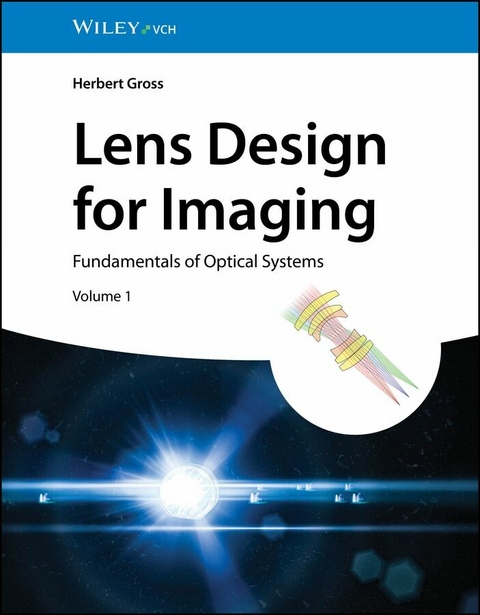
Lens Design for Imaging (eBook)
1717 Seiten
Wiley-VCH (Verlag)
978-3-527-35497-9 (ISBN)
Master the foundational principles that drive successful optical system design in modern imaging applications
Lens Design for Imaging - Volume 1: Fundamentals of Optical Systems, by Herbert Gross, delivers a comprehensive discussion of the theoretical foundations of optical systems. Gross draws on his extensive industrial and academic experience in lens design to close the gap between purely theoretical examinations of lens design and practical application. The author provides a systematic and robust methodology for lens design that guides you through the conceptual design, analysis, and optimization of complex imaging systems across diverse applications. In this first volume the basic preconditions to understand optical imaging systems are presented.
The book covers twelve domains of optical system fundamentals, from material properties and geometrical optics to advanced topics, like diffraction theory, Fourier optics, and digital image processing. Each chapter combines rigorous theory with illustrations and hands-on examples, making complex concepts accessible while maintaining the mathematical depth demanded by professional practice. Lens Design for Imaging - Volume 1 encompasses the necessary knowledge and critical review about optical materials dispersion, the geometrical optics approximation, ray tracing methodologies, component design principles, imaging system theory, physical optics effects, and modern computational approaches.
Readers will also find:
- Comprehensive coverage of optical materials including dispersion models, in particular for short pulse systems, absorption and thermal properties, and specialized materials for UV, IR, and consumer applications
- Detailed ray tracing methods with complete equation sets for aspherical surfaces, gradient media, and diffractive elements
- Presentation of physical models for diffraction effects, point spread functions, and optical transfer functions of optical systems, with practical calculation schemes with discussion of approximations and limitations
- Advanced topics, including Gaussian beam propagation, limits of Gaussian beam models, photometric analysis, and phase space representations for system analysis
- An integrated approach to digital imaging methods covering realistic image simulation, enhancement techniques, and modern imaging modalities
Perfect for optical engineers, lens designers, and advanced students in optics and photonics, Lens Design for Imaging - Volume 1 provides authoritative coverage of optical system fundamentals. It contains the systematic knowledge practitioners and students require to tackle complex design challenges.
Herbert Gross has 30 years' experience designing optical systems at Zeiss AG and has spent 12 years teaching and conducting research at the University of Jena, Germany. His unique background spans both industrial lens design and academic research, providing him with deep insights into both the theoretical foundations and practical challenges of optical system development.
1
Introduction
Motivation and Outline
This book is the first volume of a series of books about lens design. The overall outline of this series is:
- Vol 1: Optical System Properties
Introduction to the basic technical terms of optical systems.
- Vol 2: Aberration Theory
Development of aberration theoretical fundamentals for a better understanding of correction schemes and methods.
- Vol 3: Correction Strategy
Description of the major approaches, rules and methods to lay out, optimize and correct optical imaging systems.
- Vol 4: Selected Applications
Demonstration of how existing and well‐known optical systems are developed from the basis of knowledge from volumes 1–4.
- Vol 5: Tutorials and Case Studies
In this last volume a large variety of practical tasks and examples is fully worked out to demonstrate to the reader how to practice the theory
Throughout this series, considerations are restricted more or less to imaging systems. Illumination systems, as the second large category, follow different rules and are not handled here.
In this first volume, the required basic knowledge for lens design is presented. This includes consideration of material parameters, geometrical optics, the technology of simple optical components as well as consideration of compound systems. Furthermore, the basic physics of diffraction theory is presented in scope: how it is useful for lens design. As special important representations to assess the quality of systems including diffraction effects, the point spread function as well as the optical transfer function are discussed in more detail. Finally, some more marginal topics are presented: Gaussian beams as simple representatives of wave optical light fields with an important relation to the modelling of laser light sources; photometry as one relevant consideration of the energetic evaluation of optical imaging systems; the phase space as a very helpful representation of ray as well as wave optics for better understanding their relationship. Last but not least, a chapter is devoted to digital methods in the computation of quasi‐realistic images, the properties of a modern digital image acquisition as well as the digital image postprocessing, which nowadays plays an important role in modern systems.
There are many books about aberration theory and optical design [1–33]. This therefore raises the question: why do we need another? I am convinced that a competent working designer needs a deep understanding of aberration theory and huge, concrete practical experience. Therefore, beneath the description of the methods to correct a system, a comprehensive and clear presentation of aberrations is necessary and an application and training related element is required to demonstrate the realization and application of all the theory and methods. In my understanding, there are currently two types of books available: the first is mostly written by colleagues in academia, theory and mathematical treatment is in the foreground and the practical applications are a less pronounced discussion. On the other hand, there are some books that deal with the practical realization without any theoretical foundation. A book that combines both and collects the knowledge more comprehensively appears to be missing. This is the reason why I am convinced that one more book makes sense and helps the community and, in particular, younger colleagues to learn this fascinating profession with a considerable scientific systematic background. No book and nobody is perfect, but owing to a long history dealing with this topic, from applications in industry as well as from an educational position, I believe I know both worlds and will try to combine them as well as possible. Furthermore, it is well known that optical design is an interdisciplinary field between mathematics, physics and engineering. Therefore, a breadth of knowledge is necessary to work successfully. As one option to make learning easier, I always try to visualize as many aspects and information in graphical form as possible. I am sure that this helps a lot and it is one of the main features of this book series.
Rigorous mathematical strictness is not the goal of this book. With the practical approach it is much more important to gain an understanding to be able to bridge to applications. In Chapter 12, as a mathematical appendix, some more details are explained. It seems more meaningful to avoid this in the running text about optics.
There are several sections that are indicated with an asterisk and a short comment. These are topics that are more specialized and I recommend beginners skip them in the first reading. It should be possible to understand the later chapters without knowing these advanced elements.
One dilemma in this first volume was the fact that many visualizations and explanations require certain knowledge about aberrations. Aberrations are explained in detail in the second volume. Nevertheless, I think it makes sense to use these examples. I have tried to refer to the corresponding later chapters and detailed discussions. But, I know, forward referencing is not a good style. I hope the reader forgives me these inconsistencies in didactic sequence.
Of course, it's impossible to write and work out everything fully alone. There are many colleagues I have to acknowledge here for their endless help and support. I have tried to reference every source and figure accurately, but this is sometimes complicated. Therefore, I beg the pardon of anybody who I haven't dignified correspondingly.
1.1 Modelling and Goal of Lens Design
In general, there are two types of calculation scheme and aim in the simulation of optical systems. If the data and parameters of a system are given, a goal can be to analyse the setup, to calculate the functionality and to evaluate the system performance. This is a direct calculation and is quite straightforward. In this task less creativity is needed.
If a specification is known, which is needed for a special application, the question becomes what kind of system fulfils these requirements – and an inverse problem must be solved. In this case, classical optical design work has to be done to find – through experience or creative thinking – which type of system is able to achieve the request taking certain constraints into account. This second task is much more complicated, often not straightforward and sometimes unsolvable. The corresponding scheme is visualized in Figure 1.1.
Figure 1.1 Calculation goals for optical system calculations [34].
From the physical point of view, there are several levels of modelling depth used to describe an optical system. On the one hand, a calculation should be fast, effective and accurate. Usually, a more accurate result is needed for deeper physical approaches with fewer approximations. In any case, a decision about a selected model for a specific task must make sure that the investigated effects and results are covered by the approach while, conversely, the computational burden is as small as possible. Figure 1.2 shows certain levels of approximations. Depending on the effects taken into account and the accuracy of the model predictions required, the physical model can be simplified through several approximation steps. Typically, this reduces the computational effort. Furthermore, the simplifications often allow for analytical formulation of solutions, which give much more insight into the dependencies and physical principles.
Figure 1.2 Trade‐off between calculation effort and accuracy.
One of the important questions in simulation or design task reality is: what kind of modelling level is necessary to achieve the necessary accuracy, while keeping the calculation fast and robust.
Optical systems are usually designed, optimized and simulated by raytrace. This kind of approximation level is well established, fast and takes aberrations into account. For the majority of systems, this is an acceptable accuracy. In later design phases, if the system is already near the final performance, diffraction related criteria – like the point spread function or optical transfer function – can be included. But the start of calculation with a raw quality is mainly through raytrace. For this purpose, a simple mathematical model is required to describe the essential properties of the system parameters appropriate for this calculation scheme. These include the following.
- Interface surfaces:
- mathematical modelled surfaces;
- planes, spheres, aspheres, conics, free shaped surfaces.
- Size of components:
- thickness and distances along the axis;
- transversal size, circular diameter, complicated contours.
- Geometry of the setup:
- special case: rotational symmetry;
- general case: three‐dimensional, tilt angles, offsets and decentrations.
- Materials:
- refractive indices for all used wavelengths;
- other properties: absorption, birefringence, non‐linear coefficients, index gradients.
- Special surfaces:
- gratings, diffractive elements;
- arrays, scattering surfaces.
These data are part of typical system data or the archive files of commercial design software tools. For a concrete reproduction of a calculation, the light data used must additionally be given. These are the wavelengths, the...
| Erscheint lt. Verlag | 28.10.2025 |
|---|---|
| Reihe/Serie | Lens Design |
| Sprache | englisch |
| Themenwelt | Naturwissenschaften ► Physik / Astronomie |
| Schlagworte | aberration theory • Diffraction Theory • Digital Imaging • fourier optics • Gaussian beams • geometrical optics • Imaging Systems • Optical engineering • Optical Materials • optical transfer function • Photometry • Point Spread Function • Ray tracing |
| ISBN-10 | 3-527-35497-2 / 3527354972 |
| ISBN-13 | 978-3-527-35497-9 / 9783527354979 |
| Informationen gemäß Produktsicherheitsverordnung (GPSR) | |
| Haben Sie eine Frage zum Produkt? |
 EPUB (Adobe DRM)
Kopierschutz: Adobe-DRM
Adobe-DRM ist ein Kopierschutz, der das eBook vor Mißbrauch schützen soll. Dabei wird das eBook bereits beim Download auf Ihre persönliche Adobe-ID autorisiert. Lesen können Sie das eBook dann nur auf den Geräten, welche ebenfalls auf Ihre Adobe-ID registriert sind.
Details zum Adobe-DRM
Dateiformat: EPUB (Electronic Publication)
EPUB ist ein offener Standard für eBooks und eignet sich besonders zur Darstellung von Belletristik und Sachbüchern. Der Fließtext wird dynamisch an die Display- und Schriftgröße angepasst. Auch für mobile Lesegeräte ist EPUB daher gut geeignet.
Systemvoraussetzungen:
PC/Mac: Mit einem PC oder Mac können Sie dieses eBook lesen. Sie benötigen eine
eReader: Dieses eBook kann mit (fast) allen eBook-Readern gelesen werden. Mit dem amazon-Kindle ist es aber nicht kompatibel.
Smartphone/Tablet: Egal ob Apple oder Android, dieses eBook können Sie lesen. Sie benötigen eine
Geräteliste und zusätzliche Hinweise
Buying eBooks from abroad
For tax law reasons we can sell eBooks just within Germany and Switzerland. Regrettably we cannot fulfill eBook-orders from other countries.
aus dem Bereich