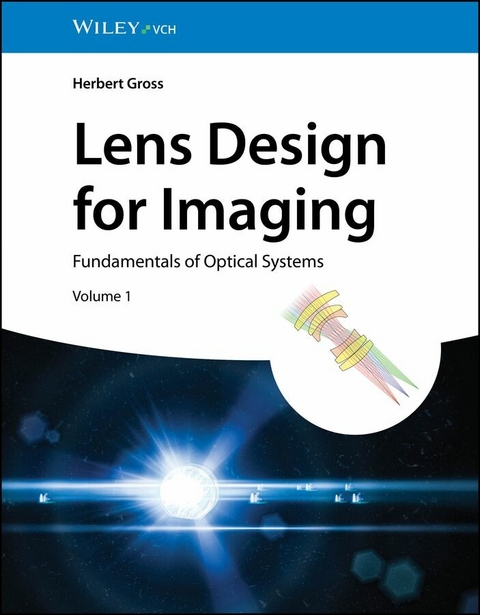
Lens Design for Imaging (eBook)
643 Seiten
Wiley-VCH (Verlag)
978-3-527-35498-6 (ISBN)
Master the foundational principles that drive successful optical system design in modern imaging applications
Lens Design for Imaging - Volume 1: Fundamentals of Optical Systems, by Herbert Gross, delivers a comprehensive discussion of the theoretical foundations of optical systems. Gross draws on his extensive industrial and academic experience in lens design to close the gap between purely theoretical examinations of lens design and practical application. The author provides a systematic and robust methodology for lens design that guides you through the conceptual design, analysis, and optimization of complex imaging systems across diverse applications. In this first volume the basic preconditions to understand optical imaging systems are presented.
The book covers twelve domains of optical system fundamentals, from material properties and geometrical optics to advanced topics, like diffraction theory, Fourier optics, and digital image processing. Each chapter combines rigorous theory with illustrations and hands-on examples, making complex concepts accessible while maintaining the mathematical depth demanded by professional practice. Lens Design for Imaging - Volume 1 encompasses the necessary knowledge and critical review about optical materials dispersion, the geometrical optics approximation, ray tracing methodologies, component design principles, imaging system theory, physical optics effects, and modern computational approaches.
Readers will also find:
- Comprehensive coverage of optical materials including dispersion models, in particular for short pulse systems, absorption and thermal properties, and specialized materials for UV, IR, and consumer applications
- Detailed ray tracing methods with complete equation sets for aspherical surfaces, gradient media, and diffractive elements
- Presentation of physical models for diffraction effects, point spread functions, and optical transfer functions of optical systems, with practical calculation schemes with discussion of approximations and limitations
- Advanced topics, including Gaussian beam propagation, limits of Gaussian beam models, photometric analysis, and phase space representations for system analysis
- An integrated approach to digital imaging methods covering realistic image simulation, enhancement techniques, and modern imaging modalities
Perfect for optical engineers, lens designers, and advanced students in optics and photonics, Lens Design for Imaging - Volume 1 provides authoritative coverage of optical system fundamentals. It contains the systematic knowledge practitioners and students require to tackle complex design challenges.
Herbert Gross has 30 years' experience designing optical systems at Zeiss AG and has spent 12 years teaching and conducting research at the University of Jena, Germany. His unique background spans both industrial lens design and academic research, providing him with deep insights into both the theoretical foundations and practical challenges of optical system development.
| Erscheint lt. Verlag | 22.10.2025 |
|---|---|
| Reihe/Serie | Lens Design |
| Sprache | englisch |
| Themenwelt | Naturwissenschaften ► Physik / Astronomie |
| Schlagworte | aberration theory • Diffraction Theory • Digital Imaging • fourier optics • Gaussian beams • geometrical optics • Imaging Systems • Optical engineering • Optical Materials • optical transfer function • Photometry • Point Spread Function • Ray tracing |
| ISBN-10 | 3-527-35498-0 / 3527354980 |
| ISBN-13 | 978-3-527-35498-6 / 9783527354986 |
| Informationen gemäß Produktsicherheitsverordnung (GPSR) | |
| Haben Sie eine Frage zum Produkt? |
 PDF (Adobe DRM)
Kopierschutz: Adobe-DRM
Adobe-DRM ist ein Kopierschutz, der das eBook vor Mißbrauch schützen soll. Dabei wird das eBook bereits beim Download auf Ihre persönliche Adobe-ID autorisiert. Lesen können Sie das eBook dann nur auf den Geräten, welche ebenfalls auf Ihre Adobe-ID registriert sind.
Details zum Adobe-DRM
Dateiformat: PDF (Portable Document Format)
Mit einem festen Seitenlayout eignet sich die PDF besonders für Fachbücher mit Spalten, Tabellen und Abbildungen. Eine PDF kann auf fast allen Geräten angezeigt werden, ist aber für kleine Displays (Smartphone, eReader) nur eingeschränkt geeignet.
Systemvoraussetzungen:
PC/Mac: Mit einem PC oder Mac können Sie dieses eBook lesen. Sie benötigen eine
eReader: Dieses eBook kann mit (fast) allen eBook-Readern gelesen werden. Mit dem amazon-Kindle ist es aber nicht kompatibel.
Smartphone/Tablet: Egal ob Apple oder Android, dieses eBook können Sie lesen. Sie benötigen eine
Geräteliste und zusätzliche Hinweise
Buying eBooks from abroad
For tax law reasons we can sell eBooks just within Germany and Switzerland. Regrettably we cannot fulfill eBook-orders from other countries.
aus dem Bereich