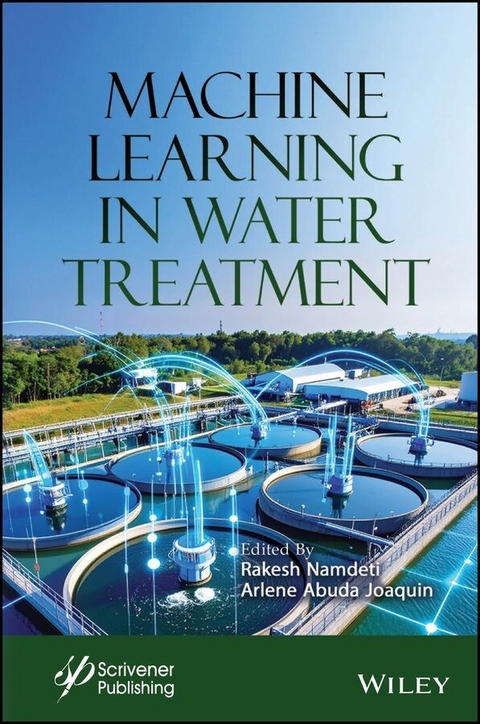
Machine Learning in Water Treatment (eBook)
1462 Seiten
Wiley-Scrivener (Verlag)
978-1-394-30350-2 (ISBN)

Machine Learning in Water Treatment is a must-have for anyone interested in how artificial intelligence is transforming water treatment, offering practical insights, case studies, and a deep dive into cutting-edge machine learning techniques that can improve water quality management.
Machine Learning in Water Treatment explores the complex fields of wastewater treatment and water purification, offering a thorough analysis of the cutting-edge machine learning methods used to solve problems with water quality control. It provides insights into how artificial intelligence can be incorporated with conventional procedures, bridging the gap between conventional water treatment techniques and state-of-the-art data-driven solutions. The book will cover the foundations of water treatment procedures, providing insights into the ideas behind physical, chemical, and biological treatment modalities. Difficulties in managing water and wastewater quality are paving the way for the use of machine learning as an effective tool for control and optimization.
Fundamentally, the book explains how machine learning models are used in water treatment system control, optimization, and predictive modeling. Readers will learn how to take advantage of machine learning algorithms' potential for real-time treatment process optimization, quality issue identification, and water pollutant level prediction through a thorough investigation of data collection, preprocessing, and model creation. Case studies and real-world applications provide insightful information about the application of machine learning technologies in a variety of scenarios. With its unique combination of theoretical understanding and real-world applications, this book is an invaluable tool for understanding how water quality management is changing in the age of data-driven decision-making.
Rakesh Namdeti, PhD is a lecturer in the Department of Chemical Engineering at the University of Technology and Applied Sciences, Salalah. He has over 20 publications, including book chapters and articles in international journals of repute. His research interests include chemical processes, separation technology, and petroleum refining.
Arlene Abuda Joaquin, PhD is lecturer in the Department of Chemical Engineering at the University of Technology and Applied Sciences, Salalah. She is credited with over 15 publications, including book chapters and articles in international journals. Her research focuses on water and wastewater treatment, water quality, and environmental pollution.
Machine Learning in Water Treatment is a must-have for anyone interested in how artificial intelligence is transforming water treatment, offering practical insights, case studies, and a deep dive into cutting-edge machine learning techniques that can improve water quality management. Machine Learning in Water Treatment explores the complex fields of wastewater treatment and water purification, offering a thorough analysis of the cutting-edge machine learning methods used to solve problems with water quality control. It provides insights into how artificial intelligence can be incorporated with conventional procedures, bridging the gap between conventional water treatment techniques and state-of-the-art data-driven solutions. The book will cover the foundations of water treatment procedures, providing insights into the ideas behind physical, chemical, and biological treatment modalities. Difficulties in managing water and wastewater quality are paving the way for the use of machine learning as an effective tool for control and optimization. Fundamentally, the book explains how machine learning models are used in water treatment system control, optimization, and predictive modeling. Readers will learn how to take advantage of machine learning algorithms potential for real-time treatment process optimization, quality issue identification, and water pollutant level prediction through a thorough investigation of data collection, preprocessing, and model creation. Case studies and real-world applications provide insightful information about the application of machine learning technologies in a variety of scenarios. With its unique combination of theoretical understanding and real-world applications, this book is an invaluable tool for understanding how water quality management is changing in the age of data-driven decision-making.
1
Overview of Wastewater Treatment and Water Purification
Sivarethinamohan R.
Symbiosis Centre for Management Studies, Bengaluru Campus, Symbiosis International (Deemed University), Pune, India
Abstract
Water serves all living things by supporting biodiversity, preserving human health, economic growth, poverty reduction, food security, and education. Further, the future economy within and between countries is decided by clean water for industrial manufacturing, agriculture, tourism, recreation, energy generation, and other economic sectors. Clean water supports preserving climatic equilibrium and mitigating extreme weather events like floods and droughts. Ecological diversity and clean water supply food and habitats. Thus, this chapter attempts to address the issues of why clean water is a necessary process and why and how clean water is essential to society. It also offers suggestions to help India get closer to accomplishing SDGs 6.1 and 6.2. Furthermore, it will discuss how communities demand clean water for socioeconomic growth, energy and food production, survival and health, and healthy ecosystems for people to flourish physically, psychologically, economically, socially, and spiritually. This chapter further honed potential clean water technology, primary and secondary wastewater treatment, and water purification processes.
Keywords: Human health, ecosystems, sustainability, pollution, biodiversity, food security
1.1 Clean Water: Its Significance for Society
Around the world, communities depend on clean water as a resource. However, environmental diversity is gravely threatened by water contamination and pollution; 3.5 billion people lacked safely managed drinking water, 1.5 billion lacked basic water service, and 653 million lacked access to handwashing facilities. Chemicals, microbes, and dangerous materials in water can cause chronic health problems, arsenic, neurological disabilities, reproductive problems, and other infectious diseases, in addition to waterborne illnesses like cholera and diarrhea. Nearly 1,000 children pass away daily from sicknesses due to inadequate sanitation and water pollution. Concerted efforts are required at the individual, community, and governmental levels. Unusual taste, unusual smell, noisy faucets, and slow water output are the problems associated with water purification (Chiu, Brown, Lucett, & Worrell, 2024).
Water lets cells absorb nutrition, eliminate waste, protect joints and organs, and regulate body temperature. Dehydration can also directly cause headaches, which water helps avoid and cure. Drinking water helps prevent joint discomfort and cramping in the muscles (Shamim, Amlus, & Jawaid, 2024). Maintaining enough hydration reduces the likelihood of joint pain by keeping muscles more supple and joints lubricated. Water lowers the risk of bladder, kidney, and colon cancer. However, in certain places, individuals find it challenging to consume enough water for good health.
The question, “Why buy bottled water when tap water is available?” provoked thought. This was an unexpectedly important question. In countries like the Netherlands, having clean, safe tap water is a daily luxury so commonplace that its scarcity in much of the globe is frequently disregarded. However, 800 million people throughout the world do not have access to clean water, and two people die every minute as a result. Membranes, synthetic filters resembling kitchen sieves, provide a solution by letting only the cleanest water pass through while keeping contaminants out. Even the dirtiest water may be made drinkable with this fantastic procedure. Cities like Minneapolis and Moscow are presently supported by membrane technology, which produces hundreds of thousands of liters per day and demonstrates that universal access to clean water is a dream and attainable. The appreciation for pure tap water has grown due to thinking about that subject. Action must replace taking this right for granted.
1.2 Production of Clean Water
The same water on the planet we were living on millions of years ago is continuously utilized today. Water is moved from the soil to the air and back again via the hydrological cycle. When water evaporates, it enters the atmosphere and joins clouds. This moisture is held in the cloud until it descends to the land as precipitation, such as rain, hail, or snow. The subsequent steps involve getting clean drinking water. Figure 1.1 provides the flowchart of different stages in which getting the clean and safe water.
- Unwanted chemicals, biological contaminants, suspended solids, and gases are removed from contaminated water by the water purification process to produce water suitable for drinking.
- Following water purification, pollutants, particles, and living things are further removed from the water by a semi-permeable membrane using a semipermeable membrane.
- For disinfection, chemicals like chlorine dioxide and chloramines are used to eliminate dangerous microorganisms.
- Semipermeable membrane is used to eliminate salt and minerals from water to get pure drinking water.
- The uniformity and quality of the water are preserved with the help of regular quality checks and tests using advanced technologies.
- The blowing machine produces clean water bottles after quality testing.
- A bottling machine bottles the water after it has been blown. The bottles are then rinsed during the procedure.
- Water is added to the bottles during filling with proper capping and Pallet wrapping.
Figure 1.1 Shows different steps involved in getting clean drinking water.
However, among the techniques mentioned above for purifying water, the following are frequently employed: (1) physical processes like filtration, sedimentation, or distillation; (2) biological processes like active carbon and sand filters; and (3) chemical processes like flocculation, chlorination, and ultraviolet light.
1.3 The Quality of Good Water
Good water is safe to drink since it is devoid of pollutants and impurities. Among the qualities of quality water are:
- Both color and odor should be absent from potable water.
- It ought to be clear.
- It must be devoid of contaminants like suspended solids.
- It should have certain salts and minerals essential to our bodies and some dissolved gasses that give it flavor.
- It should be free from harmful microbes.
1.4 Standards for Drinking Water
Pure water is neither acidic nor basic when a pH of 7 (Paz et al., 2007). But with pH 7, the water becomes acidic, and at pH 7, the water turns out to be basic. However, water can be drunk with a pH of 6.5 to 8.5.
The BOD (Biological Oxygen Demand) level would be less than or equal to five parts per million in clean water. A water body’s BOD value rises in proportion to the level of pollution present. The drinking water should have a BOD level below five parts per million. However, while water COD (Chemical Oxygen Demand) has a threshold of 10 mg/L, water BOD has a 2 mg/L threshold (Nabbou et al., 2020). The BOD value may be higher than the COD value in wastewater samples that include significant quantities of organic nitrogen or sulfur compounds. Still, the COD value is usually larger than or equal to the BOD value.
1.5 The Significance of “Clean Water for All”
Clean water for all is possible when governments, corporations, communities, and international leaders achieve an identical goal. Clean water access is a future ready to be realized, not just a far-off fantasy (Donkor, 2022).
- Global Health: Two people die every minute as a result of not having access to clean water, which leads to avoidable fatalities from waterborne illnesses.
- Universal Right: Although 800 million people globally still lack access to clean water, it is a fundamental human right that negatively impacts their dignity and quality of life.
- Economic Impact: Communities that lack access to potable water endure health expenses, missed workdays, and lower economic prospects.
- Academic Progress: Regular school attendance, rather than spending hours collecting water, is made possible by clean water, which promotes academic progress for children, particularly young girls.
- Technological Feasibility: Sophisticated membrane technology is now in use to produce clean, drinking water from many polluted sources.
1.6 Value of Clean Water
Precipitation, water bodies, groundwater, ice, rivers, great lakes, and the St. Lawrence River are the main sources of freshwater that supply huge amounts of water around the globe. Figure 1.2 depicts the average water use per person by continent per day.
The average human drinks 2–3 liters of water per day. For flushing the toilets, they use about 6 liters per flush. For washing the dishes, a dishwasher uses around 15–20 liters per load. However, nearly one in ten people worldwide, or 65 core population, couldn’t get clean drinking water access, and one in three people lack proper sanitation, which puts them at risk for infectious illnesses and early mortality.
Diarrheal infections kill 900 children under the age of five every day, or one kid every two minutes (Keusch, Walker, Das, Horton, & Habte, 2016). An estimated 88 per cent of these deaths are caused by poor drinking water, a lack of access to sanitation, and inadequate water availability for hygiene. Inadequate sanitation, hygiene, and water supply cause over...
| Erscheint lt. Verlag | 11.9.2025 |
|---|---|
| Sprache | englisch |
| Themenwelt | Naturwissenschaften ► Chemie |
| Schlagworte | Artificial Intelligence • machine learning • Wastewater Treatment • Water purification • Water resource management • Water Treatment |
| ISBN-10 | 1-394-30350-5 / 1394303505 |
| ISBN-13 | 978-1-394-30350-2 / 9781394303502 |
| Informationen gemäß Produktsicherheitsverordnung (GPSR) | |
| Haben Sie eine Frage zum Produkt? |
 EPUB (Adobe DRM)
Kopierschutz: Adobe-DRM
Adobe-DRM ist ein Kopierschutz, der das eBook vor Mißbrauch schützen soll. Dabei wird das eBook bereits beim Download auf Ihre persönliche Adobe-ID autorisiert. Lesen können Sie das eBook dann nur auf den Geräten, welche ebenfalls auf Ihre Adobe-ID registriert sind.
Details zum Adobe-DRM
Dateiformat: EPUB (Electronic Publication)
EPUB ist ein offener Standard für eBooks und eignet sich besonders zur Darstellung von Belletristik und Sachbüchern. Der Fließtext wird dynamisch an die Display- und Schriftgröße angepasst. Auch für mobile Lesegeräte ist EPUB daher gut geeignet.
Systemvoraussetzungen:
PC/Mac: Mit einem PC oder Mac können Sie dieses eBook lesen. Sie benötigen eine
eReader: Dieses eBook kann mit (fast) allen eBook-Readern gelesen werden. Mit dem amazon-Kindle ist es aber nicht kompatibel.
Smartphone/Tablet: Egal ob Apple oder Android, dieses eBook können Sie lesen. Sie benötigen eine
Geräteliste und zusätzliche Hinweise
Buying eBooks from abroad
For tax law reasons we can sell eBooks just within Germany and Switzerland. Regrettably we cannot fulfill eBook-orders from other countries.
aus dem Bereich