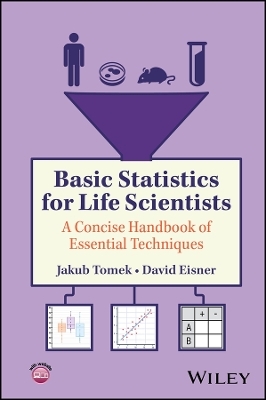
Basic Statistics for Life Scientists
John Wiley & Sons Inc (Verlag)
978-1-394-28496-2 (ISBN)
Basic Statistics for Life Scientists is an approachable, concise handbook of essential statistical techniques that teaches correct practice in the life sciences and related fields, helping readers become competent users of statistics and assisting them in identifying the best statistical method for their research question while also being aware of its strengths and limitations. The book is supported by illustrations and real-world examples explaining how to apply the techniques using statistical software tools.
Written by two highly qualified authors, Basic Statistics for Life Scientists includes information on:
Appropriate statistical techniques for evaluating experimental data, avoiding excessive jargon or mathematics
Misuse of statistical techniques in life sciences research
Systematic problems present in life sciences research, such as multiple hypothesis testing and pseudoreplication
Experimental design and the problems associated with the concept of binary statistical significance
Basic Statistics for Life Scientists is an essential reference for students and researchers in life sciences and biomedicine, especially PhD students and postdoctoral researchers, seeking to confidently apply appropriate statistical tests to their data. The book is also valuable to advanced undergraduates and more senior researchers in related fields.
Jakub Tomek is a Sir Henry Wellcome Fellow in the Department of Physiology, Anatomy and Genetics at the University of Oxford. David Eisner is the Professor of Cardiac Physiology at the University of Manchester. He has served as Editor-in-Chief of The Journal of Molecular and Cellular Cardiology and The Journal of Physiology and is currently Editor-in-Chief of The Journal of General Physiology.
List of Boxes ix
Preface xi
About the Companion Site xv
1 A Primer on Data Summarization and Visualization 1
1.1 Numerical Summary of Data 1
1.2 Data Visualization 5
2 The p-Value and Concept of Statistical Significance 13
2.1 Beware of Misconceptions 17
3 Statistical Tests: How to Get the p-Value 25
3.1 t-Tests 29
3.1.1 Unpaired t-Test 29
3.1.2 Welch’s Unpaired t-Test 37
3.1.3 Paired t-Test 38
3.1.4 Equivalence Testing 40
3.2 Non-parametric Alternatives to t-Tests for Comparison of Two Groups 42
3.2.1 Mann–Whitney U Test (Wilcoxon Rank-Sum) 42
3.2.2 Brunner–Munzel Test 48
3.2.3 Other Non-parametric Unpaired Tests 48
3.2.4 Wilcoxon Signed-Rank Test 49
3.2.5 Sign Test 49
3.3 Tests for Frequency of Occurrence 50
3.3.1 Fisher’s Exact Test and Some of Its Alternatives 50
3.3.2 Chi-Square Test 52
3.4 Correlation and Regression Analyses 52
3.4.1 Correlation 52
3.4.1.1 Pearson Correlation 54
3.4.1.2 Spearman Correlation 56
3.4.1.3 Kendall Correlation 56
3.4.1.4 Final Comments on Correlation 58
3.4.2 Linear Regression 60
3.4.3 Non-linear Regression and Comparing Curve Data 67
3.5 ANOVA Methods for Comparison of Multiple Groups 70
3.5.1 One-Way ANOVA 70
3.5.2 Repeated Measures ANOVA 75
3.5.3 Two-Way ANOVA 76
3.6 Permutation Tests 77
4 Common Pitfalls Associated with the Use of p-Values and Statistical Significance 83
4.1 Multiple Testing Problem (and How to Correct for It) 83
4.1.1 Multiple Hypothesis Testing Corrections 85
4.2 Underpowered Study Design (and Power Calculations) 88
4.2.1 Power Calculations 89
4.3 Pseudoreplication (and Hierarchical Statistics) 94
4.4 N-Hacking (and Interim and Sequential Analysis) 99
5 Problems of the Concept of Statistical Significance; Alternative Approaches 105
6 Experimental Design 111
6.1 Starting the Project 111
6.1.1 Pre-registration 111
6.2 Stopping the Project 112
6.3 Control Experiments 113
6.4 Discarding Data 113
6.5 Blinding 114
6.6 Randomization and Blocking 115
6.7 Uncontrolled Factors 117
6.8 Which Experimental Model Should Be Used? 118
7 Concluding Remarks 121
Further Reading 123
Appendix A A Brief Overview of Tools for Statistical Analysis 125
Appendix B Additional Points on Tests for Contingency Tables 129
B.1 Fisher’s Test Conservatism 129
B.2 Additional Details on Useful Alternatives to Fisher’s Test 131
Appendix C On the p-Value as a Measure of Evidence 133
Code Samples 135
Samples for Section 1.1 136
Samples for Section 1.2 136
Samples for Section 3.1 143
Samples for Section 3.2 147
Samples for Section 3.3 150
Samples for Section 3.4 151
Samples for Section 3.5 159
Samples for Section 3.6 161
Samples for Section 4.1 165
Samples for Section 4.2 166
Samples for Section 4.3 170
Bibliography 173
Index 181
| Erscheinungsdatum | 22.11.2025 |
|---|---|
| Verlagsort | New York |
| Sprache | englisch |
| Maße | 157 x 235 mm |
| Gewicht | 425 g |
| Themenwelt | Mathematik / Informatik ► Mathematik ► Statistik |
| Studium ► Querschnittsbereiche ► Epidemiologie / Med. Biometrie | |
| Naturwissenschaften ► Biologie | |
| ISBN-10 | 1-394-28496-9 / 1394284969 |
| ISBN-13 | 978-1-394-28496-2 / 9781394284962 |
| Zustand | Neuware |
| Informationen gemäß Produktsicherheitsverordnung (GPSR) | |
| Haben Sie eine Frage zum Produkt? |
aus dem Bereich