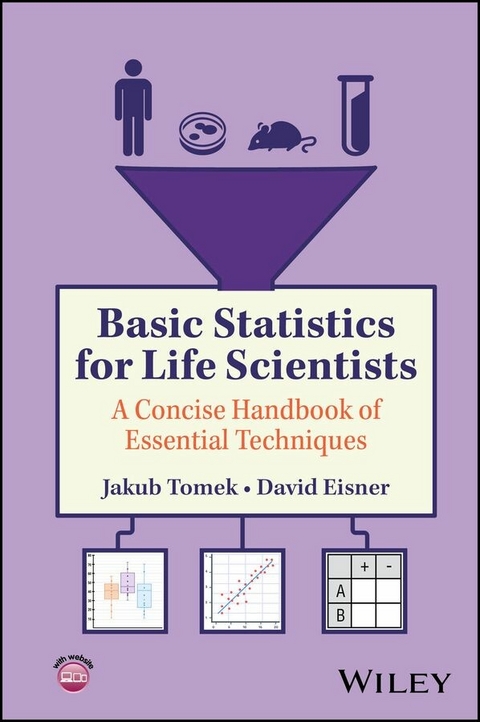
Basic Statistics for Life Scientists (eBook)
202 Seiten
Wiley (Verlag)
978-1-394-28498-6 (ISBN)
Concise and approachable yet rigorous discussion of the appropriate use of statistical techniques in life science research
Basic Statistics for Life Scientists is an approachable, concise handbook of essential statistical techniques that teaches correct practice in the life sciences and related fields, helping readers become competent users of statistics and assisting them in identifying the best statistical method for their research question while also being aware of its strengths and limitations. The book is supported by illustrations and real-world examples explaining how to apply the techniques using statistical software tools.
Written by two highly qualified authors, Basic Statistics for Life Scientists includes information on:
- Appropriate statistical techniques for evaluating experimental data, avoiding excessive jargon or mathematics
- Misuse of statistical techniques in life sciences research
- Systematic problems present in life sciences research, such as multiple hypothesis testing and pseudoreplication
- Experimental design and the problems associated with the concept of binary statistical significance
Basic Statistics for Life Scientists is an essential reference for students and researchers in life sciences and biomedicine, especially PhD students and postdoctoral researchers, seeking to confidently apply appropriate statistical tests to their data. The book is also valuable to advanced undergraduates and more senior researchers in related fields.
Jakub Tomek is a Sir Henry Wellcome Fellow in the Department of Physiology, Anatomy and Genetics at the University of Oxford.
David Eisner is the Professor of Cardiac Physiology at the University of Manchester. He has served as Editor-in-Chief of The Journal of Molecular and Cellular Cardiology and The Journal of Physiology and is currently Editor-in-Chief of The Journal of General Physiology.
Concise and approachable yet rigorous discussion of the appropriate use of statistical techniques in life science research Basic Statistics for Life Scientists is an approachable, concise handbook of essential statistical techniques that teaches correct practice in the life sciences and related fields, helping readers become competent users of statistics and assisting them in identifying the best statistical method for their research question while also being aware of its strengths and limitations. The book is supported by illustrations and real-world examples explaining how to apply the techniques using statistical software tools. Written by two highly qualified authors, Basic Statistics for Life Scientists includes information on: Appropriate statistical techniques for evaluating experimental data, avoiding excessive jargon or mathematicsMisuse of statistical techniques in life sciences researchSystematic problems present in life sciences research, such as multiple hypothesis testing and pseudoreplicationExperimental design and the problems associated with the concept of binary statistical significance Basic Statistics for Life Scientists is an essential reference for students and researchers in life sciences and biomedicine, especially PhD students and postdoctoral researchers, seeking to confidently apply appropriate statistical tests to their data. The book is also valuable to advanced undergraduates and more senior researchers in related fields.
| Erscheint lt. Verlag | 13.10.2025 |
|---|---|
| Sprache | englisch |
| Themenwelt | Mathematik / Informatik ► Mathematik ► Statistik |
| Mathematik / Informatik ► Mathematik ► Wahrscheinlichkeit / Kombinatorik | |
| Schlagworte | life science analysis • life science anova • life science experimental design • life science hypothesis • life science methods • life science pseudoreplication • Life Science Research • life science software • life science statistics |
| ISBN-10 | 1-394-28498-5 / 1394284985 |
| ISBN-13 | 978-1-394-28498-6 / 9781394284986 |
| Informationen gemäß Produktsicherheitsverordnung (GPSR) | |
| Haben Sie eine Frage zum Produkt? |
 PDF (Adobe DRM)
Kopierschutz: Adobe-DRM
Adobe-DRM ist ein Kopierschutz, der das eBook vor Mißbrauch schützen soll. Dabei wird das eBook bereits beim Download auf Ihre persönliche Adobe-ID autorisiert. Lesen können Sie das eBook dann nur auf den Geräten, welche ebenfalls auf Ihre Adobe-ID registriert sind.
Details zum Adobe-DRM
Dateiformat: PDF (Portable Document Format)
Mit einem festen Seitenlayout eignet sich die PDF besonders für Fachbücher mit Spalten, Tabellen und Abbildungen. Eine PDF kann auf fast allen Geräten angezeigt werden, ist aber für kleine Displays (Smartphone, eReader) nur eingeschränkt geeignet.
Systemvoraussetzungen:
PC/Mac: Mit einem PC oder Mac können Sie dieses eBook lesen. Sie benötigen eine
eReader: Dieses eBook kann mit (fast) allen eBook-Readern gelesen werden. Mit dem amazon-Kindle ist es aber nicht kompatibel.
Smartphone/Tablet: Egal ob Apple oder Android, dieses eBook können Sie lesen. Sie benötigen eine
Geräteliste und zusätzliche Hinweise
Buying eBooks from abroad
For tax law reasons we can sell eBooks just within Germany and Switzerland. Regrettably we cannot fulfill eBook-orders from other countries.
aus dem Bereich