Microbial Colorants (eBook)
565 Seiten
Wiley-Scrivener (Verlag)
978-1-394-28787-1 (ISBN)
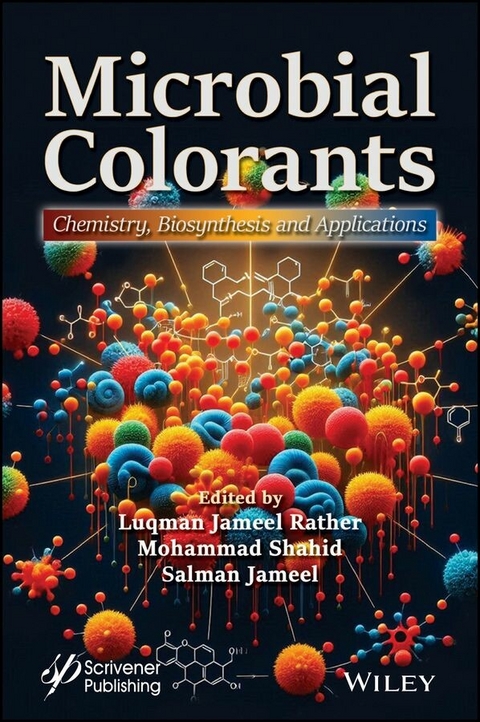
The book is a must-buy for anyone interested in the burgeoning field of microbial colorants, as it provides an extensive exploration of their sources, chemistry, and diverse applications, while addressing crucial aspects of environmental sustainability and regulatory considerations.
Microbial Colorants: Chemistry, Biosynthesis and Applications offers a comprehensive and in-depth exploration of microbial colorants, covering their sources, chemical properties, biosynthesis, and a wide range of applications. The volume compiles information on microbial and non-conventional pigment sources as well as environmental sustainability and regulatory aspects surrounding their use. The first half of the book delves into the sources and chemistry of microbial pigments, covering a variety of topics including bacterial pigments, fungal pigments, algal and cyanobacterial colorants, and more. Readers will gain insight into the diverse world of microbial pigments and the science behind their vibrant colors. The second half of the book focuses on the practical aspects of microbial colorants, including extraction and purification techniques, biotechnological approaches to enhance production, environmental sustainability, and regulatory considerations. It also explores the numerous applications of microbial colorants in industries such as food, cosmetics, textiles, and technology. Microbial colorants are gaining increasing attention due to their natural and sustainable properties. As the world seeks eco-friendly alternatives to synthetic dyes and colorants, microbial pigments offer a promising solution. This book aims to bridge the knowledge gap by providing a comprehensive resource for researchers, students, and professionals interested in this emerging field.
Readers will find the book:
- Explores various microbial pigments and their sources;
- Reviews pigment isolation, biosynthesis, and processing techniques;
- Discusses potential applications of pigments across a range of products in the food and beverage industry, pharmaceutical industry, and textile dyeing industry;
- Covers food safety and toxicity aspects of using microbial pigments as food colorants and includes the latest innovations in the use of microbial pigments in the textile industrial sector for dyeing and finishing purposes;
- Provides regulatory considerations and compliance requirements for using microbial colorants in various industries.
Audience
The book is meant for researchers, academics, and industry experts working in fields related to pigment production, chemistry, isolation, and applications in the food and beverage, medicine, and textile industries. The book will be beneficial to synthetic organic chemists who work in the field of drug development.
Luqman Jameel Rather, PhD, is a postdoctoral scientist at the College of Sericulture, Textile, and Biomass Science, Southwest University, Chongqing, China. He has published over 60 research articles in international journals of repute and edited two books. He is an active member of many research organizations and organizes both national and international conferences. His research interests include functional finishing of textile materials, thermodynamic and kinetic adsorption studies of natural colorants on wool fiber, and nanoparticle-biopolymers.
Mohammad Shahid, PhD, is an assistant professor in the Department of Chemistry, Faculty of Science and Technology, Mewar University, Chittorgarh, Rajasthan, India. He has published over 50 peer-reviewed journal articles, reports, and book chapters, as well as several books. He has also received several esteemed fellowships to support his research pursuits, including grants from the Indian University Grants Commission, a Chinese Postdoctoral Fellowship, an EU Marie Curie Fellowship, and a Dr. D.S. Kothari Fellowship.
Salman Jameel, PhD, is an assistant professor at the Indian Institute of Integrative Medicine, Sanat Nagar, Srinagar, Jammu and Kashmir, India. He is a dedicated researcher in the field of natural products and medicinal chemistry with expertise in isolation, characterization, and structural modifications of bioactive natural compounds. Over the years, he has contributed significantly to scientific literature, with multiple publications in peer-reviewed journals, covering topics such as neuroprotective compounds, antibacterial agents, and novel synthetic methodologies.
The book is a must-buy for anyone interested in the burgeoning field of microbial colorants, as it provides an extensive exploration of their sources, chemistry, and diverse applications, while addressing crucial aspects of environmental sustainability and regulatory considerations. Microbial Colorants: Chemistry, Biosynthesis and Applications offers a comprehensive and in-depth exploration of microbial colorants, covering their sources, chemical properties, biosynthesis, and a wide range of applications. The volume compiles information on microbial and non-conventional pigment sources as well as environmental sustainability and regulatory aspects surrounding their use. The first half of the book delves into the sources and chemistry of microbial pigments, covering a variety of topics including bacterial pigments, fungal pigments, algal and cyanobacterial colorants, and more. Readers will gain insight into the diverse world of microbial pigments and the science behind their vibrant colors. The second half of the book focuses on the practical aspects of microbial colorants, including extraction and purification techniques, biotechnological approaches to enhance production, environmental sustainability, and regulatory considerations. It also explores the numerous applications of microbial colorants in industries such as food, cosmetics, textiles, and technology. Microbial colorants are gaining increasing attention due to their natural and sustainable properties. As the world seeks eco-friendly alternatives to synthetic dyes and colorants, microbial pigments offer a promising solution. This book aims to bridge the knowledge gap by providing a comprehensive resource for researchers, students, and professionals interested in this emerging field. Readers will find the book: Explores various microbial pigments and their sources; Reviews pigment isolation, biosynthesis, and processing techniques; Discusses potential applications of pigments across a range of products in the food and beverage industry, pharmaceutical industry, and textile dyeing industry; Covers food safety and toxicity aspects of using microbial pigments as food colorants and includes the latest innovations in the use of microbial pigments in the textile industrial sector for dyeing and finishing purposes; Provides regulatory considerations and compliance requirements for using microbial colorants in various industries. Audience The book is meant for researchers, academics, and industry experts working in fields related to pigment production, chemistry, isolation, and applications in the food and beverage, medicine, and textile industries. The book will be beneficial to synthetic organic chemists who work in the field of drug development.
| Erscheint lt. Verlag | 26.3.2025 |
|---|---|
| Sprache | englisch |
| Themenwelt | Naturwissenschaften ► Biologie ► Mikrobiologie / Immunologie |
| Schlagworte | biosynthesis • extraction • Food Safety • Microbial Colorants • Microbial Pigments • Microbial Pigments in Medicine • Microbial Pigments in the Textile Industry • Natural Dyes • Natural Fibers • Pharmaceutical Industry • Skincare Finishes • Synthetic Dyes • textile industry • Textile Materials • UV Protection |
| ISBN-10 | 1-394-28787-9 / 1394287879 |
| ISBN-13 | 978-1-394-28787-1 / 9781394287871 |
| Informationen gemäß Produktsicherheitsverordnung (GPSR) | |
| Haben Sie eine Frage zum Produkt? |
 PDF (Adobe DRM)
Kopierschutz: Adobe-DRM
Adobe-DRM ist ein Kopierschutz, der das eBook vor Mißbrauch schützen soll. Dabei wird das eBook bereits beim Download auf Ihre persönliche Adobe-ID autorisiert. Lesen können Sie das eBook dann nur auf den Geräten, welche ebenfalls auf Ihre Adobe-ID registriert sind.
Details zum Adobe-DRM
Dateiformat: PDF (Portable Document Format)
Mit einem festen Seitenlayout eignet sich die PDF besonders für Fachbücher mit Spalten, Tabellen und Abbildungen. Eine PDF kann auf fast allen Geräten angezeigt werden, ist aber für kleine Displays (Smartphone, eReader) nur eingeschränkt geeignet.
Systemvoraussetzungen:
PC/Mac: Mit einem PC oder Mac können Sie dieses eBook lesen. Sie benötigen eine
eReader: Dieses eBook kann mit (fast) allen eBook-Readern gelesen werden. Mit dem amazon-Kindle ist es aber nicht kompatibel.
Smartphone/Tablet: Egal ob Apple oder Android, dieses eBook können Sie lesen. Sie benötigen eine
Geräteliste und zusätzliche Hinweise
Buying eBooks from abroad
For tax law reasons we can sell eBooks just within Germany and Switzerland. Regrettably we cannot fulfill eBook-orders from other countries.
aus dem Bereich