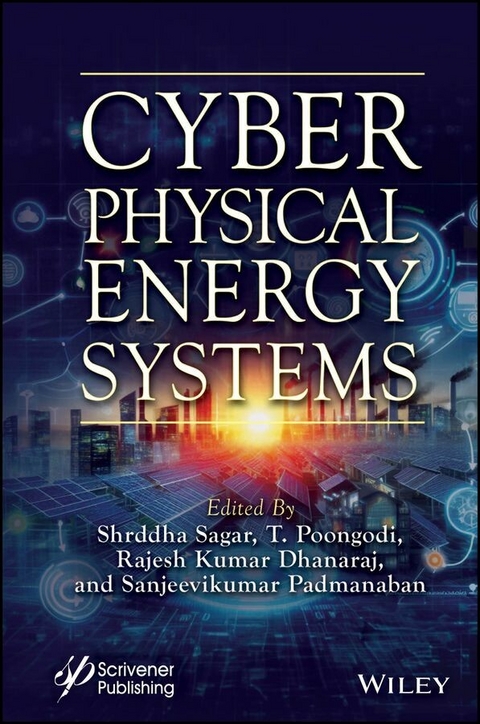
Cyber Physical Energy Systems (eBook)
801 Seiten
Wiley-Scrivener (Verlag)
978-1-394-17298-6 (ISBN)
This book is essential for understanding the transformative integration of cyber-physical systems in smart grids, providing valuable insights that will shape the future of sustainable energy production and distribution.
A novel modeling methodology that blends cyber and physical components is a significant advancement for future energy systems. A Cyber-Physical System (CPS) is an integrated component of physical microgrids that combines computers, wireless connections, and controls to create a holistic solution. As a result of cyber-physical systems, a new generation of engineering systems incorporating wireless communication has begun to emerge. Despite that there are various major CPS systems in use today, one of the most challenging sectors for implementation is the smart grid which aims to distribute dependable and efficient electric energy while maintaining a high level of global environmental sustainability.
Smart grids incorporate advanced monitoring to ensure a secure, efficient energy supply, enhancing generator and distributor performance while offering consumers more choices. These systems aim to boost the capacity and responsiveness of energy production, transmission, distribution, and consumption. As renewable energy sources grow, traditional methods are being challenged, requiring cross-domain integration of energy systems and data. This book explores architectures and methods for integrating cutting-edge technology into the power grid for more sustainable energy production and distribution.
Shrddha Sagar, PhD is a professor in the School of Computing Science and Engineering, Galgotias University, India with more than 14 years of experience working in teaching and research. She is the author of over ten book chapters and over 25 international journals and conferences. In her research, she has undertaken meticulous scientific studies of emerging issues in several disciplines including artificial intelligence, Internet of Things, machine learning, and big data.
T. Poongodi, PhD, is a professor in the School of Computing Science and Engineering at the Galgotias University, India. She is the author of over 40 book chapters, over 30 international journals and conferences, and over 10 books. In her research, she has undertaken meticulous scientific studies of emerging issues in several disciplines including network security, wireless ad hoc and sensor networks, Internet of Things (IoT), computer networks, and blockchain technology for emerging communication networks. She is a member of The Institute of Electrical and Electronics Engineers (IEEE), IEEE Women in Engineering, Association for Computing Machinery, International Association of Engineers, Institute of Research Engineers and Doctors, and the International Association of Computer Science and Information Technology.
Rajesh Kumar Dhanaraj, PhD, is a professor in the School of Computing Science and Engineering at Galgotias University, India. He has contributed to over 25 books on various technologies, has 21 Patents, and has authored 53 articles and papers in various refereed journals and international conferences, as well as chapters in books. He is a Senior Member of the Institute of Electrical and Electronics Engineers and a member of the Computer Science Teacher Association and International Association of Engineers, as well as an expert advisory panel member of Texas Instruments Inc., USA.
Sanjeevikumar Padmanaban is a chartered engineer in the Institution of Engineers, India. His research work is focused on the field of power electronics and drives and includes multi-phase machines, multilevel and DC-DC converters, and applications of renewable power generation systems. He has authored over 250 scientific research papers and is involved as a member in various capacities on the committees for more than 4500 international conferences, including the Institute of Electrical and Electronics Engineers and Institution of Engineering and Technology.
This book is essential for understanding the transformative integration of cyber-physical systems in smart grids, providing valuable insights that will shape the future of sustainable energy production and distribution. A novel modeling methodology that blends cyber and physical components is a significant advancement for future energy systems. A Cyber-Physical System (CPS) is an integrated component of physical microgrids that combines computers, wireless connections, and controls to create a holistic solution. As a result of cyber-physical systems, a new generation of engineering systems incorporating wireless communication has begun to emerge. Despite that there are various major CPS systems in use today, one of the most challenging sectors for implementation is the smart grid which aims to distribute dependable and efficient electric energy while maintaining a high level of global environmental sustainability. Smart grids incorporate advanced monitoring to ensure a secure, efficient energy supply, enhancing generator and distributor performance while offering consumers more choices. These systems aim to boost the capacity and responsiveness of energy production, transmission, distribution, and consumption. As renewable energy sources grow, traditional methods are being challenged, requiring cross-domain integration of energy systems and data. This book explores architectures and methods for integrating cutting-edge technology into the power grid for more sustainable energy production and distribution.
1
Cyber-Physical Systems: A Control and Energy Approach
Shaik Mahaboob Basha1, Gajanan Shankarrao Patange2, V. Arulkumar3*, J. V. N. Ramesh4 and A. V. Prabu5
1Electronics and Communication Engineering, N.B.K.R. Institute of Science and Technology, Vidyanagar, Tirupati, Andhra Pradesh, India
2Mechanical Engineering, CSPIT–Chrusat, Charotar University of Science and Technology, Charusat Campus Changa, Anand, Gujarat, India
3School of Computer Science and Engineering, Vellore Institute of Technology, Vellore, India
4Department of Computer Science and Engineering, Koneru Lakshmaiah Education Foundation, Vaddeswaram, Andhra Pradesh, India
5Department of ECE, Koneru Lakshmaiah Education Foundation, Vaddeswaram, Andhra Pradesh, India
Abstract
Cyber-physical systems (CPS) combine analogue and digital components to interact with the real world and are crucial to business and industry, including infrastructure like energy systems. Due to their critical nature, CPS is vulnerable to cyber-attacks, particularly phishing software that can impair their functionality. Attacks on CPS, especially on mission-critical components like energy distribution networks, can have severe consequences. To improve CPS protection, a technology demonstrator can replicate CPS behavior and identify vulnerabilities and protection mechanisms. A scenario modeling technique can accurately depict CPS components, relationships, attackers, access points, and network attacks. Risk modeling can outline the necessary resources to replicate CPS and generate large representations to assess network efficiency. The methodology includes evaluating the network using specific indicators, prioritizing cyber-attack prevention based on their impact on system function, and analyzing and preventing attacks using four example patterns that targeted CPES. This article aims to provide a staged process for conducting in-depth security evaluations that result in a safer and more durable CPS.
Keywords: Cyber-physical systems, energy systems, technology, CPES, network’s efficiency and risk analysis
1.1 Introduction
1.1.1 Background and Motivation
Energy systems have transitioned over the last few years from a single-directional production and dissemination system to an amplified distributed structure that supports both conventional sources of energy and distributed generation in the form of centralized generation, like wind and solar power, and distributed storage, like energy storage devices and energy storage systems by thermal means. The advancement of communications and information technologies, electronic control networks, environment monitoring, and integrated industrialized IoT technologies has largely made it possible for EPS to be transformed into CPES. The National Institute of Standards and Technology recognizes “designs that include electronic, analog, and hardware elements.” The characteristics of the network and the rules that govern its functioning define these parameters. By smoothly merging material objects with social, electronic, and connectivity elements meant to function via integrative physics and analytical reasoning, CPES are powerful complex systems revolutionizing the way conventional EPS functions. As a result, CPES contributes significantly to the transformation of EPS by enabling effective organization, more adaptable oversight, cyber-secure operational processes, framework efficiency, reconfigurable power generation (TES), and advancements in voltage stability, reliability enhancements, toughness, interconnectivity, and relatively clean energy production. Controlling and retaining protected access to critical framework resources and functions (for CPES: gen console deposits, recurrence consistency restrictions, power cable safeguards, and so on) as well as maintaining the confidentiality, ease of access, and truthfulness of the information being presented (for example, regulating the sequence of oversight monitoring and data procurement) pose significant challenges to CPES stability. As a huge development network of systems, CPS uses a variety of computer elements, including smart electronic devices, programmable controllers, and remote terminal modules, many of which were not created with safety in mind. Such gadgets’ architecture, firmware, and networking technology are often created using commercially available parts. As a result, flaws in such elements may be transferred to the CPS environment, potentially opening the door for nefarious adversaries seeking to disrupt CPS operations. In April 2019, a notification of a suspicious occurrence involving hostile conduct directed toward CPS operations was made.
The assailants used a recognized CPES weakness, specifically a web application firewall gap, to access one of the developed countries’ grid structures and launch a cognitive dissonance assault. The assault led to a communication issue here between the system for energy management and the facility’s generating units, which briefly disrupted operations. There is an increase in unauthorized access via hacking, with attackers exploiting current and reported flaws to breach CPS. In 2020, “98% of the holes accessed are known to safety specialists, while not a day’s worth of faults constitute just 0.5% of the responsibility exposed throughout the last decades,” according to international security. This statistic provides proof of this. The assailants may be persuaded to violate these networks in order to gain monetary or political gain because of the significance of CPS and CPES, specifically for productivity expansion and population health at the global, regional, and micro levels.
Therefore, it is crucial to assess the CPES’ stability and resistance to assaults in actual settings. In addition, since EPS—also known as the “biggest networked mechanism on the ground” [1]—integrates the impact of cyber across all sectors and sizes, the assessment of cyber threats becomes increasingly complicated and difficult. Sincerely, EPS activities might be understood by simulating certain unusual activities (such as failures, unbalanced voltage situations, frequency variations, etc.). To capture the nonlinear response of these standardization processes, increasingly precise descriptions and depictions are needed given the recent advancements toward smart and linked CPES. The improvement of CPES integrity and dependability necessitates the ongoing exploration of possible vulnerabilities [2]. The concept of security must take into account the CPES structure’s characteristics in extensive testing settings that permit the interface of hardware components that are intended to function in the “actual” network. Equipment (HIL) hardware platforms are useful in this situation because they provide testing procedures for determining how well physical and digital components are working together in limited circumstances.
In order to conduct cyber resilience and assess the consequences, recognize security weaknesses across numerous levels (e.g., memory modules, system software, applications, procedures, and methods), incorporate detection mechanisms and preventative measures algorithms, and evaluate the effectiveness of countermeasures without posing an undue financial burden or safety risks, protection HIL configurations are essential [3]. This article’s main goal is to provide a methodology that integrates conceptual and framework protection research studies, assessing CPS system behavior using testing ground settings and ultimately resulting in much more secure CPES designs. Assessment and experimentation research projects must be characterized and modeled, taking into account both the virtual and physical domains, in order to enable functional prototypes to accurately represent the features of the malware context. The research papers must provide thorough explanations of the tools and indicators that will be used to assess the effectiveness, dependability, and durability of the CPES. The evaluation configuration should also record the opponent’s vulnerability assessment attributes and the assault strategy. Threat modeling attributes for a possible enemy include antagonistic information, finances, the system’s access, and precision. Risk evaluation features for the attacking approach comprise offensive incidence, repeatability, and search capabilities, points in different targeted resources, attacker tactics, and foundation. Experts and interested parties may completely evaluate and identify potential threats present in the CPES under assessment by performing this task in a comprehensive and methodical manner.
1.1.2 Testbeds, Revisions, and a Safety Study for Cyber-Physical Energy Systems
This section describes the many CPES test chambers created by various research organizations and lists the tools used to carry out their research purposes.
We outline various types of CPES development studies seen in the field and discuss well-known examples from each. Additionally, we examine how vulnerability definition, prevention, and mitigation approaches may assist vulnerability analyses by identifying, avoiding, and reducing threats.
1.1.3 CPES Test Chamber
EPS have been built and modeled over the years using transversal topologies in which electricity is generated at massive mass energy plants and then transferred to users via various transmitting and circular delivery networks. The integration of renewable energies (RES) with distributed generation...
| Erscheint lt. Verlag | 22.11.2024 |
|---|---|
| Sprache | englisch |
| Themenwelt | Naturwissenschaften ► Physik / Astronomie |
| Technik ► Elektrotechnik / Energietechnik | |
| Schlagworte | Control and Energy • Cyber-Physical Energy Systems in Industrial IoT • Cyber-Physical Systems • Energy Consumption • Energy Consumption in Cyber-Physical Systems • Energy Management • Energy Management in Smart Factory • Federated Learning-based Intelligent Algorithms • Industrial IoT • IoT-based Advanced Energy Management • Microgrid • Optimization Techniques for Energy Management • Power System • Reliable Distribution • Smart Grid |
| ISBN-10 | 1-394-17298-2 / 1394172982 |
| ISBN-13 | 978-1-394-17298-6 / 9781394172986 |
| Informationen gemäß Produktsicherheitsverordnung (GPSR) | |
| Haben Sie eine Frage zum Produkt? |
 EPUB (Adobe DRM)
Kopierschutz: Adobe-DRM
Adobe-DRM ist ein Kopierschutz, der das eBook vor Mißbrauch schützen soll. Dabei wird das eBook bereits beim Download auf Ihre persönliche Adobe-ID autorisiert. Lesen können Sie das eBook dann nur auf den Geräten, welche ebenfalls auf Ihre Adobe-ID registriert sind.
Details zum Adobe-DRM
Dateiformat: EPUB (Electronic Publication)
EPUB ist ein offener Standard für eBooks und eignet sich besonders zur Darstellung von Belletristik und Sachbüchern. Der Fließtext wird dynamisch an die Display- und Schriftgröße angepasst. Auch für mobile Lesegeräte ist EPUB daher gut geeignet.
Systemvoraussetzungen:
PC/Mac: Mit einem PC oder Mac können Sie dieses eBook lesen. Sie benötigen eine
eReader: Dieses eBook kann mit (fast) allen eBook-Readern gelesen werden. Mit dem amazon-Kindle ist es aber nicht kompatibel.
Smartphone/Tablet: Egal ob Apple oder Android, dieses eBook können Sie lesen. Sie benötigen eine
Geräteliste und zusätzliche Hinweise
Buying eBooks from abroad
For tax law reasons we can sell eBooks just within Germany and Switzerland. Regrettably we cannot fulfill eBook-orders from other countries.
aus dem Bereich