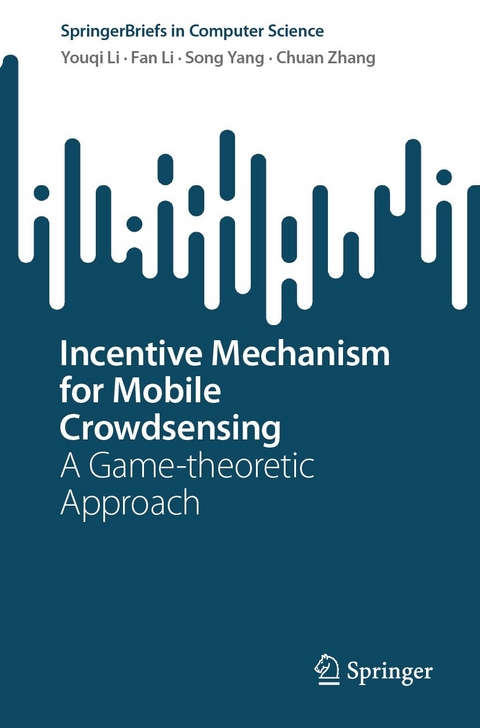
Incentive Mechanism for Mobile Crowdsensing (eBook)
129 Seiten
Springer Nature Singapore (Verlag)
978-981-99-6921-0 (ISBN)
Mobile crowdsensing (MCS) is emerging as a novel sensing paradigm in the Internet of Things (IoTs) due to the proliferation of smart devices (e.g., smartphones, wearable devices) in people’s daily lives. These ubiquitous devices provide an opportunity to harness the wisdom of crowds by recruiting mobile users to collectively perform sensing tasks, which largely collect data about a wide range of human activities and the surrounding environment. However, users suffer from resource consumption such as battery, processing power, and storage, which discourages users’ participation. To ensure the participation rate, it is necessary to employ an incentive mechanism to compensate users’ costs such that users are willing to take part in crowdsensing.
This book sheds light on the design of incentive mechanisms for MCS in the context of game theory. Particularly, this book presents several game-theoretic models for MCS in different scenarios. In Chapter 1, the authors present an overview of MCS and state the significance of incentive mechanism for MCS. Then, in Chapter 2, 3, 4, and 5, the authors propose a long-term incentive mechanism, a fair incentive mechanism, a collaborative incentive mechanism, and a coopetition-aware incentive mechanism for MCS, respectively. Finally, Chapter 6 summarizes this book and point out the future directions.
This book is of particular interest to the readers and researchers in the field of IoT research, especially in the interdisciplinary field of network economics and IoT.
Mobile crowdsensing (MCS) is emerging as a novel sensing paradigm in the Internet of Things (IoTs) due to the proliferation of smart devices (e.g., smartphones, wearable devices) in people's daily lives. These ubiquitous devices provide an opportunity to harness the wisdom of crowds by recruiting mobile users to collectively perform sensing tasks, which largely collect data about a wide range of human activities and the surrounding environment. However, users suffer from resource consumption such as battery, processing power, and storage, which discourages users' participation. To ensure the participation rate, it is necessary to employ an incentive mechanism to compensate users' costs such that users are willing to take part in crowdsensing.This book sheds light on the design of incentive mechanisms for MCS in the context of game theory. Particularly, this book presents several game-theoretic models for MCS in different scenarios. In Chapter 1, the authors present an overview of MCS and state the significance of incentive mechanism for MCS. Then, in Chapter 2, 3, 4, and 5, the authors propose a long-term incentive mechanism, a fair incentive mechanism, a collaborative incentive mechanism, and a coopetition-aware incentive mechanism for MCS, respectively. Finally, Chapter 6 summarizes this book and point out the future directions.This book is of particular interest to the readers and researchers in the field of IoT research, especially in the interdisciplinary field of network economics and IoT.
| Erscheint lt. Verlag | 3.1.2024 |
|---|---|
| Reihe/Serie | SpringerBriefs in Computer Science | SpringerBriefs in Computer Science |
| Zusatzinfo | XI, 129 p. 1 illus. |
| Sprache | englisch |
| Themenwelt | Informatik ► Datenbanken ► Data Warehouse / Data Mining |
| Mathematik / Informatik ► Informatik ► Netzwerke | |
| Mathematik / Informatik ► Informatik ► Programmiersprachen / -werkzeuge | |
| Informatik ► Software Entwicklung ► Mobile- / App-Entwicklung | |
| Informatik ► Theorie / Studium ► Algorithmen | |
| Informatik ► Theorie / Studium ► Künstliche Intelligenz / Robotik | |
| Mathematik / Informatik ► Mathematik ► Angewandte Mathematik | |
| Mathematik / Informatik ► Mathematik ► Statistik | |
| Naturwissenschaften | |
| Technik ► Elektrotechnik / Energietechnik | |
| Schlagworte | data collection • Game Theory • Incentive Mechanism • mobile crowdsensing • Mobile crowdsourcing • Optimization • Pricing • Stackelberg Game |
| ISBN-10 | 981-99-6921-2 / 9819969212 |
| ISBN-13 | 978-981-99-6921-0 / 9789819969210 |
| Informationen gemäß Produktsicherheitsverordnung (GPSR) | |
| Haben Sie eine Frage zum Produkt? |
 PDF (Wasserzeichen)
DRM: Digitales Wasserzeichen
Dieses eBook enthält ein digitales Wasserzeichen und ist damit für Sie personalisiert. Bei einer missbräuchlichen Weitergabe des eBooks an Dritte ist eine Rückverfolgung an die Quelle möglich.
Dateiformat: PDF (Portable Document Format)
Mit einem festen Seitenlayout eignet sich die PDF besonders für Fachbücher mit Spalten, Tabellen und Abbildungen. Eine PDF kann auf fast allen Geräten angezeigt werden, ist aber für kleine Displays (Smartphone, eReader) nur eingeschränkt geeignet.
Systemvoraussetzungen:
PC/Mac: Mit einem PC oder Mac können Sie dieses eBook lesen. Sie benötigen dafür einen PDF-Viewer - z.B. den Adobe Reader oder Adobe Digital Editions.
eReader: Dieses eBook kann mit (fast) allen eBook-Readern gelesen werden. Mit dem amazon-Kindle ist es aber nicht kompatibel.
Smartphone/Tablet: Egal ob Apple oder Android, dieses eBook können Sie lesen. Sie benötigen dafür einen PDF-Viewer - z.B. die kostenlose Adobe Digital Editions-App.
Buying eBooks from abroad
For tax law reasons we can sell eBooks just within Germany and Switzerland. Regrettably we cannot fulfill eBook-orders from other countries.
aus dem Bereich