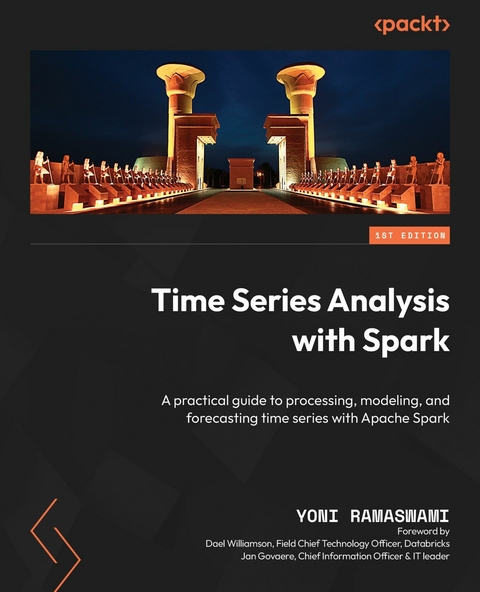
Time Series Analysis with Spark (eBook)
302 Seiten
Packt Publishing (Verlag)
978-1-80324-717-5 (ISBN)
Written by Databricks Senior Solutions Architect Yoni Ramaswami, whose expertise in Data and AI has shaped innovative digital transformations across industries, this comprehensive guide bridges foundational concepts of time series analysis with the Spark framework and Databricks, preparing you to tackle real-world challenges with confidence.
From preparing and processing large-scale time series datasets to building reliable models, this book offers practical techniques that scale effortlessly for big data environments. You'll explore advanced topics such as scaling your analyses, deploying time series models into production, Generative AI, and leveraging Spark's latest features for cutting-edge applications across industries. Packed with hands-on examples and industry-relevant use cases, this guide is perfect for data engineers, ML engineers, data scientists, and analysts looking to enhance their expertise in handling large-scale time series data.
By the end of this book, you'll have mastered the skills to design and deploy robust, scalable time series models tailored to your unique project needs-qualifying you to excel in the rapidly evolving world of big data analytics.
*Email sign-up and proof of purchase required
Master the fundamentals of time series analysis with Apache Spark and Databricks and uncover actionable insights at scaleKey FeaturesQuickly get started with your first models and explore the potential of Generative AILearn how to use Apache Spark and Databricks for scalable time series solutionsEstablish best practices to ensure success from development to production and beyondPurchase of the print or Kindle book includes a free PDF eBookBook DescriptionWritten by Databricks Senior Solutions Architect Yoni Ramaswami, whose expertise in Data and AI has shaped innovative digital transformations across industries, this comprehensive guide bridges foundational concepts of time series analysis with the Spark framework and Databricks, preparing you to tackle real-world challenges with confidence. From preparing and processing large-scale time series datasets to building reliable models, this book offers practical techniques that scale effortlessly for big data environments. You ll explore advanced topics such as scaling your analyses, deploying time series models into production, Generative AI, and leveraging Spark's latest features for cutting-edge applications across industries. Packed with hands-on examples and industry-relevant use cases, this guide is perfect for data engineers, ML engineers, data scientists, and analysts looking to enhance their expertise in handling large-scale time series data. By the end of this book, you ll have mastered the skills to design and deploy robust, scalable time series models tailored to your unique project needs qualifying you to excel in the rapidly evolving world of big data analytics.What you will learnUnderstand the core concepts and architectures of Apache SparkClean and organize time series dataChoose the most suitable modeling approach for your use caseGain expertise in building and training a variety of time series modelsExplore ways to leverage Apache Spark and Databricks to scale your modelsDeploy time series models in productionIntegrate your time series solutions with big data tools for enhanced analyticsLeverage GenAI to enhance predictions and uncover patternsWho this book is forIf you are a data engineer, ML engineer, data scientist, or analyst looking to enhance your skills in time series analysis with Apache Spark and Databricks, this book is for you. Whether you re new to time series or an experienced practitioner, this guide provides valuable insights and techniques to improve your data processing capabilities. A basic understanding of Apache Spark is helpful, but no prior experience with time series analysis is required.]]>
1
What Are Time Series?
“Time is the wisest counselor of all.” – Pericles
History is fascinating. It offers a profound narrative of our origins, the journey we are on, and the destination we strive toward. History equips us with learnings from the past to better face the future.
Let’s take, for example, the impact of meteorological data on history. Disruptions in weather patterns, starting in the Middle Ages and worsened by the Laki volcanic eruption in 1783, caused widespread hardship in France. This climatic upheaval contributed to the social unrest that ultimately led to the French Revolution in 1789. (Find out more about this in the Further reading section.)
Time series embody this narrative with numbers echoing our past. They are history quantified, a numerical narrative of our collective past, with lessons for the future.
This book takes you on a comprehensive journey with time series, starting with foundational concepts, guiding you through practical data preparation and model building techniques, and culminating in advanced topics such as scaling, and deploying to production, while staying abreast of recent developments for cutting-edge applications across industries. By the end of this book, you will be equipped to build robust time series models, in combination with Apache Spark, to meet the requirements of the use cases in your industry.
As a start on this journey, this chapter introduces the fundamental concepts of time series data, exploring its sequential nature and the unique challenges it poses. The content covers key components such as trend and seasonality, providing a foundation to embark on time series analysis at scale using the Spark framework. This knowledge is crucial for data scientists and analysts as it forms the basis for leveraging Spark’s distributed computing capabilities in effectively analyzing and forecasting time-dependent data and making informed decisions in various domains such as finance, healthcare, and marketing.
We will cover the following topics in this chapter:
- Introduction to time series
- Breaking time series into their components
- Additional considerations with time series analysis
Free Benefits with Your Book
Your purchase includes a free PDF copy of this book along with other exclusive benefits. Check the Free Benefits with Your Book section in the Preface to unlock them instantly and maximize your learning experience.
Technical requirements
In the first part of the book, which sets the foundations, you can follow along without participating in hands-on examples (although it’s recommended). The latter part of the book will be more practice-driven. If you want to get hands-on from the beginning, the code for this chapter can be found in the GitHub repository of this book at:
https://github.com/PacktPublishing/Time-Series-Analysis-with-Spark/tree/main/ch1
Note
Refer to this GitHub repository for the latest revisions of the code, which will be commented on if updated post-publication. The updated code (if any) might differ from what is presented in the book's code sections.
The following hands-on sections will give you further details to get started with time series analysis.
Introduction to time series
In this section, we will develop an understanding of what time series are and some related terms. This will be illustrated by hands-on examples to visualize time series. We will look at different types of time series and what characterizes them. This knowledge of the nature of time series is necessary for us to choose the appropriate time series analysis approach in the upcoming chapters.
Let’s start with an example of a time series with the average temperature in Mauritius every year since 1950. A short sample of the data is shown in Table 1.1.
| Year | Average temperature |
| 1950 | 22.66 |
| 1951 | 22.35 |
| 1952 | 22.50 |
| 1953 | 22.71 |
| 1954 | 22.61 |
| 1955 | 22.40 |
| 1956 | 22.22 |
| 1957 | 22.53 |
| 1958 | 22.71 |
| 1959 | 22.49 |
Table 1.1: Sample time series data – average temperature
While visualizing and explaining this example, we will be introduced to some terms related to time series. The code to visualize this dataset is covered in the hands-on section of this chapter.
In the following figure, we see the change in temperature over the years since 1950. If we focus on the period after 1980, we can observe the variations more closely, with similarly increasing temperatures over the years (trend – shown with a dashed line in both figures) to the current temperature.
Figure 1.1: Average temperature in Mauritius since 1950
If the temperature continues to increase in the same way, we are heading to a warmer future, a manifestation of what is now widely accepted as global warming. At the same time as the temperature has been increasing over the years, it also goes up every summer and down during the winter months (seasonality). We will visualize this and other components of temperature time series in the hands-on section of this chapter.
With the temperatures getting warmer over the years (trend), global warming has an impact (causality) on our planet and its inhabitants. This impact can also be represented with time series – for example, sea level or rainfall measurements. The consequences of global warming can be dramatic and irreversible, which further highlights the importance of understanding this trend.
These time-over-time readings of temperature form what we call a time series. Analysis and understanding of such a time series is critical for our future.
So, what is a time series in more general terms? It is simply a chronological series of measurements together with the specific time at which it was generated by a source system. In the example of temperature, the source system is the thermometer at a specific geographical location.
Time series can also be represented in an aggregated form, such as the average temperature every year, as shown in Table 1.1.
From this definition, illustrated with an example, let’s now probe further into the nature of time series. We will also cover in further detail in the rest of this book the terms introduced here, such as trend, seasonality, and causality.
Chronological order
At the beginning of the chapter, we mentioned chronological order while defining time series, this is because it is a major factor that differentiates the approach when working with time series data compared to other datasets. One of the main reasons why order matters is due to potential auto-correlation within time series, where measurement at time t is related to measurement at n time steps earlier (lag). Ignoring this order will make our analysis incomplete and even incorrect. We will look at the method to identify auto-correlation later, in Chapter 6 on exploratory data analysis.
It is worth noting that, in many cases with time series, auto-correlation tends to make measurements closer in time closer in value, as compared to measurements further apart in time.
Another reason to respect chronological order is to avoid data leakage during model training. In some of the analysis and forecasting methods, we will be training models on past data to predict value at a future target date. We need to ensure that all data points used are prior to the target date. Data leakage during training, often tricky to spot with...
| Erscheint lt. Verlag | 28.3.2025 |
|---|---|
| Vorwort | Dael Williamson, Jan Govaere |
| Sprache | englisch |
| Themenwelt | Informatik ► Datenbanken ► Data Warehouse / Data Mining |
| Mathematik / Informatik ► Informatik ► Theorie / Studium | |
| Mathematik / Informatik ► Informatik ► Web / Internet | |
| ISBN-10 | 1-80324-717-7 / 1803247177 |
| ISBN-13 | 978-1-80324-717-5 / 9781803247175 |
| Informationen gemäß Produktsicherheitsverordnung (GPSR) | |
| Haben Sie eine Frage zum Produkt? |
 EPUB (Ohne DRM)
Digital Rights Management: ohne DRM
Dieses eBook enthält kein DRM oder Kopierschutz. Eine Weitergabe an Dritte ist jedoch rechtlich nicht zulässig, weil Sie beim Kauf nur die Rechte an der persönlichen Nutzung erwerben.
Dateiformat: EPUB (Electronic Publication)
EPUB ist ein offener Standard für eBooks und eignet sich besonders zur Darstellung von Belletristik und Sachbüchern. Der Fließtext wird dynamisch an die Display- und Schriftgröße angepasst. Auch für mobile Lesegeräte ist EPUB daher gut geeignet.
Systemvoraussetzungen:
PC/Mac: Mit einem PC oder Mac können Sie dieses eBook lesen. Sie benötigen dafür die kostenlose Software Adobe Digital Editions.
eReader: Dieses eBook kann mit (fast) allen eBook-Readern gelesen werden. Mit dem amazon-Kindle ist es aber nicht kompatibel.
Smartphone/Tablet: Egal ob Apple oder Android, dieses eBook können Sie lesen. Sie benötigen dafür eine kostenlose App.
Geräteliste und zusätzliche Hinweise
Buying eBooks from abroad
For tax law reasons we can sell eBooks just within Germany and Switzerland. Regrettably we cannot fulfill eBook-orders from other countries.
aus dem Bereich