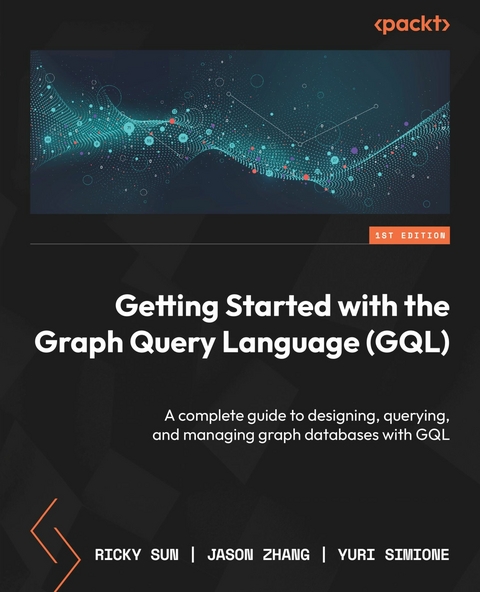
Getting Started with the Graph Query Language (GQL) (eBook)
382 Seiten
Packt Publishing (Verlag)
978-1-83620-400-8 (ISBN)
This pioneering guide to the new ISO-standardized Graph Query Language (GQL) will help you modify, query, and analyze graph data using foundational and advanced concepts, as well as practice with sample codes on the GQL Playground.
Learn how to build and query graph databases with this first comprehensive guide to ISO-standard GQL featuring 50+ hands-on examples and a real-world case study that will change the way you work with connected dataKey FeaturesGo beyond theory and apply key concepts and syntax through interactive tutorials and practical examples via the GQL PlaygroundLeverage advanced features of GQL to manipulate graph data efficientlyExplore GQL applications in data analytics and discover how to leverage graph knowledge in real-world scenariosPurchase of the print or Kindle book includes a free PDF eBookBook DescriptionGraph Query Language is becoming the go-to standard for graph databases, especially with its support for interconnected analytics and GenAI capabilities. This book comes from a team of industry veterans who know exactly how to break down the fundamental GQL concepts, graph terms, definitions, catalog systems, and everything that matters in actual work. You ll get to grips with graph data types, value expressions, graph matching patterns, and modifying statements through practical GQL examples. With access to the GQL Playground via Ultipa Graph, you ll get hands-on experience querying and manipulating graph data. Once you've got the basics down, you ll tackle advanced GQL topics such as path modes, complex path matching patterns, shortest path queries, composite statements, session and transaction commands, and procedures. You ll also learn to create extensions and understand the design of graph databases to solve industry issues. The authors cover techniques like property graphs to help you optimize your graph queries and offer insights into the future of GQL and graph technology. By the end of this book, you ll confidently query and update graph data, run graph algorithms, and create visualizations. Plus, you ll apply your learnings to a real-world use case of money flow analysis for assessing bank client behaviors and detecting transaction risks.What you will learnExperiment with GQL syntax on GQL Playground, including MATCH, RETURN, INSERT, UPDATE, and DELETEWork with operators, functions, and variables in an organized fashionBecome familiar with complex topics such as varying path matching modes, repeated variables, shortest path, procedures, and transactionsEnhance execution speed through indexing or caching systemsUnderstand how to manage access control effectivelyTackle real-world issues with a case study focused on money transaction analyticsWho this book is forThis book is for graph database developers, DBAs, programmers, data engineers, and analysts who want to learn the new graph database standard GQL. A basic understanding of graph and relational databases, data models, knowledge of SQL basics, and programming will make the content easy to grasp. While it is designed to be accessible even if you don t have a background in graph theory, familiarity with concepts like nodes, edges, relationships, and the distinction between directed and undirected graphs will enhance your learning experience.]]>
Preface
Over the past several decades, the world of data has evolved dramatically—from the structured era of relational databases to the expansive realms of big data and fast data. Today, we are entering a new phase: the age of deep and connected data. As data volumes grow and analytics become increasingly interdependent, traditional database systems are being reimagined. Graph technology has emerged as a powerful solution, offering new possibilities for modeling and querying complex relationships.
Before the standardization of Graph Query Language (GQL), the graph database landscape was fragmented. Popular query languages such as Cypher (Neo4j), Gremlin (Apache TinkerPop), GSQL (TigerGraph), UQL (Ultipa), and AQL (ArangoDB) each introduced unique features tailored to specific platforms. While these innovations advanced the field, they also created challenges for users—requiring time and effort to learn multiple proprietary syntaxes.
The introduction of GQL (ISO/IEC 39075) marks a pivotal moment in database history. As the second standardized database query language—following SQL’s release in 1986 (ANSI) and 1987 (ISO)—GQL provides a unified, vendor-neutral syntax for querying graph databases. This standardization fosters interoperability, reduces learning curves, and accelerates adoption across industries.
This book begins with the evolution of graph databases and query languages, setting the stage for a comprehensive understanding of GQL. You’ll explore its syntax, structure, data types, and clauses, and gain hands-on experience through practical examples. As you progress, you’ll learn how to write efficient queries, optimize performance, and apply GQL to real-world scenarios such as fraud detection.
By the end of this journey, you’ll have a solid grasp of GQL, be equipped to implement a graph-based solution with GQL, and gain insight into the future direction of graph technology and its growing role in data ecosystems.
Who this book is for
As GQL emerges as a new standard for querying graph databases, its relevance is expanding across nearly every industry. This book is designed for a wide range of professionals who work with data and seek to harness the power of graph-based systems. Whether you’re a developer, engineer, data analyst, database administrator (DBA), data engineer, or data scientist, you’ll find valuable insights and practical guidance in these pages. GQL opens new possibilities for modeling and analyzing complex, interconnected data. As such, this book serves as both an introduction and a deep dive into the language, helping readers of all backgrounds understand and apply GQL effectively in real-world scenarios.
Note: Some features covered in this book may not work as expected with the current versions of GQL Playground and the cloud. These features are planned for future releases. The book includes them to provide a comprehensive guide to GQL and its evolving capabilities.
What this book covers
Chapter 1, Evolution Towards Graph Databases, traces the journey from relational databases to NoSQL, and ultimately to the emergence of GQL, which promises to redefine how we query and manage complex, interconnected data in the digital age.
Chapter 2, Key Concepts of GQL, introduces the key concepts of GQL and graph theory. The foundational knowledge covered here will enhance your understanding of the remaining sections of the book.
Chapter 3, Getting Started with GQL, takes you on a journey to acquiring practical experience in interacting with graph data using GQL. You will learn how to formulate and execute GQL queries against a graph database, which is essential for querying, manipulating, and analyzing graph-structured data.
Chapter 4, GQL Basics, explores the fundamentals of GQL, uncovering the power of GQL statements and learning how to match data and return results tailored to your needs.
Chapter 5, Exploring Expressions and Operators, explores expressions and operators to be able to filter nodes and relationships, compute metrics over graph structures, construct dynamic labels, and transform properties on the fly.
Chapter 6, Working with GQL Functions, introduces a variety of essential functions for effective data manipulation and analysis.
Chapter 7, Delve into Advanced Clauses, delves into more advanced usages of GQL that allow for more sophisticated graph queries and operations.
Chapter 8, Configuring Sessions, delves into session management, exploring the creation, modification, and termination of sessions. This chapter presents a detailed overview of the session context, commands for setting session parameters, and resetting and closing sessions.
Chapter 9, Graph Transactions, delves into the specifics of initiating transactions using the TRANSACTION commands, detailing the syntax, usage, and conditions.
Chapter 10, Conformance to the GQL Standard, overviews conformance to the GQL standard, including required capabilities, optional features, and implementation-defined and implementation-dependent elements.
Chapter 11, Beyond GQL, explores GQL extensions provided by Ultipa Graph Database, including operations such as additional options to create a graph, constraints, and index operations, as well as access controls.
Chapter 12, A Case Study – Anti-Fraud, provides hands-on practice by tackling a common issue with GQL, identifying suspicious transactions in bank accounts.
Chapter 13, The Evolving Landscape of GQL, explores local Terraform automation processes and implementing a CI/CD pipeline to apply Terraform configuration automatically.
Chapter 14, Glossary and Resources, provides definitions of key terms and a comprehensive list of required and optional GQL features, along with additional resources for further learning.
Download the example code files
The code bundle for the book is hosted on GitHub at https://github.com/PacktPublishing/Getting-Started-with-the-Graph-Query-Language-GQL. We also have other code bundles from our rich catalog of books and videos available at https://github.com/PacktPublishing. Check them out!
Download the color images
We also provide a PDF file that has color images of the screenshots/diagrams used in this book. You can download it here: https://packt.link/gbp/9781836204015.
Conventions used
There are a number of text conventions used throughout this book.
CodeInText: Indicates code words in text, database table names, folder names, filenames, file extensions, pathnames, dummy URLs, user input, and Twitter/X handles. For example: “TRAIL mode excludes paths that contain duplicate edges, such as the a->b->a->b path, where the edge a->b is traversed more than once.”
A block of code is set as follows:
GQL: INSERT (a:Node {_id: 'a'}), (b:Node {_id: 'b'}), (c:Node {_id: 'c'}), (i:Node {_id: 'i'}), (j:Node {_id: 'j'}), (b)-[:Edge]->(a), (a)-[:Edge]->(c), (c)-[:Edge]->(i), (i)-[:Edge]->(j) When we wish to draw your attention to a particular part of a code block, the relevant lines or items are set in bold:
GQL: FOR id in ["a", "b", "z"] OPTIONAL CALL { MATCH (start {_id: id }) MATCH (start)-(end) RETURN COLLECT_LIST(end._id) as neigbours } LET neigbours = COALESCE(neigbours, []) RETURN id, neigbours Bold: Indicates a new term, an important word, or words that you see on the screen. For instance, words in menus or dialog boxes appear in the text like this. For example: “In this case, the results are generated by computing the Cartesian product of the result sets from the individual patterns.”
Warnings or important notes appear like this.
Tips and tricks appear like this.
Get in touch
Feedback from our readers is always welcome.
General feedback: If you have questions about any aspect of this book or have any general feedback, please email us at customercare@packt.com and mention the book’s title in the subject of your message.
Errata: Although we have taken every care to ensure the accuracy of our content, mistakes do happen. If you have found a mistake in this book, we would be grateful if you reported this to us. Please visit http://www.packt.com/submit-errata, click Submit Errata, and fill in the form.
Piracy: If you come across any illegal copies of our works in any form on the internet, we would be...
| Erscheint lt. Verlag | 22.8.2025 |
|---|---|
| Sprache | englisch |
| Themenwelt | Informatik ► Datenbanken ► Data Warehouse / Data Mining |
| ISBN-10 | 1-83620-400-0 / 1836204000 |
| ISBN-13 | 978-1-83620-400-8 / 9781836204008 |
| Informationen gemäß Produktsicherheitsverordnung (GPSR) | |
| Haben Sie eine Frage zum Produkt? |
 EPUB (Ohne DRM)
Digital Rights Management: ohne DRM
Dieses eBook enthält kein DRM oder Kopierschutz. Eine Weitergabe an Dritte ist jedoch rechtlich nicht zulässig, weil Sie beim Kauf nur die Rechte an der persönlichen Nutzung erwerben.
Dateiformat: EPUB (Electronic Publication)
EPUB ist ein offener Standard für eBooks und eignet sich besonders zur Darstellung von Belletristik und Sachbüchern. Der Fließtext wird dynamisch an die Display- und Schriftgröße angepasst. Auch für mobile Lesegeräte ist EPUB daher gut geeignet.
Systemvoraussetzungen:
PC/Mac: Mit einem PC oder Mac können Sie dieses eBook lesen. Sie benötigen dafür die kostenlose Software Adobe Digital Editions.
eReader: Dieses eBook kann mit (fast) allen eBook-Readern gelesen werden. Mit dem amazon-Kindle ist es aber nicht kompatibel.
Smartphone/Tablet: Egal ob Apple oder Android, dieses eBook können Sie lesen. Sie benötigen dafür eine kostenlose App.
Geräteliste und zusätzliche Hinweise
Buying eBooks from abroad
For tax law reasons we can sell eBooks just within Germany and Switzerland. Regrettably we cannot fulfill eBook-orders from other countries.
aus dem Bereich