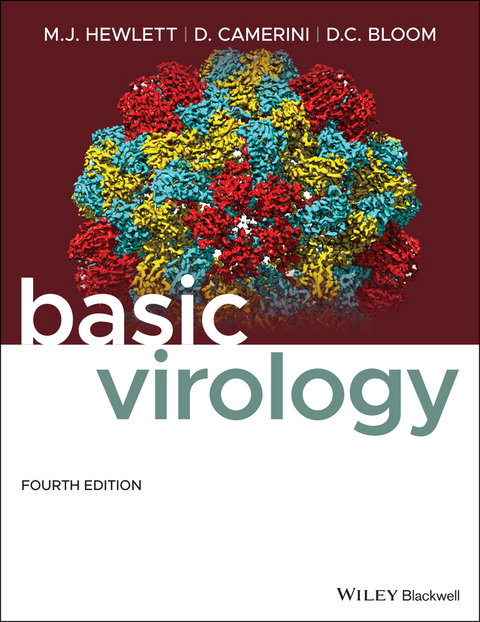
Basic Virology (eBook)
John Wiley & Sons (Verlag)
978-1-119-31406-6 (ISBN)
The foundational textbook on the study of virology
Basic Virology, 4th Edition cements this series' position as the leading introductory virology textbook in the world. It's easily read style, outstanding figures, and comprehensive coverage of fundamental topics in virology all account for its immense popularity.
This undergraduate-accessible book covers all the foundational topics in virology, including:
- The basics of virology
- Virological techniques
- Molecular biology
- Pathogenesis of human viral disease
The 4th edition includes new information on the SARS, MERS and COVID-19 coronaviruses, hepatitis C virus, influenza virus, as well as HIV and Ebola. New virological techniques including bioinformatics and advances in viral therapies for human disease are also explored in-depth. The book also includes entirely new sections on metapneumoviruses, dengue virus, and the chikungunya virus.
MARTINEZ J. HEWLETT is Professor Emeritus in the Department of Molecular and Cellular Biology at the University of Arizona.
DAVID CAMERINI is Assistant Professor in the Department of Molecular Biology and Biochemistry at the University of California Irvine.
DAVID C. BLOOM is Associate Professor in the Department of Molecular Genetics and Microbiology at University of Florida.
MARTINEZ J. HEWLETT is Professor Emeritus in the Department of Molecular and Cellular Biology at the University of Arizona. DAVID CAMERINI is Assistant Professor in the Department of Molecular Biology and Biochemistry at the University of California Irvine. DAVID C. BLOOM is Associate Professor in the Department of Molecular Genetics and Microbiology at University of Florida.
Preface xxi
Acknowledgements xxvii
Part I Virology and Viral Disease 1
Chapter 1 Introduction - The Impact of Viruses on Our View of Life 3
Chapter 2 An Outline of Virus Replication and Viral Pathogenesis 15
Chapter 3 Virus Disease in Populations and Individual Animals 27
Chapter 4 Patterns of Some Viral Diseases of Humans 43
Part II Basic Properties of Viruses and Virus-cell Interaction 65
Chapter 5 Virus Structure and Classification 67
Chapter 6 The Beginning and End of the Virus Replication Cycle 85
Chapter 7 The Innate Immune Response: Early Defense Against Pathogens 105
Chapter 8 Strategies to Protect Against and Combat Viral Infection 131
Part III Working with Virus 153
Chapter 9 Visualization and Enumeration of Virus Particles 155
Chapter 10 Replicating and Measuring Biological Activity of Viruses 163
Chapter 11 Physical and Chemical Manipulation of the Structural Components of Viruses 181
Chapter 12 Characterization of Viral Products Expressed in the Infected Cell 197
Chapter 13 Viruses Use Cellular Processes to Express their Genetic Information 217
Part IV Replication Patterns of Specific Viruses 245
Chapter 14 Replication of Positive-Sense RNA Viruses 247
Chapter 15 Replication Strategies of RNA Viruses Requiring RNA-directed mRNA Transcription as the First Step in Viral Gene Expression 277
Chapter 16 Replication Strategies of Small and Medium-sized DNA Viruses 307
Chapter 17 Replication of Some Nuclear-replicating Eukaryotic DNA Viruses with Large Genomes 335
Chapter 18 Replication of Cytoplasmic DNA Viruses and "Large" Bacteriophages 363
Chapter 19 Retroviruses: Converting RNA to DNA 385
Chapter 20 Human Immunodeficiency Virus Type 1 (HIV-1) and Related Lentiviruses 403
Chapter 21 Hepadnaviruses: Variations on the Retrovirus Theme 415
Part V Molecular Genetics of Viruses 437
Chapter 22 The Molecular Genetics of Viruses 439
Chapter 23 Molecular Pathogenesis 467
Chapter 24 Viral Bioinformatics 477
Chapter 25 Viruses and the Future - Problems and Promises 489
Appendix - Resource Center 503
Technical Glossary 509
Index 533
CHAPTER 1
Introduction – The Impact of Viruses on Our View of Life
- THE SCIENCE OF VIROLOGY
- The effect of virus infections on the host organism and populations – viral pathogenesis, virulence, and epidemiology
- The interaction between viruses and their hosts
- The history of virology
- Examples of the impact of viral disease on human history
- Examples of the evolutionary impact of the virus–host interaction
- The origin of viruses
- Viruses have a constructive as well as destructive impact on society
- Viruses are not the smallest self‐replicating pathogens
- QUESTIONS FOR CHAPTER 1
THE SCIENCE OF VIROLOGY
The study of viruses has historically provided and continues to provide the basis for much of our most fundamental understanding of modern biology, genetics, and medicine. Virology has had an impact on the study of biological macromolecules, processes of cellular gene expression, mechanisms for generating genetic diversity, processes involved in the control of cell growth and development, aspects of molecular evolution, the mechanism of disease and response of the host to it, and the spread of disease in populations.
In essence, viruses are collections of genetic information directed toward one end: their own replication. They are the ultimate and prototypical example of “selfish genes.” The viral genome contains the “blueprints” for virus replication enciphered in the genetic code, and must be decoded by the molecular machinery of the cell that it infects to gain this end. Viruses are thus obligate intracellular parasites dependent on the metabolic and genetic functions of living cells.
Given the essential simplicity of virus organization – a genome containing genes dedicated to self‐replication surrounded by a protective protein shell – it has been argued that viruses are nonliving collections of biochemicals whose functions are derivative and separable from the cell. Yet this generalization does not stand up to the increasingly detailed information accumulating describing the nature of viral genes, the role of viral infections in evolutionary change, and the evolution of cellular function. A view of viruses as constituting a major subdivision of the biosphere, as ancient as and fully interactive and integrated with the three great branches of cellular life, becomes more strongly established with each investigational advance.
It is a major problem in the study of biology at a detailed molecular and functional level that almost no generalization is sacred, and the concept of viruses as simple parasitic collections of genes functioning to replicate themselves at the expense of the cell they attack does not hold up. Many generalizations will be made in the survey of the world of viruses introduced in this book; most if not all will be ultimately classified as being useful, but unreliable, tools for the full understanding and organization of information.
Even the size range of viral genomes, generalized to range from one or two genes to a few hundred at most (significantly less than those contained in the simplest free‐living cells), cannot be supported by a close analysis of data. While it is true that the vast majority of viruses studied range in size from smaller than the smallest organelle to just smaller than the simplest cells capable of energy metabolism and protein synthesis, the mycoplasma and simple unicellular algae, the recently discovered mimivirus (distantly related to poxviruses such as smallpox or variola) contains nearly 1000 genes and is significantly larger than the smallest cells. With such caveats in mind, it is still appropriate to note that despite their limited size, viruses have evolved and appropriated a means of propagation and replication that ensures their survival in free‐living organisms that are generally between 10 and 10 000 000 times their size and genetic complexity.
The effect of virus infections on the host organism and populations – viral pathogenesis, virulence, and epidemiology
Since a major motivating factor for the study of virology is that viruses cause disease of varying levels of severity in human populations and in the populations of plants and animals that support such populations, it is not particularly surprising that virus infections have historically been considered episodic interruptions of the wellbeing of a normally healthy host. This view was supported in some of the earliest studies on bacterial viruses, which were seen to cause the destruction of the host cell and general disruption of healthy, growing populations of the host bacteria. Despite this, it was seen with another type of bacterial virus that a persistent, lysogenic infection could ensue in the host population. In this case, stress to the lysogenic bacteria could release infectious virus long after the establishment of the initial infection.
These two modes of infection of host populations by viruses, which can be accurately modeled by mathematical methods developed for studying predator–prey relationships in animal and plant populations, are now understood to be general for virus–host interactions. Indeed, persistent infections with low or no levels of viral disease are universal in virus–host ecosystems that have evolved together for extended periods – it is only upon the introduction of a virus into a novel population that widespread disease and host morbidity occur.
While we can therefore consider severe virus‐induced disease to be evidence of a recent introduction of the virus into the population in question, the accommodation of the one to the other is a very slow process requiring genetic changes in both virus and host, and it is by no means certain that the accommodation can occur without severe disruption of the host population – even its extinction. For this reason, the study of the replication and propagation of a given virus in a population is of critical importance to the body politic, especially in terms of formulating and implementing health policy. This is, of course, in addition to its importance to the scientific and medical communities.
The study of viral pathogenesis is broadly defined as the study of effects of viral infection on the host. The pathogenicity of a virus is defined as the sum total of the virus‐encoded functions that contribute to virus propagation in the infected cell, in the host organism, and in the population. Pathogenicity is essentially the genetic ability of members of a given specific virus population (which can be considered to be genetically more or less equivalent) to cause a disease and spread through (propagate in) a population. Thus, a major factor in the pathogenicity of a given virus is its genetic makeup or genotype.
The basis for severity of the symptoms of a viral disease in an organism or a population is complex. It results from an intricate combination of expression of the viral genes controlling pathogenicity, physiological response of the infected individual to these pathogenic determinants, and response of the population to the presence of the virus propagating in it. Taken together, these factors determine or define the virulence of the virus and the disease it causes.
A basic factor contributing to virulence is the interaction among specific viral genes and the genetically encoded defenses of the infected individual. It is important to understand, however, that virulence is also affected by the general health and genetic makeup of the infected population, and in humans, by the societal and economic factors that affect the nature and extent of the response to the infection.
The distinction and gradation of meanings between the terms pathogenesis and virulence can be understood by considering the manifold factors involved in disease severity and spread exhibited in a human population subjected to infection with a disease‐causing virus. Consider a virus whose genotype makes it highly efficient in causing a disease, the signs and symptoms of which are important in the spread between individuals – perhaps a respiratory infection with accompanying sneezing, coughing, and so on. This ideal or optimal virus will incorporate numerous, random genetic changes during its replication cycles as it spreads in an individual and in the population. Some viruses generated during the course of a disease may, then, contain genes that are not optimally efficient in causing symptoms. Such a virus is of reduced virulence, and in the extreme case, it might be a virus that has accumulated so many mutations in pathogenic genes that it can cause no disease at all (i.e., has mutated to an avirulent or apathogenic strain). While an avirulent virus may not cause a disease, its infection may well lead to complete or partial immunity against the most virulent genotypes in an infected individual. This is the basis of vaccination, which is described in Part II, Chapter 8. But the capacity to generate an immune response and the resulting generation of herd immunity also mean that as a virus infection proceeds in a population, either its virulence must change or the virus must genetically adapt to the changing host.
Other factors not fully correlated with the genetic makeup of a virus also contribute to variations in virulence of a pathogenic genotype. The...
| Erscheint lt. Verlag | 27.4.2021 |
|---|---|
| Sprache | englisch |
| Themenwelt | Naturwissenschaften ► Biologie ► Mikrobiologie / Immunologie |
| Schlagworte | Biowissenschaften • Cell & Molecular Biology • Covid-19 • hep c • Infectious Disease & Microbiology • Infektionskrankheiten u. Mikrobiologie • Life Sciences • Medical Science • Medizin • mers • Microbiology & Virology • Mikrobiologie • Mikrobiologie u. Virologie • Molecular Biology • pathogenesis of viral disease • SARS • virological basics • virological research • virological techniques • Virologie • virology basics • virology foundations • Virology fundamentals • virology reference • virology textbook • Zell- u. Molekularbiologie |
| ISBN-10 | 1-119-31406-2 / 1119314062 |
| ISBN-13 | 978-1-119-31406-6 / 9781119314066 |
| Informationen gemäß Produktsicherheitsverordnung (GPSR) | |
| Haben Sie eine Frage zum Produkt? |
 EPUB (Adobe DRM)
Kopierschutz: Adobe-DRM
Adobe-DRM ist ein Kopierschutz, der das eBook vor Mißbrauch schützen soll. Dabei wird das eBook bereits beim Download auf Ihre persönliche Adobe-ID autorisiert. Lesen können Sie das eBook dann nur auf den Geräten, welche ebenfalls auf Ihre Adobe-ID registriert sind.
Details zum Adobe-DRM
Dateiformat: EPUB (Electronic Publication)
EPUB ist ein offener Standard für eBooks und eignet sich besonders zur Darstellung von Belletristik und Sachbüchern. Der Fließtext wird dynamisch an die Display- und Schriftgröße angepasst. Auch für mobile Lesegeräte ist EPUB daher gut geeignet.
Systemvoraussetzungen:
PC/Mac: Mit einem PC oder Mac können Sie dieses eBook lesen. Sie benötigen eine
eReader: Dieses eBook kann mit (fast) allen eBook-Readern gelesen werden. Mit dem amazon-Kindle ist es aber nicht kompatibel.
Smartphone/Tablet: Egal ob Apple oder Android, dieses eBook können Sie lesen. Sie benötigen eine
Geräteliste und zusätzliche Hinweise
Buying eBooks from abroad
For tax law reasons we can sell eBooks just within Germany and Switzerland. Regrettably we cannot fulfill eBook-orders from other countries.
aus dem Bereich