Zum Hauptinhalt springen
Nicht aus der Schweiz? Besuchen Sie lehmanns.de

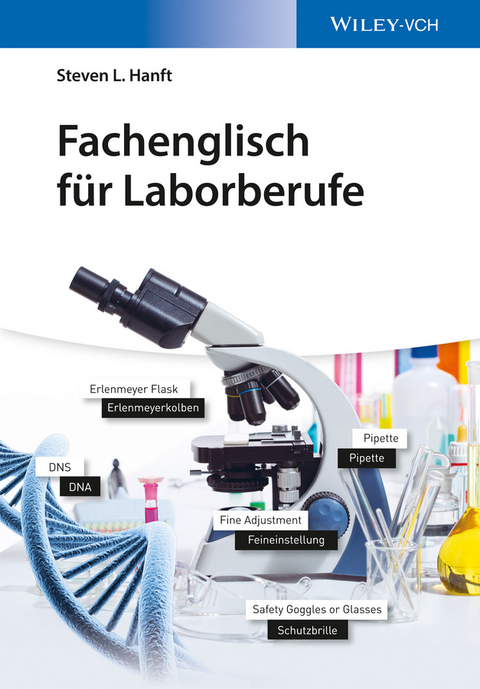
Fachenglisch fr Laborberufe (eBook)

eBook Download: EPUB
2015 | 1. Auflage
240 Seiten
Wiley-VCH (Verlag)
978-3-527-69344-3 (ISBN)

Lese- und Medienproben

Fachenglisch fr Laborberufe -  Steven L. Hanft
Systemvoraussetzungen
33,99 inkl. MwSt
(CHF 33,20)
Der eBook-Verkauf erfolgt durch die Lehmanns Media GmbH (Berlin) zum Preis in Euro inkl. MwSt.
  • Download sofort lieferbar
  • Zahlungsarten anzeigen


Steven Hanft, ein gebürtiger New Yorker mit Wohnsitz in Aachen, hält seit vielen Jahren Sprach- und Kommunkationskurse speziell für den naturwissenschaftlichen und medizinischen Sektor, unter anderem in Zusammenarbeit mit der Gesellschaft Deutscher Chemiker und als Dozent der Konrad-Adenauer-Stiftung. Von 1999 bis 2010 war er als Lehrbeauftragter an der RWTH Aachen tätig. Hanft ist Gründer und Geschäftsführer der Firma CONUSBAT, die professionelle Dienstleistungen und Trainings für Kunden im Chemie-, Pharma- und Kosmetikbereich anbietet.

Steven Hanft, ein gebürtiger New Yorker mit Wohnsitz in Aachen, hält seit vielen Jahren Sprach- und Kommunikationskurse speziell für den naturwissenschaftlichen und medizinischen Sektor, unter anderem in Zusammenarbeit mit der Gesellschaft Deutscher Chemiker und als Dozent der Konrad-Adenauer-Stiftung. Von 1999 bis 2010 war er als Lehrbeauftragter an der RWTH Aachen tätig. Hanft ist Gründer und Geschäftsführer der Firma CONUSBAT, die regulatorische Dienstleistungen und Trainings für Kunden im Chemie- und Kosmetikbereich anbietet.

1 English Grammar 101
2 English Grammar 102
3 Technical English Vocabulary
4 Specialized Usages of English Language
5 MBA 101 - Business Communication Skills
6 MBA 102 - Business Communication Skills
7 Science 101
8 Bio-Medicine 102
9 Chemistry 101
10 Biochemistry 102
11 Physical Chemistry 103
12 Physics 101
13 Regulatory Affairs 101
14 Legal Language 101
15 Mathematics 101
16 Measurements
17 Biology 101
18 Sector Industry Terminology
Appendix: Answers to the quizzes (Antworten zu allen Testfragen)

"Das Werk hilft beim Trainieren von Wortschatz und Sprachformen. Durch abwechslungsreiche Beispiele wird das Einüben aufgelockert. Der Spezialwortschatz wird und Schreibformen werden erläutert. Gesprächssituationen wie z.B. der Anruf beim Kundendienst, ein Gespräch am Messestand etc. werden eingeübt."
Allgemeines Ministerialblatt (9/2016)


"Die Themenpalette ist dabei vielfältig und reicht von der chemischen Nomenklatur über mathematische Ausdrücke und die Prozesstechnik bis hin zum Umgang mit Regulierungsbehörden. Außerdem werden Gesprächssituationen eingeübt. Das kann der Anruf beim Kundendienst sein, die Vorstellung beim neuen Chef oder das Gespräch am Messestand."
dei-die Ernährungsindustrie (01.04.2016)


"Das Buch stellt eine wichtige Ergänzung für normale Englischkurse dar und kann somit für den fachbezogenen Sprachunterricht eingesetzt werden."
VDLUFA Mitteilungen (01/2016)

"Fachenglisch für Laborberufe ist sehr informativ und somit zur Auffrischung und Vertiefung der Englisch- bzw. Fachkenntnisse für alle naturwissenschaftlichen Berufe oder als hilfreiche Ergänzung im Hochschulstudium geeignet."
Fachschaft der Biowissenschaften der TUM (04.02.2016)


"Insgesamt finde ich dieses Buch für einen Biologiestudierenden, besonders im Master, wo die meisten Vorlesungen und Praktika auf Englisch sind, sehr empfehlenswert. Das Buch ist sein Geld auf jeden Fall wert, wenn es einem manchmal schwer fällt sich gerade im Labor auf Englisch auszudrücken."
FSI-bio.Imu.de (15.12.2015)


"Das Einüben lockert der Autor durch abwechslungsreiche Beispiele auf und sorgt oft genug mit einprägsamen Hinweisen für den 'Aha-Effekt'. So geht dieses Buch weit über 'normale' Englischkurse hinaus und ist auch bestens für den fachbezogenen Sprachunterricht geeignet."
Giesserei (11.12.2015)

1
English Grammar 101


1.1 Parts of Speech: Noun, Pronoun, Adjective, Verb, Adverb, and so on


When putting your words together to form sentences, would you agree that it is important to know “the parts of speech” used in the sentence or paragraph you are writing? This means knowing if the word in the sentence is a noun, pronoun, verb, adverb, adjective, gerund, conjunction, preposition, or interjection.

QUIZ YOURSELF

What parts of speech are the following words (noun, verb, adjective, etc.)?

  1. 1. analyzing ____________
  2. 2. beaker ____________
  3. 3. to measure ___________
  4. 4. red _________
Answers to the above:
  1. 1. Gerund, analyzing is an action word, where a verb is transformed into a noun.
  2. 2. Noun, a beaker is an object.
  3. 3. Verb, measure is used in its infinitive form.
  4. 4. Red describes the color of an object, and therefore is an adjective.

Parts of Speech – Sector Keywords


Adjective Adjektiv
Adverb Adverb
Conjunction Konjunktion
Gerund Gerundium
Interjection Interjektion
Noun Substantiv
Paragraph Absatz
Preposition Präposition
Pronoun Pronomen
Punctuation marks (part of grammar, yet related to this topic) Interpunktionszeichen
Sentence Satz
Verb Verb

1.1.1 Noun = Subject (Person, Place, Thing)


  • The cat sat on the mat.
  • George Washington was America's first President.

1.1.2 Pronoun = Expresses a Distinction of a Person


Pronoun as subject Pronoun as object Possessive pronoun Reflexive pronoun
I Me Mine Myself
You You Yours Yourself
He Him His Himself
She Her Hers Herself
It It Its Itself
We Us Ours Ourselves
You You Yours Yourselves
They Them Theirs Themselves

1.1.3 Adjective = Words That Describe or Modify a Noun


  • The good, the bad, and the ugly.
  • The idea is cool, yet crazy!
  • She has five shirts, and two are red and the rest are green.

1.1.4 Verb = Action Word


  • She washed her automobile.
  • Did you bring your language dictionaries to this workshop?
  • To be or to have, shall/should, will/would, can/may, and so on.

Verb infinitives (the verb in its basic form: To be, to love, to have, to perceive, to say, to speak, to ski, to run, and so on.

1.1.4.1 The Use of the Two Verbs; Can vs. May

Can (können) May (dürfen)
Can you work in my lab today? (ability) • You too may borrow my HPLC. (permission)
Can you do me a favor? (could) • Due to the late scheduling of the symposium,I may arrive late. (possibility)
• Reminder.…May, the month is a noun!(months are capitalized!)
QUIZ YOURSELF: Can or May

When using the rules from above, the choice between can or may, is not so obvious in the sentences below.

  1. Which word would you choose?
    1. 1. Can or May I have food served in the conference room?
    2. 2. Yes, you can or may make arrangements with the onsite cafe.
    3. 3. Restaurant guests can or may have their parking tickets validated.
  2. For the sentences above, does the meaning involve ability, possibility, or permission?
  3. Some people would say each one involves ability. For example:
    1. 1. Am I able to have food served in the conference room?
    2. 2. Yes, you are able to make arrangements with the onsite cafe.
    3. 3. Restaurant guests are able to have their parking tickets validated.
  4. Yet, some people would say each one involves ability. For example:
    1. 1. Am I permitted to have food served in the conference room?
    2. 2. Yes, you are permitted to make arrangements with the onsite cafe.
    3. 3. Restaurant guests are permitted to have their parking tickets validated.

Can vs. May – Mr. H's Grammar Tip


  • can – ability, could
  • may – permission, possibility or to be courteous (höflich) in your answer or reply.

1.1.5 Adverb = Words That Modify a Verb


  • Quickly, the oil flowed through the drilling pipe.
  • The meeting went well.
  • The concert was beautifully performed.
  • Sam asked Jean, “How are you doing after surgery?” Jean replied, “I'm doing incredibly well!

Mr. H's Special Tips


  1. 1. Many adverbs in English langauge end with the suffix, -ly, i.e., similarily, honestly, currently, justifiably, brilliantly
  2. 2. Consider the fact that in German language many adverbs end with the Nachsilbe, -lich, i.e., ehrlich
  3. 3. Some adverbs of frequency; always, often, sometimes, daily, weekly, monthly, again.

1.1.5.1 Good (adj.) vs. Well (adv.)

Two special words, which are easily confused

Incorrect usage Correct usage
I did good on the test. I did well on the test.
She played the game good. She played the game well.

Mr. H's Grammar Tip


  • Use good when describing something or someone.
  • Use well when describing how something is done or how someone does something.
Usage of Good versus Well – exceptions
  1. 1. “Well” may be used when describing if something is proper, healthy, or suitable. As in, “I am well (healthy) today.” However, an exception to this is the following: How are you feeling? I feel good. (think of James Brown's soul song, “I Feel Good”)
  2. 2. Another way well may be used is when starting a sentence such as, “Well, that explains everything.” In this case, well means “Of course” or “Yes.”

1.1.6 Gerund = Using -ing, an Action Word, a Verb Becomes a Noun


Swimming and reading are both fun!

1.1.7 Prepositions Indicate a Relation Between Things


Common prepositions used: of, in, with, on, about, beneath, against, beside, over, during, throughBrE versus thruAmE.

  • The weather in May in Chicago is generally quite pleasant.
  • On Tuesday, she was declared the winner of the election.
  • The biochemistry book was taken away from the student.

Mr. H's Grammar Tip


Two prepositions which have homonyms (words which sound the same, but are spelled differently and have other meanings) are the following:

  • to vs. too (also) vs. two (2)
  • for vs. four (4).

1.1.7.1 Between (zwischen) vs. Among (unter); two confusing prepositions

  1. 1. between (used with either two people or things)
    1. a. Between you and me, I think we can solve the problem easily!
    2. b. The Pyrenees mountain chain lies between Spain and France.
  2. 2. Among, amongst (used with three or more people or things).
    1. a. Among the three of us, I am sure we can resolve the issue between them.
    2. b. Living in the rain forest amongst other wild animals, gorillas continue to endure.

1.1.8 Conjunctions Connect Two Words, Phrases, or Clauses


  • And: presents non-contrasting item(s) or idea(s); “They gamble, and they smoke.”
  • But: presents a contrast or exception; “They gamble, but they don't smoke.”
  • Nor...

Erscheint lt. Verlag 15.9.2015
Sprache englisch
Themenwelt Naturwissenschaften Chemie Allgemeines / Lexika
Technik
Schlagworte aber • Alltagsthemen • Beschreiben • biotechbranche • Chemie • Chemielaborant • Chemistry • Darum • DEM • der • DES • Dienstleistungen • Einzug • Englisch als Fremdsprache • Englisch /Sprache • English as a Second Language • ES • Fachenglisch • Fehlfunktion • Foreign Languages • Fremdsprachen • Globalisierung • Hat • immer • Industrial Chemistry • Kundendienst • Labor • Laborberufe • MAN • mehr • Schule • Technische u. Industrielle Chemie • Telefon • teuersten • unterhalten • von • Waren • wenn
ISBN-10 3-527-69344-0 / 3527693440
ISBN-13 978-3-527-69344-3 / 9783527693443
Informationen gemäß Produktsicherheitsverordnung (GPSR)
Haben Sie eine Frage zum Produkt?
EPUBEPUB (Adobe DRM)

Kopierschutz: Adobe-DRM
Adobe-DRM ist ein Kopierschutz, der das eBook vor Mißbrauch schützen soll. Dabei wird das eBook bereits beim Download auf Ihre persönliche Adobe-ID autorisiert. Lesen können Sie das eBook dann nur auf den Geräten, welche ebenfalls auf Ihre Adobe-ID registriert sind.
Details zum Adobe-DRM

Dateiformat: EPUB (Electronic Publication)
EPUB ist ein offener Standard für eBooks und eignet sich besonders zur Darstellung von Belle­tristik und Sach­büchern. Der Fließ­text wird dynamisch an die Display- und Schrift­größe ange­passt. Auch für mobile Lese­geräte ist EPUB daher gut geeignet.

Systemvoraussetzungen:
PC/Mac: Mit einem PC oder Mac können Sie dieses eBook lesen. Sie benötigen eine Adobe-ID und die Software Adobe Digital Editions (kostenlos). Von der Benutzung der OverDrive Media Console raten wir Ihnen ab. Erfahrungsgemäß treten hier gehäuft Probleme mit dem Adobe DRM auf.
eReader: Dieses eBook kann mit (fast) allen eBook-Readern gelesen werden. Mit dem amazon-Kindle ist es aber nicht kompatibel.
Smartphone/Tablet: Egal ob Apple oder Android, dieses eBook können Sie lesen. Sie benötigen eine Adobe-ID sowie eine kostenlose App.
Geräteliste und zusätzliche Hinweise

Buying eBooks from abroad
For tax law reasons we can sell eBooks just within Germany and Switzerland. Regrettably we cannot fulfill eBook-orders from other countries.

Mehr entdecken
aus dem Bereich