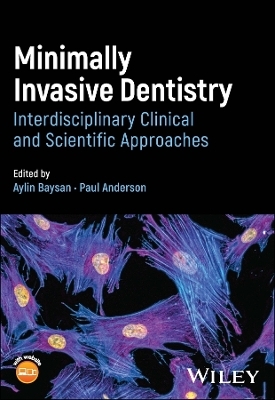
Minimally Invasive Dentistry
Wiley-Blackwell (Verlag)
978-1-119-21506-6 (ISBN)
Minimally Invasive Dentistry provides a practical introduction to holistic patient care across all the dental specialties. Beginning with the definitions and key principles of MID, the following chapters focus on the concepts of MID, including saliva as a natural product, risk assessments, the early detection of diseases, management of dental caries, futuristic materials, innovative techniques, and the implementation of preventative strategies with health education for patients. In this way, this book offers a comprehensive and evidence-based look at this important branch of dentistry.
Minimally Invasive Dentistry readers will also find:
- A unique approach to minimally invasive dentistry across all dental disciplines
- A companion website with case studies and interactive MCQs to test your knowledge
- Coverage of MID factors in the prevention, control and treatment of disease
Edited by leading figures, and with contributions from a diverse group of international authors, Minimally Invasive Dentistry is a useful reference for undergraduate and postgraduate dental students. It is also a practical guide for the whole dental team.
Aylin Baysan, BDS, MSc, PhD, MFDS RCS (Edin), FHEA, is a Clinical Senior Lecturer (Specialist Registrar) at Queen Mary University of London.
Paul Anderson, BSc, PhD, is Professor of Oral Biology at Queen Mary University of London.
List of Contributors ix
Foreword xi
Preface xiii
About the Companion Website xiv
1 Introduction to Minimally Invasive Dentistry: History of Minimally Invasive Dentistry and Key Concepts 1
Aylin Baysan and Kenneth Eaton
Key Topics 1
Learning Objectives 1
Introduction 1
The Epidemiology of Dental Caries Worldwide 2
The Epidemiology of Periodontitis Worldwide 4
The Epidemiology of Tooth Wear 5
The Epidemiology of Tooth Loss 5
The Concept of Minimally Invasive Dentistry (MID) 7
Principles of Minimally Invasive Dentistry (MID) with Advantages and Disadvantages 7
The History of Minimally Invasive Dentistry (MID) 8
Summary 8
Further Reading 9
References 9
2 Where Are We with the Evidence for Minimally Invasive Dentistry? 11
Derek Richards and Valeria Marinho
Key Topics 11
Learning Objectives 11
Introduction 11
Clinical Experiences and Patient Values 12
Evidence 12
Clinical Experience 13
Patients Values 13
The Evidence-based Approach 13
Asking Answerable Questions 14
Searching for the Best Evidence 14
Evidence-based Computerised Decision Support Systems 15
Evidence-based Guidelines 15
Systematic Reviews 15
Individual Studies 16
Critical Appraisal 16
Applying the Evidence 17
Evaluating the Outcome 17
High Quality Evidence in Relation to MID 17
Cochrane Reviews on the Effects of Minimal Intervention Approaches in Caries Management 18
The Main Findings/Conclusions from Each Review Were 19
Cochrane Reviews on the Effects of Other MID Approaches (Consequences of Dental Caries) 21
Summary 22
Further Reading 22
References 23
3 Molecular Dentistry: Role of Salivary Proteins in Dental Hard Tissue Protection 25
Paul Anderson
Key Topics 25
Learning Objectives 25
Introduction 25
Protein Control of Enamel Formation 26
The Inorganic Chemistry of Dental Hard Tissue Mineral Loss 27
The Role of the Organic Proteins of Saliva in Enamel Mineral Preservation 30
Biomineralisation and Bio-demineralisation/remineralisation 31
The Potential Roles of Protein Engineered Salivas in Minimally Invasive Dentistry 32
Overall Conclusion 33
References 33
4 Dental Caries Risk Assessment and Early Caries Detection 35
Bennett T. Amaechi
Key Topics 35
Learning Objectives 35
Introduction 35
What Is Caries Risk Assessment and Its Benefits? 37
The Components and Uses of Caries Risk Assessment Tools 38
The Caries Risk Likelihood Matrix 45
Identification of Factors Predictive of Risk 46
Caries Detection, Activity Assessment, Staging, and Diagnosis in Caries Risk Assessment 47
Visual Caries Detection 47
Detecting Early Lesions on Buccal, Lingual and Root Surfaces 49
Detecting Early Caries in Pits and Fissures on Tooth Surface 51
Detecting Lesions on Tooth Proximal Surfaces 52
Detecting Early Caries around Restorations 53
Assessing Caries Lesion Activity 53
Staging of the Caries Process 54
Radiographic Detection of Early Caries 56
Diagnosis of Dental Caries 57
Clinical Application of Caries Risk Assessment 57
Summary 57
Further Reading 58
References 58
5 Management of Dental Caries: Minimally Invasive Dentistry vs. Conventional Strategies 65
John Featherstone
Key Topics 65
Learning Objectives 65
Introduction 65
Clinical Challenges to Manage Dental Caries 66
Caries Risk Assessment and the Process 67
Disease Indicators 68
Biological and Environmental Risk Factors 70
Protective Factors 70
Determining the Caries Risk as Low, Moderate, High, or Extreme 71
Levels of Chemical Therapy Needed According to the Caries Risk Assessment 71
Low Caries Risk Chemical Therapy 72
Moderate Caries Risk Chemical Therapy 72
High Caries Risk Chemical Therapy 72
Extreme Caries Risk Chemical Therapy 73
Anticaries Agents and Delivery Systems 73
Bioactive Materials and the Future 74
When to Consider Conventional Treatment in High Risk Patients? 74
Summary 74
Further Reading 75
References 75
6 Intraoral Vaccine and Their Potential Clinical Use 77
Lesley Ann Bergmeier
Key Topics 77
Learning Objectives 77
Introduction 77
A Brief History of Vaccination 78
Principals of Vaccination 78
Types of Vaccine Preparations 80
Immunisation 83
The Structure and Function of the Oral Cavity 84
Immune Responses in the Oral Cavity 85
Inflammation and the Immune Response: Defending the Barricades 85
Inductive and Effector Sites in the Oral Cavity 88
Mucosal Immunisation and Oral Tolerance 89
Oral Diseases and Vaccination 89
Dental Caries 90
Periodontal Disease 91
Behçet’s Disease (BD) 92
Sublingual and Buccal Vaccine Delivery 92
‘Biologics’-passive Immunotherapy with Monoclonal Antibodies 93
Cancer 95
Summary 95
References 96
7 Can Minimally Invasive Strategies Be Applicable in Restorative Dentistry? 101
Sevil Gurgan, Zeynep Bilge Kutuk, and Aylin Baysan
Key Topics 101
Learning Objectives 101
Introduction 101
Evolution of Minimally Invasive (MI) Strategies in Restorative Dentistry 102
mi Operative Management Strategies in Anterior and Posterior Dentition 103
mi Management of Early Carious Lesions 103
Fissure Sealants 103
Preventive Resin Restoration (PRR) 104
Resin Infiltration Technique 104
mi Restorations in Non-Carious Cervical Lesions 105
mi Management for Deep Carious Lesions 105
Remineralisation of Demineralised Dentine 105
Cavity Design and Principles for MID 106
Appropriate Excavation Methods 106
mi Restorations in Posterior Teeth 107
mi Restorations in The “Aesthetic Zone” 107
“No-Prep” Adhesive Restorations: Another Way to Deal with Problems Related to Aesthetics 108
Management of Tooth Discoloration with MI Approach 108
Tooth Whitening/Bleaching 108
Management of Tooth Wear with MI Approaches 111
Tooth Loss and MI Restorative Approaches 113
An Alternative Replacement Approach to Tooth Loss: Resin Bonded Bridges 113
Repair of Defective Restorations 115
Summary 116
Further Reading 117
References 117
8 Dental Materials and Their Clinical Implications in Minimally Invasive Dentistry 123
Saroash Shahid and Robert Hill
Key Topics 123
Learning Objectives 123
Introduction 123
Glass Ionomer Cements and the Atraumatic Restorative Treatment (ART) 124
Bioactive Dental Composites 126
Cention N 126
Activa Bioactive 127
Bioactive Glass as Remineralizing Agent 127
Original Studies by Hench and Spilman on Incorporating Fluoride 129
New Fluoride- Containing Bioactive Glasses 129
Sol=Gel Fluoride- Containing Bioactive Glasses 130
Chloride- Containing Bioactive Glasses 131
Incorporating Bioactive Glasses into Resin Matrices 131
Summary 135
Further Reading 135
References 136
9 Where Are We with a Minimally Invasive Approach in Periodontology? 141
David Gillam, Nik Pandya, and Wendy Turner
Key Topics 141
Learning Objectives 141
Introduction 141
Changing Concepts: Dynamic Paradigm Shifts in Dentistry and in Periodontology 142
Non-surgical and Surgical Procedures in Periodontology 143
Non-surgical Procedures 144
Surgical Procedures in Minimally Invasive Periodontal Surgery (mips/mist) 146
Advantages of Minimally Invasive Periodontal Surgery 146
Disadvantages of Minimally Invasive Periodontal Surgery 147
Example of Applying the Principles of Minimal Invasive Periodontal Surgery in a Periodontal Practice 148
Relevant Medical and Dental History 148
Clinical Examination 148
Main Complaint 149
Surgical Procedure 149
Post-operative Instructions 150
Patient Outcomes 151
Post Script 152
Concluding Remarks 152
Glossary 153
Further Reading 155
References 155
10 Pulp and Endodonic Regeneration 158
Alastair J. Sloan
Key Topics 158
Learning Objectives 158
Introduction 158
The Dentin-Pulp Complex 159
Dental Pulp Stem Cells and Regeneration of the Dentine-Pulp Complex 161
Vital Pulp Therapy 163
Regenerative Endodontics 165
Summary 167
References 168
11 Minimally Invasive Dentistry in Paediatric Dentistry 173
Paul Ashley and Ferranti Wong
Key Topics 173
Learning Objectives 173
Introduction 173
Differences between Primary and Permanent Teeth and How This Will Influence the MI Approach 174
Eruption and Exfoliation 174
Thinner Enamel and Dentine 175
Pulp Chamber and Canals 175
Dental Materials for Primary Teeth 176
Differences between Treating Children and Adults and How This Will Influence the MI Approach 177
Managing Behaviour 177
Health Promotion for Children 177
mi Therapies for Children 178
Silver Diamine Fluoride 178
Sealing in Caries 178
Atraumatic Restorative Technique 180
Summary 180
References 180
12 Minimally Invasive Dentistry in Orthodontics 182
Tarek EL-Bialy
Key Topics 182
Learning Objectives 182
Introduction 182
New Technologies in Orthodontics (Diagnosis and Treatment Options) 183
How New Technologies in Orthodontics Help Achieving Minimally Invasive Orthodontics 185
Anchorage 186
Dentofacial Orthopedics 186
Accelerated Tooth Movement 187
Summary 187
References 188
Index 190
| Erscheinungsdatum | 10.10.2025 |
|---|---|
| Verlagsort | Hoboken |
| Sprache | englisch |
| Maße | 170 x 244 mm |
| Gewicht | 408 g |
| Einbandart | kartoniert |
| Themenwelt | Medizin / Pharmazie ► Zahnmedizin ► Klinik und Praxis |
| Medizin / Pharmazie ► Zahnmedizin ► Studium der Zahnmedizin | |
| ISBN-10 | 1-119-21506-4 / 1119215064 |
| ISBN-13 | 978-1-119-21506-6 / 9781119215066 |
| Zustand | Neuware |
| Informationen gemäß Produktsicherheitsverordnung (GPSR) | |
| Haben Sie eine Frage zum Produkt? |
aus dem Bereich