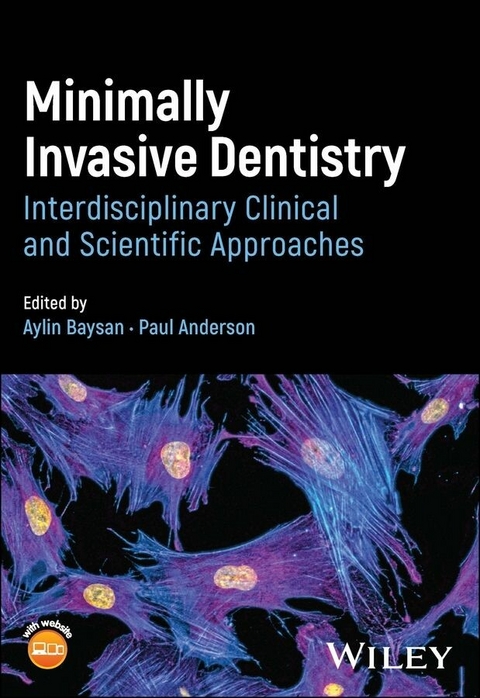
Minimally Invasive Dentistry (eBook)
407 Seiten
Wiley (Verlag)
978-1-119-21501-1 (ISBN)
A helpful introduction to the Minimally Invasive Dentistry concept for patient care in the treatment of dental disease
Minimally Invasive Dentistry provides a practical introduction to holistic patient care across all the dental specialties. Beginning with the definitions and key principles of MID, the following chapters focus on the concepts of MID, including saliva as a natural product, risk assessments, the early detection of diseases, management of dental caries, futuristic materials, innovative techniques, and the implementation of preventative strategies with health education for patients. In this way, this book offers a comprehensive and evidence-based look at this important branch of dentistry.
Minimally Invasive Dentistry readers will also find:
- A unique approach to minimally invasive dentistry across all dental disciplines
- A companion website with case studies and interactive MCQs to test your knowledge
- Coverage of MID factors in the prevention, control and treatment of disease
Edited by leading figures, and with contributions from a diverse group of international authors, Minimally Invasive Dentistry is a useful reference for undergraduate and postgraduate dental students. It is also a practical guide for the whole dental team.
The Editors
Aylin Baysan, BDS MSc PhD MFDS RCSEd SFHEA MEndo RCSEd FDTFEd FDS RCSEng, is a Clinical Reader in Cariology in relation to Minimally Invasive Dentistry at Queen Mary University of London, UK.
Paul Anderson, BSc, PhD, is Professor of Oral Biology at Queen Mary University of London, UK.
A helpful introduction to the Minimally Invasive Dentistry concept for patient care in the treatment of dental disease Minimally Invasive Dentistry provides a practical introduction to holistic patient care across all the dental specialties. Beginning with the definitions and key principles of MID, the following chapters focus on the concepts of MID, including saliva as a natural product, risk assessments, the early detection of diseases, management of dental caries, futuristic materials, innovative techniques, and the implementation of preventative strategies with health education for patients. In this way, this book offers a comprehensive and evidence-based look at this important branch of dentistry. Minimally Invasive Dentistry readers will also find: A unique approach to minimally invasive dentistry across all dental disciplinesA companion website with case studies and interactive MCQs to test your knowledgeCoverage of MID factors in the prevention, control and treatment of disease Edited by leading figures, and with contributions from a diverse group of international authors, Minimally Invasive Dentistry is a useful reference for undergraduate and postgraduate dental students. It is also a practical guide for the whole dental team.
1
Introduction to Minimally Invasive Dentistry: History of Minimally Invasive Dentistry and Key Concepts
Aylin Baysan and Kenneth Eaton
Key Topics
- Facts and figures: Demographics of dental disease
- Concept of Minimally Invasive Dentistry
- Principles of Minimally Invasive Dentistry with advantages and disadvantages
- History of Minimally Invasive Dentistry
Learning Objectives
- Be able to appreciate the facts and figures on demographics of dental disease
- Be able to appreciate the limited evidence on epidemiology of common dental diseases
- Be able to define the concept of Minimally Invasive Dentistry
- Be able to understand the principles with advantages and disadvantages
- Be able to understand the history of Minimally Invasive Dentistry and impact on clinical dentistry
Introduction
The World Health Organisation (WHO) Global Oral Health Status Report (2022) reported that oral diseases affect approximately 3.5 billion people worldwide. In this respect, it is estimated that 2 billion people present with dental caries in permanent teeth whilst 514 million children have carious lesions in primary teeth [1].
The Global Burden of Oral Conditions report revealed that untreated dental caries in permanent teeth was the most prevalent of all the 291 diseases and conditions investigated. With this respect, severe periodontitis was sixth most common and untreated dental caries in deciduous teeth was the tenth [2].
Figure 1.1 Percentage of restorations for which replacement with an increased number of surfaces according to tooth type and reason for replacement.
Following this evidence, the cost of the provision of oral care was reported to be £79 billion and that over two thirds of this cost related to the treatment of dental caries and its sequelae [3]. However, these costs could substantially be reduced if the population was educated in preventive practices and oral health care workers improved the early diagnosis of dental caries in their patients, such that enamel caries was treated with the application of fluoride and early dentinal caries with minimally invasive restorations. Elderton [4] reported a negative factor in replacing restorations which is the likelihood of increasing the size of potential new restorations. This author also emphasised the need for preventive advice and Minimally Invasive Dentistry (MID). Subsequently, Brantley et al. [5] illustrated the percentage of restorations and planned replacement with an increased number of surfaces (Figure 1.1). The reasons “new caries” and “other” (i.e., fracture, fracture risk, abutment, contact/contour problems led to the greatest proportion of increased surfaces for premolar teeth. The reason “other” was cited most frequently by dentists who recommended replacement of restorations in molar teeth with extensive restorations. However, “recurrent caries” and “faulty restoration” led to the increase in the number of surfaces for approximately one‐half of premolar and molar restorations.
The Epidemiology of Dental Caries Worldwide
Dental caries is still a major oral health problem in most countries, affecting 60–90% of schoolchildren and the vast majority of adults. Despite recent improvements in oral health of sections of the population of developed countries, overall there appears to have been some deterioration, particularly amongst under‐privileged groups in developed countries and in many developing countries [1]. It is also a most prevalent oral disease in several Asian and Latin‐American countries, whilst interestingly dental caries is less common and less severe in most African countries. Frencken et al. [6], reported that untreated cavitated dentine carious lesions are the only single most common disease that affects humans worldwide.
There is evidence that the severity of cavitated dentine carious lesions amongst 5‐ and 12‐year‐old children declined over the last decades. However, the percentage of observed dental caries within these age groups is still high, with a low prevalence among 12‐year‐olds and among 35‐ to 44‐year‐olds in high‐income countries [6].
However, the data on which the above trends have been reported must be treated with caution. International comparisons may be very unreliable due to a wide range of factors including, the threshold level for a diagnosis of caries, sampling techniques and the fact that some of the studies took place more than 15 years ago [3].
In the UK, since 1968 for adults and 1973 for children, national epidemiological surveys of oral health have taken place [7]. A remarkable improvement has been reported as far as the prevalence of dental caries in children and adults is concerned. In 1968, 37% of adults were edentulous and by 2009 this had fallen to 6% [8]. By 2013 the percentage of 12‐year‐old children with no obvious dental caries had risen to 66% (56% in 2003) [9]. However, within these overall improvements, there are still challenges for the management of dental caries.
More people over the age of 75 years are retaining teeth [7], which have often been restored with invasive procedures such as crowns, bridges, and dental implants. Unfortunately, due to the conditions such as rheumatoid arthritis, Alzheimer, and dementia, many are unable to maintain their oral health. In addition, reduced salivary flow affects the ability to buffer acids, produced by cariogenic bacteria, and secondary and/or root caries are more likely to ensue.
In spite of the overall reduction in the prevalence of dental caries in children, there has been a polarisation such that there has been no improvement, over the years, in dental caries in a minority of children, who invariably come from socio‐economically deprived groups with the population [9]. Interestingly, extraction of teeth of those under 16 years of age, under general anaesthetic, was previously the most frequently performed hospital operation in the UK.
In order to promote the concepts of prevention for dental caries worldwide, the Alliance for a Cavity Free Future (ACFF) has been formed. The ACFF seeks to work with dental educators, clinicians, policymakers and patients to prevent dental caries and where/when these lesions occur, the ultimate aim is to diagnose and treat this disease, before there is dentinal involvement [10].
If dental caries is present, it is essential to assess its extent in a tooth. The simple diagnosis of caries present or absent is unable to help the practice of MID. A more detailed assessment with different grades is required. This concept has been incorporated in the International Caries Detection and Assessment System (ICDAS), which grades dental caries from 0 to 6 (Figure 1.2) [11]. Diagnosis of early dentinal caries (ICDAS Grade 3) can be an indication for the caries removal and the placement of a restoration following minimally invasive cavity preparation.
Figure 1.2 ICDAS clinical visual codes, based on evidence of the histological extent of carious lesions by staging the caries continuum.
Source: Pitts and Ekstrand [11]/John Wiley & Sons, Inc.
The Epidemiology of Periodontitis Worldwide
As previously stated in 2010 the Global Burden of Disease study suggested that periodontitis was the sixth most prevalent disease on Earth. Periodontitis is a chronic, multifactorial inflammatory disease and is associated with diabetes, hypertension, and cardiovascular diseases. This disease is interestingly linked to behavioural and lifestyle factors (i.e., smoking habits, psychosocial stress, and nutrition) [12–14]. Frencken et al. [6] suggested that the prevalence and incidence of periodontitis are highly age dependent and that there is marked geographic variation. There are no meaningful gender differences and that the prevalence and incidence of periodontitis may have stagnated over the past 20 years (Figure 1.3).
In 2010, worldwide loss of productivity due to severe periodontitis was estimated to be US $54 billion per year. The global prevalence of periodontal disease is expected to increase in coming years due to growth in the aging population and increased retention of natural teeth due to a significant reduction in tooth loss in the older population.
Figure 1.3 Prevalence of periodontitis globally.
Source: Frencken et al. [6]/John Wiley & Sons.
However, even worse than epidemiological data for dental caries, national data for severity of periodontitis are unreliable as the thresholds for a case definition of periodontitis have varied widely from country to country [15] and also utilising the techniques for assessment [16].
Periodontal care is being provided in a variety of health systems around the world and given the global burden of disease, the active engagement of a motivated oral health professional team and patients play a key role for the management of this disease. However, as the complexity of treatment increases with disease progression, it is important to plan appropriate primary and...
| Erscheint lt. Verlag | 29.7.2025 |
|---|---|
| Sprache | englisch |
| Themenwelt | Medizin / Pharmazie ► Medizinische Fachgebiete |
| Medizin / Pharmazie ► Zahnmedizin | |
| Schlagworte | Caries Risk Assessment • dental caries • Dental material • early caries detection • Endodontology • intra-oral vaccine • natural MID product • Orthodontics • Periodontal Disease • Pulp Regeneration • restorative dentistry • Saliva • tissue response tooth movement |
| ISBN-10 | 1-119-21501-3 / 1119215013 |
| ISBN-13 | 978-1-119-21501-1 / 9781119215011 |
| Informationen gemäß Produktsicherheitsverordnung (GPSR) | |
| Haben Sie eine Frage zum Produkt? |
 EPUB (Adobe DRM)
Kopierschutz: Adobe-DRM
Adobe-DRM ist ein Kopierschutz, der das eBook vor Mißbrauch schützen soll. Dabei wird das eBook bereits beim Download auf Ihre persönliche Adobe-ID autorisiert. Lesen können Sie das eBook dann nur auf den Geräten, welche ebenfalls auf Ihre Adobe-ID registriert sind.
Details zum Adobe-DRM
Dateiformat: EPUB (Electronic Publication)
EPUB ist ein offener Standard für eBooks und eignet sich besonders zur Darstellung von Belletristik und Sachbüchern. Der Fließtext wird dynamisch an die Display- und Schriftgröße angepasst. Auch für mobile Lesegeräte ist EPUB daher gut geeignet.
Systemvoraussetzungen:
PC/Mac: Mit einem PC oder Mac können Sie dieses eBook lesen. Sie benötigen eine
eReader: Dieses eBook kann mit (fast) allen eBook-Readern gelesen werden. Mit dem amazon-Kindle ist es aber nicht kompatibel.
Smartphone/Tablet: Egal ob Apple oder Android, dieses eBook können Sie lesen. Sie benötigen eine
Geräteliste und zusätzliche Hinweise
Buying eBooks from abroad
For tax law reasons we can sell eBooks just within Germany and Switzerland. Regrettably we cannot fulfill eBook-orders from other countries.
aus dem Bereich