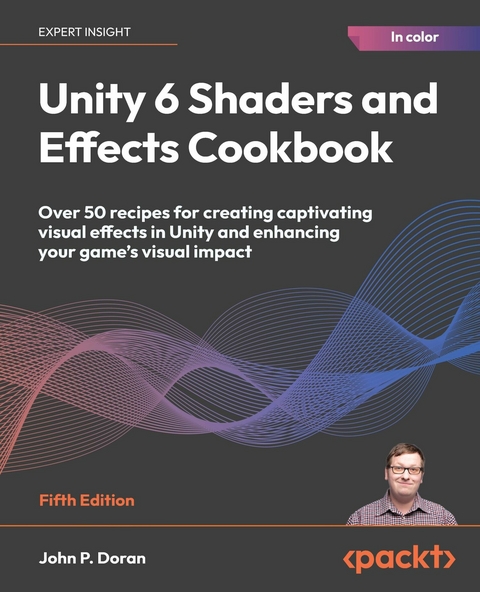
Unity 6 Shaders and Effects Cookbook (eBook)
532 Seiten
Packt Publishing (Verlag)
978-1-83546-080-1 (ISBN)
Shaders enable game developers to craft visually stunning experiences, but their complexity and mathematical and technical challenges make it hard to achieve the desired level of realism. Written by a top-selling author with extensive hands-on expertise in game development, this latest edition is your indispensable guide to mastering the art of shaders within this evolving landscape.
Through meticulously curated recipes, this book takes a practical approach to equip you with the knowledge and tools necessary to elevate your game visuals to unmatched sophistication. In this updated edition, you'll gain invaluable insights into leveraging Unity's latest tools, including Unity Muse for advanced AI-powered texture creation. From fully grasping Shader Graph to harnessing the power of vectors and textures, this Unity cookbook covers all the aspects of shader development without the need for elaborate mathematical calculations. You'll also discover practical techniques for achieving stunning visual effects with ease when creating 2D or 3D elements.
Overcome challenges head-on in Unity 6 shader creation with the help of expert tips, practical solutions, and cutting-edge techniques from best-selling author John DoranKey FeaturesExplore Shader Graph to develop expertise in post-processing and advanced shadingUnlock shortcuts to achieve AAA shader quality without complex algorithmsBecome proficient in Unity's latest tools, including VFX Graph and Unity MusePurchase of the print or Kindle book includes a free PDF eBookBook DescriptionShaders enable game developers to craft visually stunning experiences, but their complexity and mathematical and technical challenges make it hard to achieve the desired level of realism. Written by a top-selling author with extensive hands-on expertise in game development, this latest edition is your indispensable guide to mastering the art of shaders within this evolving landscape. Through meticulously curated recipes, this book takes a practical approach to equip you with the knowledge and tools necessary to elevate your game visuals to unmatched sophistication. In this updated edition, you ll gain invaluable insights into leveraging Unity s latest tools, including Unity Muse for advanced AI-powered texture creation. From fully grasping Shader Graph to harnessing the power of vectors and textures, this Unity cookbook covers all the aspects of shader development without the need for elaborate mathematical calculations. You'll also discover practical techniques for achieving stunning visual effects with ease when creating 2D or 3D elements.What you will learnUnderstand the principles of shaders, along with how to work in Shader GraphHarness URP and HDRP packages for efficient shader creationEnhance game visuals with modern shader techniquesOptimize shaders for performance and aestheticsMaster the math and algorithms behind the commonly used lighting modelsTransform your game's atmosphere with the Post Processing StackDevelop sophisticated shader effects by leveraging fragment shaders and grab-pass techniquesWho this book is forThis book is for game developers looking to elevate their shader expertise and enhance game visuals using Unity 6. Game programmers, technical artists, and aspiring game developers eager to master shader creation with Shader Graph will find this book very useful. A solid understanding of Unity is required to get the most out of this book.]]>
Preface
Unity 6 Shaders and Effects Cookbook is your guide to mastering shader creation and post-processing effects in Unity 6. With Unity 6 making the Universal Render Pipeline (URP) the default render pipeline used, this edition of the book has been rewritten with a focus on URP and Shader Graph, ensuring that you are equipped to create shaders using Unity’s latest rendering technology.
You will start your journey by exploring URP’s built-in post-processing features, learning how to enhance your game’s visuals without writing custom scripts. From there, you will dive into Shader Graph, creating your first shaders and learning how surfaces interact with light. As you progress, you will explore texture mapping, vertex functions, and advanced transparency effects using grab passes, all of which help bring your game world to life.
This edition introduces Unity Muse, a generative AI tool that simplifies texture creation, alongside deeper coverage of physically based rendering (PBR), lighting models, and fullscreen shaders. You’ll learn how to optimize shaders for performance, implement dynamic screen effects such as night vision and old film filters, and use HLSL and ShaderLab to create fully customized shading techniques. The final chapter explores high-end rendering with HDRP, helping you create shaders suited for AAA-quality visuals.
Each chapter is designed to build your skills step by step, but you can also jump into specific topics to quickly learn a new technique. Whether you’re a game programmer, technical artist, or an experienced Unity developer looking to deepen your shader expertise, this book will give you the knowledge and practical recipes to create stunning effects in Unity 6. So, let’s get started!
Who this book is for
Unity 6 Shaders and Effects Cookbook is designed for game developers who want to create shaders from scratch or enhance their projects with custom visual effects in Unity 6. It is especially useful for game programmers, technical artists, and aspiring developers who already have a solid understanding of Unity and are looking to deepen their skills in shader creation with Shader Graph, ShaderLab, and HLSL. This book assumes familiarity with Unity’s interface and basic workflows, and is best suited for those at an intermediate level or higher in their Unity development journey.
What this book covers
Chapter 1, Using Post-Processing with URP, explores how screen shaders in URP can refine a game’s style while introducing key shader concepts.
You will learn how to enable and configure post-processing, apply grain, vignetting, and depth of field for a filmic look, use bloom and motion blur for dynamic effects, and adjust scene tone through color grading. The chapter concludes with using fog to create immersive atmospheres, ideal for horror games.
Chapter 2, Creating Your First Shader with Shader Graph, introduces common diffusion techniques in modern shading pipelines, focusing on how light interacts with surfaces to enhance realism in 3D graphics.
You will be introduced to Shader Graph in Unity, a visual tool that enables shader creation without writing code. By the end of the chapter, you’ll be able to create basic shaders, define adjustable properties, and use Shader Graph to execute fundamental visual operations in Unity.
Chapter 3, Working with Surfaces, takes a deeper dive into surface materials in Shader Graph. Mastering surface materials is essential for creating visually compelling and optimized shaders in Unity.
This chapter begins with a simple matte material and progresses to more advanced effects, including holographic projections.
Chapter 4, Working with Texture Mapping, teaches you how to apply and manipulate textures in shaders to enhance visual quality and create dynamic effects. The chapter covers UV manipulation for scrolling textures, blending multiple textures for richer materials, and implementing transparency for realistic surfaces. By the end of the chapter, you will be able to animate textures and modify shader properties at runtime using C#.
Chapter 5, Enhancing Realism: Unity Muse and Physically Based Rendering, explores PBR and how Unity Muse, a generative AI tool, simplifies the creation of realistic materials and textures.
The chapter covers how light interacts with surfaces, the role of PBR in achieving realism, and how to fine-tune materials using Muse’s refinements menu. By the end, you will be able to apply PBR principles, create reflective surfaces, add transparency, and bake lighting for optimized visual fidelity.
Chapter 6, Using Vertex Functions, explains vertex functions and how shaders can be used not only to define an object’s appearance but also to modify its geometry in real time. The chapter covers accessing vertex data, animating vertices, and using shaders to create deformations without altering the underlying mesh. By the end, you will have hands-on experience with extruding models, implementing a snow shader, and simulating volumetric explosions.
Chapter 7, Using Grab Passes, delves into grab passes, a powerful technique for capturing and manipulating the background scene within shaders to create advanced transparency effects. Unlike simple transparency, which only reveals what’s behind an object, grab passes allow for refraction, distortion, and dynamic interactions with the background.
The chapter covers using grab passes to draw behind objects, implementing a glass shader with stained-glass effects, and creating a water shader for 2D games to simulate animated distortions.
Chapter 8, Optimizing Shaders, explores shader optimization techniques to ensure performance-friendly rendering across different platforms. We will break down key elements that impact shader performance, including reducing memory overhead, optimizing calculations, and how to best leverage Unity’s built-in variables.
You will learn how to profile shaders, adjust precision types (fixed, half, or float) for better memory management, and refine lighting calculations to suit lower-end hardware.
Chapter 9, Creating Screen Effects with Fullscreen Shaders, teaches you how to create fullscreen shaders to apply effects directly within Unity, gaining full control over real-time rendering. Unlike Unity’s built-in post-processing stack, fullscreen shaders allow developers to craft custom visual effects such as depth-based effects and color correction from scratch.
This chapter explores the depth buffer, demonstrates how to create Photoshop-like blend modes, and teaches you how to adjust brightness, saturation, and contrast dynamically.
Chapter 10, Gameplay and Screen Effects, builds on concepts from Chapter 9, Creating Screen Effects with Fullscreen Shaders, focusing on creating specific screen effects that completely change how a game feels. You will learn how to create an old movie screen effect, complete with film grain, scratches, and sepia tones, and implement a night vision effect, commonly used in FPS games, while also learning about using sub-graphs to break up complex effects and the Custom Function node, which will allow us to write High-Level Shader Language (HLSL) code directly within Shader Graph.
Chapter 11, Understanding Lighting Models, explores how lighting models determine the way light interacts with surfaces in shaders. You will learn how to create custom lighting models, including diffuse shading, toon shading, and Blinn-Phong specular reflections, while also adding shadows and multiple light support. By the end, you will understand how to control light reflection and shading effects, enabling you to create both realistic and stylized materials.
Chapter 12, Developing Advanced Shading Techniques, delves into advanced shader development by writing .shader files, combining ShaderLab and HLSL for greater control over rendering effects.
You will learn how ShaderLab structures shaders, handling rendering properties, passes, and tags, while HLSL is used to define the vertex and fragment shader logic. By leveraging both, developers can push the boundaries of graphical effects, crafting unique materials that go beyond Shader Graph’s capabilities.
Chapter 13, Utilizing the HDRP, introduces the High-Definition Render Pipeline (HDRP). Unlike URP, which prioritizes efficiency, HDRP is designed for powerful hardware such as modern consoles and high-performance PCs. This chapter will guide you through Shader Graph techniques in HDRP, focusing on implementing a glowing highlight system and portal shaders to create dynamic visual effects.
To get the most out of this book
To get the most out of this book, you should have experience working with Unity and some scripting knowledge (C# is fine). While no prior experience with shaders is required, familiarity with Unity’s rendering system will help you grasp the concepts more easily.
This book is written using Unity Editor version 6 Preview 6000.0.7f1, but the techniques covered should work with future versions of Unity with only minor adjustments.
...| Erscheint lt. Verlag | 28.7.2025 |
|---|---|
| Sprache | englisch |
| Themenwelt | Mathematik / Informatik ► Informatik ► Grafik / Design |
| Mathematik / Informatik ► Informatik ► Programmiersprachen / -werkzeuge | |
| Informatik ► Software Entwicklung ► Spieleprogrammierung | |
| ISBN-10 | 1-83546-080-1 / 1835460801 |
| ISBN-13 | 978-1-83546-080-1 / 9781835460801 |
| Informationen gemäß Produktsicherheitsverordnung (GPSR) | |
| Haben Sie eine Frage zum Produkt? |
 EPUB (Ohne DRM)
Digital Rights Management: ohne DRM
Dieses eBook enthält kein DRM oder Kopierschutz. Eine Weitergabe an Dritte ist jedoch rechtlich nicht zulässig, weil Sie beim Kauf nur die Rechte an der persönlichen Nutzung erwerben.
Dateiformat: EPUB (Electronic Publication)
EPUB ist ein offener Standard für eBooks und eignet sich besonders zur Darstellung von Belletristik und Sachbüchern. Der Fließtext wird dynamisch an die Display- und Schriftgröße angepasst. Auch für mobile Lesegeräte ist EPUB daher gut geeignet.
Systemvoraussetzungen:
PC/Mac: Mit einem PC oder Mac können Sie dieses eBook lesen. Sie benötigen dafür die kostenlose Software Adobe Digital Editions.
eReader: Dieses eBook kann mit (fast) allen eBook-Readern gelesen werden. Mit dem amazon-Kindle ist es aber nicht kompatibel.
Smartphone/Tablet: Egal ob Apple oder Android, dieses eBook können Sie lesen. Sie benötigen dafür eine kostenlose App.
Geräteliste und zusätzliche Hinweise
Buying eBooks from abroad
For tax law reasons we can sell eBooks just within Germany and Switzerland. Regrettably we cannot fulfill eBook-orders from other countries.
aus dem Bereich