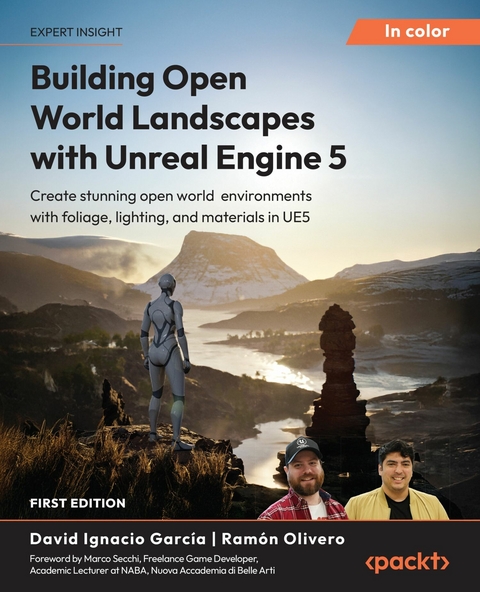
Building Open World Landscapes with Unreal Engine 5 (eBook)
446 Seiten
Packt Publishing (Verlag)
978-1-83508-136-5 (ISBN)
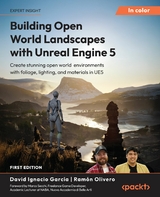
Creating expansive open worlds in Unreal Engine 5 (UE5) can be daunting, especially if you're just starting out. In this practical guide, the authors leverage their vast experience to break down the essential tools and workflows needed to design immersive environments with ease.
The book guides you step by step through sculpting landscapes, painting foliage, setting up lighting, and applying post-processing effects to elevate your outdoor scenes. The chapters will walk you through the UE5 interface and core tools such as Landscape Mode, Foliage Mode, and related features. You'll also sculpt terrain that evokes emotion in practical projects, design materials that bring surfaces to life, and create lush foliage to transform your landscapes into vibrant ecosystems. You'll explore level design techniques, world composition, and World Partition for seamless integration of large environments. You'll enhance visual fidelity with real-time lighting and post-processing techniques and gain the skills to optimize your creations for smooth performance.
By the end of this UE5 book, you'll have the confidence and technical foundation to create stylized and realistic outdoor environments and continue refining your UE5 skills.
*Email sign-up and proof of purchase required
Discover step-by-step workflows for creating immersive open world landscapes in Unreal Engine 5 using terrain sculpting, foliage painting, and post-processing with a professional finishFree with your book: DRM-free PDF version + access to Packt's next-gen Reader*Key FeaturesEnhance your digital artistry and design skills to craft breathtaking open worldsLearn terrain sculpting, foliage painting, and lighting to set the mood and realismOptimize basic scenes to ensure smooth performance in gameplayPurchase of the print or Kindle book includes a free PDF eBookBook DescriptionCreating expansive open worlds in Unreal Engine 5 (UE5) can be daunting, especially if you re just starting out. In this practical guide, the authors leverage their vast experience to break down the essential tools and workflows needed to design immersive environments with ease. The book guides you step by step through sculpting landscapes, painting foliage, setting up lighting, and applying post-processing effects to elevate your outdoor scenes. The chapters will walk you through the UE5 interface and core tools such as Landscape Mode, Foliage Mode, and related features. You ll also sculpt terrain that evokes emotion in practical projects, design materials that bring surfaces to life, and create lush foliage to transform your landscapes into vibrant ecosystems. You ll explore level design techniques, world composition, and World Partition for seamless integration of large environments. You ll enhance visual fidelity with real-time lighting and post-processing techniques and gain the skills to optimize your creations for smooth performance. By the end of this UE5 book, you ll have the confidence and technical foundation to create stylized and realistic outdoor environments and continue refining your UE5 skills. *Email sign-up and proof of purchase requiredWhat you will learnSet up UE5 projects with structured folders and naming conventionsManage levels, layers, and assets across your UE5 projectsBuild your terrain-sculpting skills to shape your virtual landscapeApply lighting to enhance mood and environmental realismUse textures and shaders to create detailed materialsUtilize Nanite for high-performance asset renderingAdd post-processing to unify mood and visual appealUse Blueprints to prototype tools and test scenesWho this book is forThis book is for aspiring environment artists, level designers, game development students, and hobbyists who want to learn how to build open world landscapes in Unreal Engine 5. It s ideal for beginners entering the Unreal ecosystem and seeking a structured, practical approach to landscape creation, foliage workflows, lighting, and post-processing. No prior Unreal Engine experience is required, though basic knowledge of 3D or game design concepts will help you follow along more easily.]]>
Preface
Creating natural and believable open worlds has always been one of the greatest challenges in game development. The vast scale, fine detail, and technical complexity they demand often make the process overwhelming for artists and designers alike. The goal of Building Open World Landscapes with Unreal Engine 5 is to make that journey approachable. It provides a structured and practical framework to help you understand how Unreal Engine 5 (UE5) equips you with the tools needed to design, build, and optimize large-scale environments with confidence and artistic intent.
Throughout the book’s chapters, we will explore every key stage of world creation from initial project setup and efficient asset management, through level organization and World Partition, to terrain sculpting, material creation, foliage workflows, lighting design, and performance optimization. Each topic connects seamlessly to the next, guiding you from core principles to advanced techniques for building production-quality environments.
This book follows a hands-on learning methodology: each concept is introduced through real-world examples and step-by-step exercises that reflect professional studio practices. The focus is not only on gaining expertise at using the tools, but also on understanding the reasoning behind each decision, helping you develop both technical proficiency and creative judgment.
By the end of this journey, you will have built your own optimized open world environment in UE5. More importantly, you will understand the complete workflow required to take an idea from early reference gathering and world planning to a visually rich, efficient, and scalable environment. Whether your goal is game development, cinematic production, or virtual production, this book will provide you with the insight and skills to transform your creative vision into a compelling world.
Who this book is for
If you want to use UE5 to create convincing open world environments, this book is for you. It’s a practical guide for aspiring level and game designers, environment and technical artists, indie developers, and educators or students who need a clear, production-ready workflow.
You’ll learn studio-relevant skills: sculpting terrains, building landscape materials, painting vegetation and foliage, setting up lighting, and optimizing large levels. Along the way, you’ll work with World Partition for streaming, tap into Quixel Megascans for high-quality assets, and apply profiling techniques to keep performance on target. The result is portfolio-ready worlds you can iterate on for gameplay, cinematics, or virtual production.
No prior expertise is required, only a basic familiarity with Unreal Engine and core 3D concepts. The book takes you step by step from first principles to confident execution, so you can ship environments that look great and run efficiently.
What this book covers
Chapter 1, Starting a Project in Unreal Engine, establishes the development environment and core terminology. It walks you through installing UE5, creating a new project from templates, and navigating the interface, viewports, and essential panels. By the end of the chapter, you will be able to configure basic project settings and understand the key tools needed to begin building environments.
Chapter 2, Quixel Bridge, Megascans, and Fab, maps the UE5 asset ecosystem and shows how to source and manage production-ready content. It introduces Fab as a unified marketplace, then demonstrates using Quixel Bridge inside the editor to browse, import, and organize Megascans assets, including surfaces, 3D models, and digital humans.
Chapter 3, Ingestion and Static Meshes, focuses on importing and validating static meshes for real-time use in UE5. It covers clean ingestion workflows, scale and orientation checks, common import issues, and optimization techniques, including Level of Detail (LODs), mesh simplification, and efficient UVs. The chapter also applies materials to meshes and demonstrates practical exercises that balance visual fidelity with performance.
Chapter 4, Project Structure and Naming Conventions, establishes a clear folder hierarchy and consistent naming to keep UE5 projects scalable and team-friendly. It references the Allar style guide as a practical baseline, then shows how to apply conventions to assets, actors, and code. The chapter also introduces version control options (Git, Perforce, Plastic, and SVN) and best practices for repositories, enabling reliable collaboration and safer iteration.
Chapter 5, Managing Levels and Layers, explains how UE5 organizes game worlds and why that structure matters for scale, collaboration, and performance. It introduces levels, lighting scenarios, and layers, then contrasts traditional level/sublevel hierarchies with World Partition, detailing streaming, region-based editing, and multi-user workflows.
Chapter 6, Building Your Landscape, moves from planning to hands-on environment creation in UE5. It introduces practical methods to translate ideas into a playable scene, covering project/template selection, early scene blocking, and validation techniques, then guides you through Landscape and Sculpt tools for shaping natural terrain.
Chapter 7, Populating Your World with Foliage, introduces UE5 tools for adding, managing, and optimizing plant life to shape mood, narrative, and atmosphere. It explains foliage terminology, demonstrates Foliage Mode for rapid painting and editing of large areas, and outlines procedural options for broad coverage. The chapter concludes with performance tips for density, LODs, culling, and instancing to keep rich scenes efficient at scale.
Chapter 8, Introduction to Materials, explains how surfaces respond to light and how to build physically based materials in UE5. It orients you to the Material Editor interface, common nodes, and texture inputs, then walks through Physically Based Rendering (PBR) workflows for creating consistent, reusable materials and material instances. The chapter also highlights practical tips for organization and performance when authoring shaders at scale.
Chapter 9, Create Your World’s Atmospheric Lighting, focuses on building believable, performant open world lighting in UE5. It introduces the Environment Light Mixer and key actors for physically grounded ambience, then explains Lumen, Virtual Shadow Maps, and Nanite considerations for quality and performance, including tuning exposure, shadows, and time-of-day for consistent results.
Chapter 10, Setting Up Your Post Process Volume, shows how to control a scene’s final look using global volumes. It covers setup and tuning of core effects: color grading and tonemapping, Bloom, and Depth of Field, plus blending, priorities for consistent art direction. The chapter closes with best practices for dynamic changes and performance in large open world levels.
Chapter 11, Understanding Programming Logic and Blueprints, introduces UE5’s visual scripting for building game and tool logic without writing code. It explains the node-based workflow, core concepts (variables, events, functions, and the Construction Script), and common Blueprint types. The chapter then walks through creating a Blueprint Class and shows how to prototype reusable tools that streamline environment creation and iteration.
Chapter 12, Optimizing and Testing Your Scene, reframes world-building with performance as a continuous design constraint. It explains the real-time rendering pipeline and shows how to profile scenes to locate bottlenecks, then applies best practices across meshes, materials, lighting, collisions, and LODs for open world scale.
To get the most out of this book
You should feel comfortable with basic 3D concepts such as meshes, UVs, textures, materials, and lighting, as well as with Unreal Engine’s navigation and interface. If you’ve already opened a project, moved the camera, and placed a few Actors in a scene, you’re ready to begin.
Recommended knowledge (helpful, but not required)
Some familiarity with asset management tools such as Fab or Quixel Bridge, project organization, and real-time performance concepts (LODs, draw calls, and culling) will help you follow along more easily. A basic understanding of Blueprints will also make the exercises more intuitive.
Additional skills that accelerate learning
Knowing how to use version control systems such as Git, Perforce, and Tortoise can make experimentation safer. Building and maintaining mood boards or visual reference folders helps define a consistent artistic direction. Understanding scale, proportion, and composition supports better design decisions in large environments, while a grasp of PBR materials and texture maps (Base Color, Normal, Roughness, Metallic, and Ambient Occlusion) ensures that surfaces react to light realistically.
Software/hardware...
| Erscheint lt. Verlag | 28.11.2025 |
|---|---|
| Vorwort | Marco Secchi |
| Sprache | englisch |
| Themenwelt | Mathematik / Informatik ► Informatik ► Grafik / Design |
| Informatik ► Software Entwicklung ► Spieleprogrammierung | |
| Informatik ► Software Entwicklung ► User Interfaces (HCI) | |
| ISBN-10 | 1-83508-136-3 / 1835081363 |
| ISBN-13 | 978-1-83508-136-5 / 9781835081365 |
| Informationen gemäß Produktsicherheitsverordnung (GPSR) | |
| Haben Sie eine Frage zum Produkt? |
 EPUB (Ohne DRM)
Digital Rights Management: ohne DRM
Dieses eBook enthält kein DRM oder Kopierschutz. Eine Weitergabe an Dritte ist jedoch rechtlich nicht zulässig, weil Sie beim Kauf nur die Rechte an der persönlichen Nutzung erwerben.
Dateiformat: EPUB (Electronic Publication)
EPUB ist ein offener Standard für eBooks und eignet sich besonders zur Darstellung von Belletristik und Sachbüchern. Der Fließtext wird dynamisch an die Display- und Schriftgröße angepasst. Auch für mobile Lesegeräte ist EPUB daher gut geeignet.
Systemvoraussetzungen:
PC/Mac: Mit einem PC oder Mac können Sie dieses eBook lesen. Sie benötigen dafür die kostenlose Software Adobe Digital Editions.
eReader: Dieses eBook kann mit (fast) allen eBook-Readern gelesen werden. Mit dem amazon-Kindle ist es aber nicht kompatibel.
Smartphone/Tablet: Egal ob Apple oder Android, dieses eBook können Sie lesen. Sie benötigen dafür eine kostenlose App.
Geräteliste und zusätzliche Hinweise
Buying eBooks from abroad
For tax law reasons we can sell eBooks just within Germany and Switzerland. Regrettably we cannot fulfill eBook-orders from other countries.
aus dem Bereich