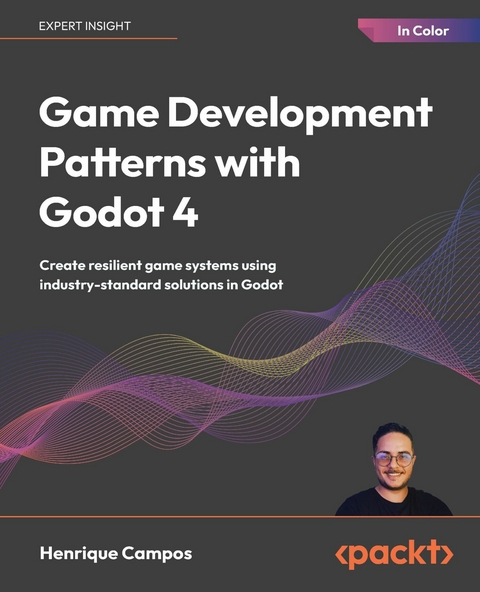
Game Development Patterns with Godot 4 (eBook)
304 Seiten
Packt Publishing (Verlag)
978-1-83588-029-6 (ISBN)
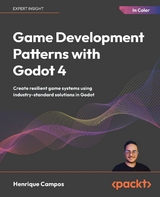
Game development demands more than just creativity; it requires code that's as dynamic and adaptable as the games you dream of creating. Seasoned Godot developer, educator and creator of popular resources like The Essential Guide to Creating Multiplayer Games with Godot 4.0, Henrique Campos introduces you to object-oriented programming design patterns, offering time-tested, reliable solutions to common coding issues. With these patterns, you'll not only build scalable, maintainable architectures for your games but also gain the confidence to tackle real-world development challenges head-on with Godot's built-in features.
In this hands-on guide, you'll step into the role of a game mechanics engineer tasked with implementing requests from a fictional game designer, simulating the collaborative nature of real-world game development. Using Godot 4.3, you'll develop a complete platformer game featuring a playable character, enemies with advanced AI, interactive objects, multiple levels, music, and more. Along the way, you'll master core programming concepts such as SOLID principles, favor composition over inheritance, and have a solid understanding of object-oriented programming along with the principles behind the design patterns.
By the end of the book, you'll be able to diagnose and fix pathologies in your code with ease.
Streamline game development with proven design patterns and create scalable, reliable architectures effortlesslyKey FeaturesSave time and avoid pitfalls in game development with proven design patternsLeverage the tools in the Godot editor to benefit from native implementations of design patterns such as the observer and singletonLearn SOLID principles and refactoring techniques to build scalable, reusable architectures for robust gamesPurchase of the print or Kindle book includes a free PDF eBookBook DescriptionGame development demands more than just creativity; it requires code that's as dynamic and adaptable as the games you dream of creating. Seasoned Godot developer, educator and creator of popular resources like The Essential Guide to Creating Multiplayer Games with Godot 4.0, Henrique Campos introduces you to object-oriented programming design patterns, offering time-tested, reliable solutions to common coding issues. With these patterns, you'll not only build scalable, maintainable architectures for your games but also gain the confidence to tackle real-world development challenges head-on with Godot's built-in features. In this hands-on guide, you ll step into the role of a game mechanics engineer tasked with implementing requests from a fictional game designer, simulating the collaborative nature of real-world game development. Using Godot 4.3, you ll develop a complete platformer game featuring a playable character, enemies with advanced AI, interactive objects, multiple levels, music, and more. Along the way, you ll master core programming concepts such as SOLID principles, favor composition over inheritance, and have a solid understanding of object-oriented programming along with the principles behind the design patterns. By the end of the book, you ll be able to diagnose and fix pathologies in your code with ease.What you will learnCreate reusable and scalable code that follows SOLID principlesIdentify common game development issues and apply industry-standard solutionsUnderstand feature requests and how to turn them into concrete solutions leveraging design patternsAnalyze game development pathologies to figure out underlying issuesArchitect reliable systems that are understandable, intuitive, and scalableStructure professional, collaborative game systems that are easy to maintainWho this book is forIf you are a game developer, game designer, technical artist, or solo developer with programming experience in Godot Engine and the GDScript programming language, this book is for you. Prior knowledge of programming concepts (e.g., functions, variables, algorithms) and an understanding of Godot's nodes and resources philosophy are essential to fully benefit from this book. Perfect for professionals looking to create solid, reusable, and reliable architecture that can adapt and grow with their creative vision.]]>
1
Understanding Object-Oriented Design
Let’s commence our journey by learning about what Object-Oriented Programming (OOP) is first because as we start implementing different patterns throughout the book, they will all approach the presented problems from an OOP perspective. For example, you will notice that the State pattern turns an object’s states into other objects. The Command pattern turns an object’s functions into objects. The Strategy pattern turns an object’s logic branching into objects. So, it’s important to understand what OOP is and why it is the main programming paradigm for developing games.
In this chapter, we will explore this paradigm from a unique standpoint that will help you understand it better and even approach programming and coding from a different perspective. We will approach it from the perspective of the philosophy of language. The reason for this is that as human beings, the way we solve problems is by structuring them using formal syntax to understand what each step of a proposed solution tries to achieve.
I am not going to teach the basics of programming as this would take a whole new book. Instead, we will understand how OOP helps us structure our thoughts.
In this chapter, we will cover the following topics:
- Learning the basics of OOP
- Complying with the principles of OOP
- Designing games with OOP
- Turning your design into an object in Godot Engine
Technical requirements
Throughout this book, we will use the projects presented in the official repository. Each chapter has its distinct folder named after the chapter. Inside the chapter’s folder, you will find two sub-folders:
- start/
- final/
To follow along with the chapter’s instructions, use the project files available inside the start folder. You can use the files presented in the final folder as a reference in case you feel lost or get errors or bugs through the process of following the instructions. You can download the repository files at https://github.com/PacktPublishing/Game-Development-Patterns-with-Godot-4.
For this book, you will also need, of course, Godot Engine version 4.3 and beyond, which you can find at https://godotengine.org/download/archive/4.3-stable/.
On top of that, it’s recommended that you have a computer with dedicated video drives due to Godot Engine’s Vulkan render. All the projects are under the Compatibility render option, so it’s not absolutely necessary that you have a dedicated GPU. You may follow along with any hardware that runs Godot Engine.
With that said, you have everything in place to get started with the amazing journey that will lead to having great tools in your game development toolkit, on top of knowledge about the best practices regarding game development architectures.
Learning the basics of OOP
When we talk about programming, we are trying to convey the idea of a structured formalization of a solution to a given problem. This is what an algorithm is, and to program is to be able to formalize such solutions in such a way that everyone can follow the steps and get the same result. In that sense, programming is almost a science. However, the philosophical aspect of this craft is that we work with how each individual approaches the problem. Drawing from their own knowledge and experiences, they implement a variety of solutions, all of which can achieve the same goal.
The computer comes in to automate the implementation of the solutions that we created. Computers are pretty standard when it comes to reasoning, so they are perfect for following instructions as they won’t pollute the solution with subjective matters and will be as accurate as the instructions allow. Note that we are going to avoid the engineering aspects of computing here. I don’t need you to understand computers, how they work, how electricity turns into bits, or any of these aspects. I want you to become an excellent problem solver who can look at a problem, think about a solution, and formalize it. Nonetheless, to code these solutions, you will need to write them in a language that the computer can understand, so keep that in mind. First, you must think about a solution from a human perspective, then translate it into code so the machine can understand and test it for you.
The main way to write your solution using a formalized programming language is to abstract everything as data and procedures that work with and change this data. In that sense, OOP is a paradigm that allows you to bundle these procedures and the data they work with into a single super data type that we call a class.
I want you to approach classes in the following way: they are how you describe how you would solve a given problem. They have the data that you think is necessary to approach the problem and how, mutating this data, you reach the solution. Mutation is just an OOP term for changing the value of a variable.
Once you have a class in place, you can test your solution. For that, we have objects that you can approach as instances of your solution that are put into different contexts. The fact is that each individual object is called an instance of a class, and to create a concrete instance of a class, you instantiate it.
When you create a class, you are establishing all the terms and conditions for how its data mutates. To that, we give the name of behavior, and for the data, properties. When objects are instantiated, they will always have the same behavior and properties, but the idea is that there will be different mutations depending on how they react to the context they were put into. This is how we put our solutions into context, test them against different scenarios to see how they will behave, and see whether we will get the results we desire.
Now, something interesting about OOP is that it allows us to reference these bundles of data and procedures in run time, which we can use to leverage previous solutions and focus on specific scenarios. For instance, one trademark of OOP is inheritance, whereby we can create a new class that extends the behavior and properties of a previous class. This allows you to create specialized solutions as opposed to generic ones.
More important than referencing a class is being able to reference objects. This allows us to make multiple solutions work together in some kind of assembly line where each one specializes in a very specific task and works together with other objects to solve complex problems.
You can think about objects as little robots that pass small and simple data between each other. In that sense, a program, application, or game is made of millions of robots working together with small, simple solutions to mutate data in specific ways and pass that data around. However, in the big picture, you have a complex emergent behavior that is what you would expect from your game. This is one thing to keep in mind when programming with OOP: it is always better to compose your application with many tiny solutions instead of big monolithic classes or deep hierarchies of inheritance. Just create numerous small, specialized robots and have them work together.
This ability to reference objects is especially useful when we start to abstract solutions into objects that other objects should use. It was through this approach that design patterns started to appear. To this relationship, we give the name of user class, or just user. It can also be described as when a given class uses another class in its behavior. For instance, the Mediator pattern is an object that specializes in turning one data structure into another. Two or more classes use them to mediate their data processing. It’s usually used when your architecture relies on third-party solutions.
To summarize, OOP is a programming paradigm that helps you abstract your solutions into bundles of properties and behaviors that mutate data in specific ways and then pass it around, ultimately creating emergent behaviors. This paradigm is useful because it helps you break problems down into small solutions and build up complex behaviors by making objects work together.
With the basics of OOP in mind, let’s move on with our journey. In the next section, we are going to talk about the fundamental principles of the OOP paradigm.
Complying with the principles of OOP
When it comes to OOP, things can get messy quickly. OOP is a powerful paradigm to work with that allows us to leverage our own code to increase productivity while developing software. As we will see throughout Part 1, especially in Chapter 2, working with OOP demands that we approach it with the correct mindset so we don’t get side-tracked and end up with code that is inferior to what we would achieve with other...
| Erscheint lt. Verlag | 10.1.2025 |
|---|---|
| Sprache | englisch |
| Themenwelt | Mathematik / Informatik ► Informatik ► Grafik / Design |
| Mathematik / Informatik ► Informatik ► Programmiersprachen / -werkzeuge | |
| Informatik ► Software Entwicklung ► Spieleprogrammierung | |
| ISBN-10 | 1-83588-029-0 / 1835880290 |
| ISBN-13 | 978-1-83588-029-6 / 9781835880296 |
| Informationen gemäß Produktsicherheitsverordnung (GPSR) | |
| Haben Sie eine Frage zum Produkt? |
 EPUB (Ohne DRM)
Digital Rights Management: ohne DRM
Dieses eBook enthält kein DRM oder Kopierschutz. Eine Weitergabe an Dritte ist jedoch rechtlich nicht zulässig, weil Sie beim Kauf nur die Rechte an der persönlichen Nutzung erwerben.
Dateiformat: EPUB (Electronic Publication)
EPUB ist ein offener Standard für eBooks und eignet sich besonders zur Darstellung von Belletristik und Sachbüchern. Der Fließtext wird dynamisch an die Display- und Schriftgröße angepasst. Auch für mobile Lesegeräte ist EPUB daher gut geeignet.
Systemvoraussetzungen:
PC/Mac: Mit einem PC oder Mac können Sie dieses eBook lesen. Sie benötigen dafür die kostenlose Software Adobe Digital Editions.
eReader: Dieses eBook kann mit (fast) allen eBook-Readern gelesen werden. Mit dem amazon-Kindle ist es aber nicht kompatibel.
Smartphone/Tablet: Egal ob Apple oder Android, dieses eBook können Sie lesen. Sie benötigen dafür eine kostenlose App.
Geräteliste und zusätzliche Hinweise
Buying eBooks from abroad
For tax law reasons we can sell eBooks just within Germany and Switzerland. Regrettably we cannot fulfill eBook-orders from other countries.
aus dem Bereich