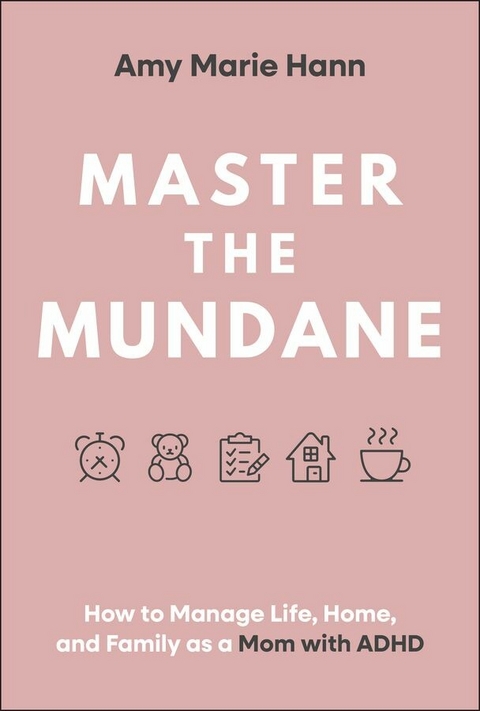
Master the Mundane (eBook)
277 Seiten
Jossey-Bass (Verlag)
978-1-394-30815-6 (ISBN)
Effective, realistic strategies for moms with ADHD to manage their homes and lives
With the tips and strategies offered in Master The Mundane, moms with ADHD can take control of their lives and make real changes for immediate impacts in their homes, both for themselves and if raising neurodivergent kids. This book shows readers how to understand the impact of ADHD on their lives, implement strategies for parenting and organization, manage their time effectively, and end the daily overwhelm, helping to make life less stressful, isolating, and difficult.
Written by Amy Marie Hann, a popular advocate in the ADHD community and a neurodivergent mother who practices what she preaches, this book explores topics including:
- How and why motherhood exacerbates ADHD symptoms
- Three types of women with ADHD: the unrealistic perfectionist, the passionate procrastinator, and the overthinker
- Practical strategies like chunking, simplifying, and body doubling to create lasting rhythms and routines
- Energy management tips and tricks to avoid burnout, even during busy days
- Essential aspects of raising children with ADHD and how to create an ADHD-friendly family culture
With a relatable, authentic voice that makes readers feel immediately heard and understood, Master The Mundane is your go-to resource for transforming chaos into calm and thriving as a mom with ADHD, no matter whether you're newly diagnosed or have been managing ADHD for years.
AMY MARIE HANN is the creator of Master the Mundane, where she coaches moms with ADHD on managing their homes and families. Through her community and resources she shares applicable, realistic tips and insights to help moms with ADHD thrive and feel hopeful and encouraged.
Effective, realistic strategies for moms with ADHD to manage their homes and lives With the tips and strategies offered in Master The Mundane, moms with ADHD can take control of their lives and make real changes for immediate impacts in their homes, both for themselves and if raising neurodivergent kids. This book shows readers how to understand the impact of ADHD on their lives, implement strategies for parenting and organization, manage their time effectively, and end the daily overwhelm, helping to make life less stressful, isolating, and difficult. Written by Amy Marie Hann, a popular advocate in the ADHD community and a neurodivergent mother who practices what she preaches, this book explores topics including: How and why motherhood exacerbates ADHD symptoms Three types of women with ADHD: the unrealistic perfectionist, the passionate procrastinator, and the overthinker Practical strategies like chunking, simplifying, and body doubling to create lasting rhythms and routines Energy management tips and tricks to avoid burnout, even during busy days Essential aspects of raising children with ADHD and how to create an ADHD-friendly family culture With a relatable, authentic voice that makes readers feel immediately heard and understood, Master The Mundane is your go-to resource for transforming chaos into calm and thriving as a mom with ADHD, no matter whether you're newly diagnosed or have been managing ADHD for years.
Introduction
Dear Reader,
Let's pretend that you are sitting right here with me at this random table at my hometown Starbucks, shall we?
I don't know about you, but I don't get enough of that in this season of life, and there is something deeply restorative about sitting face to face with someone who really gets me. And as a 40‐something mom with ADHD, raising three kids with ADHD, I don't get to do that with too many people on the regular.
My greatest hope in writing this book is that you'd walk away with that restorative, “I feel seen and understood” feeling.
Yes, I'm going to share lots of practical tips and insights because I know that you crave actionable steps to make your daily life a little easier, so trust me when I say that lots of those are coming.
But as I share my own self‐discovery journey, I hope to empower you to better understand your brain, your needs, and your desires for your life and family. I hope you go from “me too!” to “Wow, I never thought about it that way!”
And as I believe that every great conversation starts with the essential step of history‐giving, I'm going to start by sharing a little bit of my personal journal in learning to thrive in motherhood with ADHD.
You see, I'm a little bit of an ADHD unicorn in that I was diagnosed in kindergarten in the mid‐'80s with ADD (as it was then called). I consider myself extremely fortunate to have had the support of medicine most of my life, though my understanding of the implications was very limited. It's kind of a miracle that I was even diagnosed, but the science and understanding of things like behavior modification or emotional regulation just weren't around back then.
Throughout my school years, my understanding was that ADHD was a school/success problem and it didn't really impact other areas of my life. If I took my medicine, I did well in school, and that was addressed. And because I did well in school, I thought my ADHD was under control.
Looking back now, I can see how my ADHD impacted so many areas of my life—my self‐confidence, my emotions, and my relationships. I also believe that I did well in school because I liked school and was highly motivated by getting good grades. I know now that managing ADHD is a lot more involved.
In my early 20s, life got a lot more complicated, and my ADHD struggles became more transparent, but that core belief remained the same. I thought ADHD was a school and work focus problem. And though school hadn't been challenging for me, work was a different story.
My life felt like a constant roller coaster of taking on too much until I'd burn out and then believe that I was capable of less and take a boring, easy job below my capabilities. Once I got stir‐crazy from the tedium, I'd then take some new challenging, exciting position with very little life balance. And the up‐and‐down roller coaster continued.
I needed challenge and stimulation and was smart and capable, yet I couldn't figure out how to get the right amount of challenge without overextending myself.
After I got married, I began biding my time until I could be a stay‐at‐home mom. I basically assumed that the whole roller coaster problem would go away once I became a mom. I have always loved kids and been very energetic, so I assumed that motherhood would be where I'd really shine.
Flash‐forward five years to 30‐year‐old me as a stay‐at‐home mom of my first child and it took me only three months to realize just how wrong I'd been. I mistakenly thought that once I walked away from my corporate job, I'd have more energy for the monotonous home tasks like cleaning and organizing and exercise, but my struggles were only magnified by the lack of structure, routine, and solitude.
I had finally arrived at this season of life that I'd longed for and yet it was so much harder than I ever imagined. In fact, it was much harder than being a young professional or student. It was deeply discouraging and hard to share those struggles with others. I felt so much shame about my struggles, especially because I'd wanted to be a stay‐at‐home mom so badly and had given up any ambitions of a successful career.
I found that I truly didn't enjoy (and even hated) so many things about motherhood that I thought I'd love: planning class parties, volunteering for field trips, going to the playground—it all was so dull and yet also overstimulating.
Don't get me wrong; I was still doing all those boring things. If you asked someone in my life back then, they'd probably tell you that I was supermom. I was way overcompensating by overextending myself and trying to live up to the Pinterest‐perfect idea of motherhood in order to mask my internal struggles. I was still on the burnout roller coaster, taking on too much out of boredom, only to then get totally overwhelmed. I might have looked like I had it all together, but inwardly I was frustrated, restless, exhausted, and lonely. Behind closed doors I was coping with those feelings in unhealthy ways that left me feeling humiliated.
And as I had more kids, it all just got harder and more discouraging. Finally, I hit a massive wall after having my third child and starting perimenopause.
I was still on medicine. I was in therapy. I was exercising consistently. And yet I was floundering under the mental load of managing my daily life. I was trying so hard and yet I felt like I was drowning in dishes, cleaning, and laundry. And the massive amount of shame and insecurity didn't do anything for my self‐esteem or self‐confidence.
Meanwhile, all three of my kids (Bowman, Frank, and Libby) as well as my husband (Mark) were also diagnosed with ADHD, and we also have a fair bit of autism spectrum disorder in the mix to keep things interesting.
As I began to learn about ways to help them, I realized that though I'd been diagnosed with ADD as a child, there were so many implications that I hadn't unpacked. I realized that even though I knew I have ADHD, I'd spent most of my life trying to fit in with the world around me. When I couldn't, I just assumed that meant I was capable of less and lowered my bar or my goals.
I didn't realize that my ADHD has massive implications for every area of my life and that it was unrealistic to expect myself to follow the same instruction manual as my neurotypical mom friends raising neurotypical kids. Doing so was making me feel like a failure and adding to the overwhelm and discouragement.
It wasn't just managing the boring daily tasks of life like laundry, dishes, cleaning, and meals, though that was part of it.
It wasn't just managing my own mental health struggles and finding time for exercise and sleep while being a mom of young kids, though that was part of it.
It wasn't just learning how to accommodate the needs of multiple neurodivergent kids with big needs that often seemed to conflict, though that was part of it.
It wasn't just managing the ADHD roller coaster of taking on too much and then burning out, though that was part of it.
It wasn't just how to get myself and my kids the stimulation that we desperately need without me or them getting overstimulated, though that was part of it.
It wasn't just managing my time and my energy, though that was part of it.
It wasn't just learning to regulate my emotions so that I didn't become a rage monster daily with my kids, though that was part of it.
It wasn't just learning to make time for my big ideas and creative interests, though that was part of it.
It was all of it. How in the world could I create a life that addressed all these big needs without sinking in to complete despair?
It was all of it. How in the world could I create a life that addressed all these big needs without sinking in to complete despair?
I was already diagnosed with ADHD. I was already on ADHD medicine. I had read so many books on ADHD and been in therapy for years. And yet I was still massively struggling.
And since no one was talking about all these things and there was no instruction manual to follow, I realized I would have to create my own. I began to read every resource that I could get my hands on and gave myself permission to think outside the box around how I manage my home, my time, my energy, and my family in relation to what I was learning about my brain.
I began to take seriously my need for stimulation and challenge and gave myself permission for my days to look different than those of the women around me.
I began to own my challenges and to find work‐arounds for me and my family so that my ADHD wouldn't be an excuse or a hindrance to having a happy, healthy, thriving family life.
I began to prioritize self‐care and the big needs of my children and let go of many of the “shoulds” that plagued me for so many years.
I began to believe that my creative brain has value to bring to the world and to confidently own my big goals and big ideas and take steps to bring them to life.
I began to own my ADHD quirks and stopped wasting my energy trying to fit into a mold that had never worked for me.
I began to slowly mourn the visions I had for motherhood and began to embrace and even (gasp!) love the family life that my husband and I...
| Erscheint lt. Verlag | 5.9.2025 |
|---|---|
| Sprache | englisch |
| Themenwelt | Geisteswissenschaften ► Religion / Theologie ► Christentum |
| Schlagworte | adhd advice • adhd burnout • adhd children • adhd families • adhd lifestyle • adhd management • adhd mental • adhd parenting • ADHD time management • adhd women • neurodivergent children • neurodivergent families • neurodivergent parenting |
| ISBN-10 | 1-394-30815-9 / 1394308159 |
| ISBN-13 | 978-1-394-30815-6 / 9781394308156 |
| Informationen gemäß Produktsicherheitsverordnung (GPSR) | |
| Haben Sie eine Frage zum Produkt? |
 EPUB (Adobe DRM)
Kopierschutz: Adobe-DRM
Adobe-DRM ist ein Kopierschutz, der das eBook vor Mißbrauch schützen soll. Dabei wird das eBook bereits beim Download auf Ihre persönliche Adobe-ID autorisiert. Lesen können Sie das eBook dann nur auf den Geräten, welche ebenfalls auf Ihre Adobe-ID registriert sind.
Details zum Adobe-DRM
Dateiformat: EPUB (Electronic Publication)
EPUB ist ein offener Standard für eBooks und eignet sich besonders zur Darstellung von Belletristik und Sachbüchern. Der Fließtext wird dynamisch an die Display- und Schriftgröße angepasst. Auch für mobile Lesegeräte ist EPUB daher gut geeignet.
Systemvoraussetzungen:
PC/Mac: Mit einem PC oder Mac können Sie dieses eBook lesen. Sie benötigen eine
eReader: Dieses eBook kann mit (fast) allen eBook-Readern gelesen werden. Mit dem amazon-Kindle ist es aber nicht kompatibel.
Smartphone/Tablet: Egal ob Apple oder Android, dieses eBook können Sie lesen. Sie benötigen eine
Geräteliste und zusätzliche Hinweise
Buying eBooks from abroad
For tax law reasons we can sell eBooks just within Germany and Switzerland. Regrettably we cannot fulfill eBook-orders from other countries.
aus dem Bereich