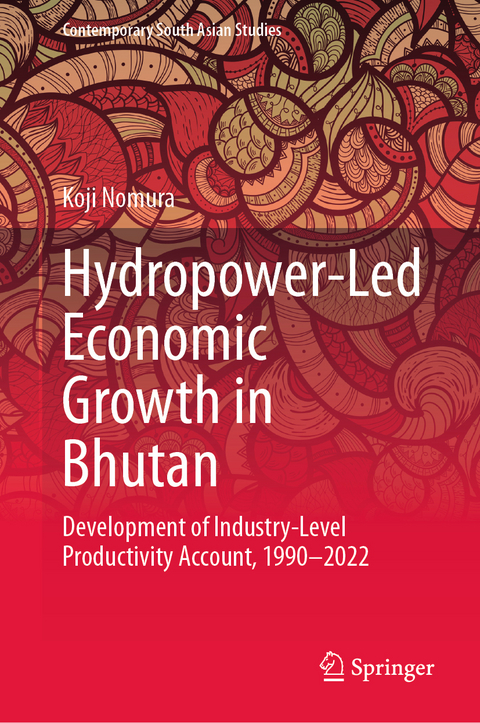
Hydropower-Led Economic Growth in Bhutan
Springer Nature Switzerland AG (Verlag)
978-981-96-5149-8 (ISBN)
- Titel nicht im Sortiment
- Artikel merken
Koji Nomura is a Professor and Director at the Keio Economic Observatory, Keio University, Tokyo. Nomura received a BA in 1993, an MA in 1995, and a Ph.D. in 2005 from Keio University. He has previously served as an assistant professor (1996–2003) and associate professor (2003–2017) at Keio University; a CBG fellow at the JFK School of Government, Harvard University (2003–2005); an economist at the OECD (2006–2007); a faculty fellow at the Research Institute of Economy, Trade, and Industry (2013–2019); a consultant for the United Nations Department of Economic and Social Affairs (2015–2016); and chief research officer at The 21st Century Public Policy Institute, Keidanren (2019–2020). He is currently a visiting fellow at the Economic Social Research Institute, Cabinet Office, Government of Japan (2005–2008 and 2012–present); a project manager for the APO Productivity Database at the Asian Productivity Organization (2007–present); a visiting senior fellow at the Research Institute of Capital Formation, Development Bank of Japan (2009–present); and a consultant for the United Nations Economic and Social Commission for Asia and the Pacific (2024–present). His research focuses on economic measurement, productivity analysis, and energy economics. He is the author of Measurement of Capital and Productivity in Japan (in Japanese, Keio University Press, 2004), APO Productivity Databook (Asian Productivity Organization, annual publication from 2008 to 2024), Energy Productivity in Japan’s Economic Growth: Exploring Possibilities for Balancing Economy and Environment (in Japanese, Keio University Press, 2021), and Energy Productivity and Economic Growth: Experiences of the Japanese Industries, 1955–2019 (Springer, 2023).
Bhutan’s Hydropower-Led Economic Growth.- Bhutan’s Aggregate Output: A Review.- Reevaluating Industry Origins of Bhutan’s Economic Growth.- Labor Input and Quality Evolution in Bhutan.- Measuring Capital Accumulation in Bhutan.- Bhutan’s Productivity Stagnation: Hydropower and Beyond.
| Erscheinungsdatum | 07.06.2025 |
|---|---|
| Reihe/Serie | Contemporary South Asian Studies |
| Zusatzinfo | 108 Illustrations, color; 5 Illustrations, black and white |
| Verlagsort | Cham |
| Sprache | englisch |
| Maße | 155 x 235 mm |
| Themenwelt | Geschichte ► Teilgebiete der Geschichte ► Wirtschaftsgeschichte |
| Technik ► Elektrotechnik / Energietechnik | |
| Wirtschaft ► Volkswirtschaftslehre ► Makroökonomie | |
| Schlagworte | Bhutan economic growth and productivity analysis • Capital accumulation in Bhutan's hydropower sector • Diversification beyond hydropower in Bhutan • Economic competitiveness of Bhutan vs India • Economic transition in Bhutan post-democratization • Hydropower development impact on Bhutan's economic growth • Industry-level productivity measurement in Bhutan • Labor and capital productivity in Bhutan and South Asia • Long-term sustainability of hydropower-led growth • Productivity challenges in Bhutan's non-electricity sectors • Quality-adjusted labor input measurement in Bhutan • Total factor productivity in Bhutan and South Asia |
| ISBN-10 | 981-96-5149-2 / 9819651492 |
| ISBN-13 | 978-981-96-5149-8 / 9789819651498 |
| Zustand | Neuware |
| Informationen gemäß Produktsicherheitsverordnung (GPSR) | |
| Haben Sie eine Frage zum Produkt? |
aus dem Bereich