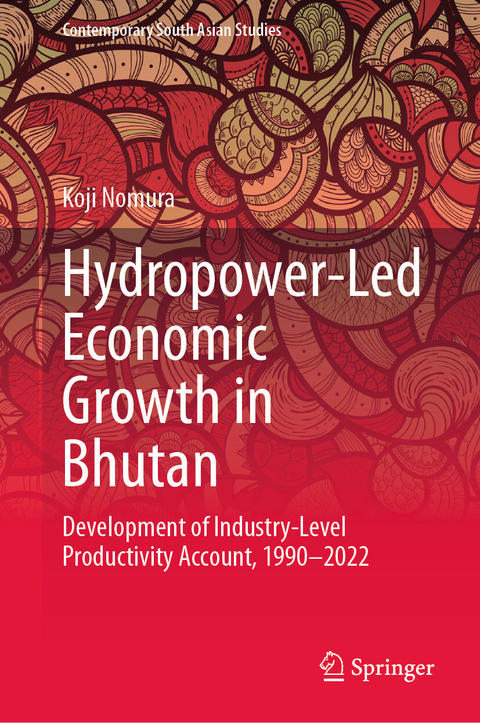
Hydropower-Led Economic Growth in Bhutan (eBook)
237 Seiten
Springer Nature Singapore (Verlag)
978-981-96-5150-4 (ISBN)
This book provides a comprehensive analysis of Bhutan’s economic growth and productivity dynamics from 1990 to 2022, with a special focus on hydropower development. Through the construction of detailed industry-level productivity accounts, the study addresses significant data gaps in Bhutan’s national accounts, measuring outputs and inputs across various sectors and developing quality-adjusted labor and capital input series. The analysis reveals the complexities of Bhutan’s hydropower-led growth strategy: while the sector has driven substantial economic growth, its contribution to overall productivity improvement has been limited. The electricity sector shows gains in labor productivity but declining capital productivity, resulting in stagnant Total Factor Productivity (TFP). The study also examines productivity trends in non-electricity sectors and addresses potential “Dutch disease” effects on manufacturing and agricultural competitiveness. International comparisons place Bhutan’s productivity performance in a regional context, revealing significant gaps in productivity performance, particularly when compared to India, Bhutan’s largest trading partner and a regional economic benchmark. This comparative analysis informs policy recommendations for achieving more balanced and sustainable economic growth. The findings are particularly relevant for Bhutan’s Thirteenth Five-Year Plan (2024–2029), which emphasizes productivity improvements across all economic sectors. The book serves as a valuable resource for policymakers, economists, and researchers interested in development economics, particularly those focused on the unique challenges faced by small, landlocked nations pursuing sustainable economic development.
This book provides a comprehensive analysis of Bhutan’s economic growth and productivity dynamics from 1990 to 2022, with a special focus on hydropower development. Through the construction of detailed industry-level productivity accounts, the study addresses significant data gaps in Bhutan’s national accounts, measuring outputs and inputs across various sectors and developing quality-adjusted labor and capital input series. The analysis reveals the complexities of Bhutan’s hydropower-led growth strategy: while the sector has driven substantial economic growth, its contribution to overall productivity improvement has been limited. The electricity sector shows gains in labor productivity but declining capital productivity, resulting in stagnant Total Factor Productivity (TFP). The study also examines productivity trends in non-electricity sectors and addresses potential “Dutch disease” effects on manufacturing and agricultural competitiveness. International comparisons place Bhutan’s productivity performance in a regional context, revealing significant gaps in productivity performance, particularly when compared to India, Bhutan’s largest trading partner and a regional economic benchmark. This comparative analysis informs policy recommendations for achieving more balanced and sustainable economic growth. The findings are particularly relevant for Bhutan’s Thirteenth Five-Year Plan (2024–2029), which emphasizes productivity improvements across all economic sectors. The book serves as a valuable resource for policymakers, economists, and researchers interested in development economics, particularly those focused on the unique challenges faced by small, landlocked nations pursuing sustainable economic development.
| Erscheint lt. Verlag | 28.5.2025 |
|---|---|
| Reihe/Serie | Contemporary South Asian Studies |
| Zusatzinfo | XXII, 237 p. 113 illus., 108 illus. in color. |
| Sprache | englisch |
| Themenwelt | Geschichte ► Teilgebiete der Geschichte ► Wirtschaftsgeschichte |
| Technik ► Elektrotechnik / Energietechnik | |
| Wirtschaft ► Betriebswirtschaft / Management ► Unternehmensführung / Management | |
| Wirtschaft ► Volkswirtschaftslehre ► Makroökonomie | |
| Schlagworte | Bhutan economic growth and productivity analysis • Capital accumulation in Bhutan's hydropower sector • Diversification beyond hydropower in Bhutan • Economic competitiveness of Bhutan vs India • Economic transition in Bhutan post-democratization • Hydropower development impact on Bhutan's economic growth • Industry-level productivity measurement in Bhutan • Labor and capital productivity in Bhutan and South Asia • Long-term sustainability of hydropower-led growth • Productivity challenges in Bhutan's non-electricity sectors • Quality-adjusted labor input measurement in Bhutan • Total factor productivity in Bhutan and South Asia |
| ISBN-10 | 981-96-5150-6 / 9819651506 |
| ISBN-13 | 978-981-96-5150-4 / 9789819651504 |
| Informationen gemäß Produktsicherheitsverordnung (GPSR) | |
| Haben Sie eine Frage zum Produkt? |
 PDF (Wasserzeichen)
DRM: Digitales Wasserzeichen
Dieses eBook enthält ein digitales Wasserzeichen und ist damit für Sie personalisiert. Bei einer missbräuchlichen Weitergabe des eBooks an Dritte ist eine Rückverfolgung an die Quelle möglich.
Dateiformat: PDF (Portable Document Format)
Mit einem festen Seitenlayout eignet sich die PDF besonders für Fachbücher mit Spalten, Tabellen und Abbildungen. Eine PDF kann auf fast allen Geräten angezeigt werden, ist aber für kleine Displays (Smartphone, eReader) nur eingeschränkt geeignet.
Systemvoraussetzungen:
PC/Mac: Mit einem PC oder Mac können Sie dieses eBook lesen. Sie benötigen dafür einen PDF-Viewer - z.B. den Adobe Reader oder Adobe Digital Editions.
eReader: Dieses eBook kann mit (fast) allen eBook-Readern gelesen werden. Mit dem amazon-Kindle ist es aber nicht kompatibel.
Smartphone/Tablet: Egal ob Apple oder Android, dieses eBook können Sie lesen. Sie benötigen dafür einen PDF-Viewer - z.B. die kostenlose Adobe Digital Editions-App.
Buying eBooks from abroad
For tax law reasons we can sell eBooks just within Germany and Switzerland. Regrettably we cannot fulfill eBook-orders from other countries.
aus dem Bereich