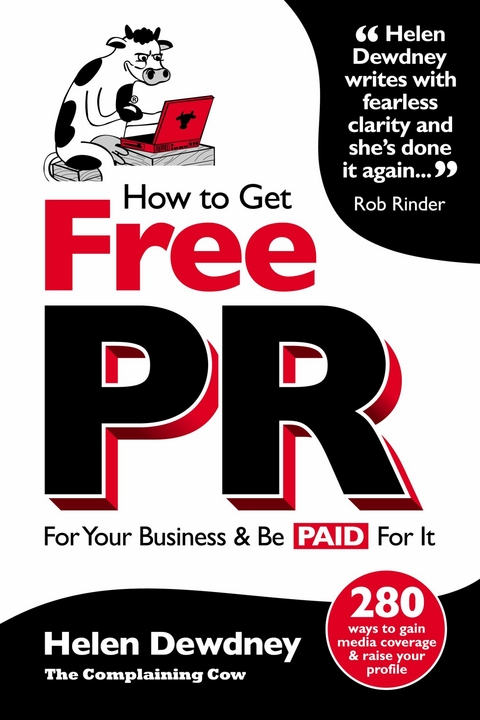
How to Get Free PR For Your Business & Be PAID For It (eBook)
355 Seiten
M-Y Books (Verlag)
978-1-917311-41-0 (ISBN)
Public Relations (PR) coverage is a key tool in demonstrating your expertise, products and services. Cheaper and more effective than paid advertising, being in the media gives you credibility. A key element of your marketing strategy, PR helps people to know, like, trust and buy from you.
Whilst you can pay a PR consultant for their skills, knowledge, expertise and contact list, you can go from no PR coverage to being paid for it by doing the work yourself.
Helen started The Complaining Cow blog in 2012 as a hobby. Since then she has developed it into a business. With two best-selling consumer advice books under her belt, she is now a well-established and trusted Consumer Champion, who also advises businesses on improving customer service to increase sales. She has appeared in/on about 200 media outlets, many of them regularly, with countless case studies and contributions, plus writing specially-commissioned pieces.
Here she shows how you can do it.
A comprehensive guide packed full of ideas, it includes many examples from Helen and others, who have used these ideas to boost their PR coverage. It will help you grow your own contact list, approach television, radio and newspaper outlets and leverage your coverage. Armed with this knowledge you can become the 'go-to' media expert in your chosen subject area, with regular paid-for appearances.
Chapter 2: Prepare for your coverage
It is normal to get excited or worried and to doubt yourself but work through it!
My blog had been going for less than six months when I got my first media request, an email asking me to appear on a phone-in on BBC Radio 5 late at night, for The Phil Williams Show. I was overwhelmed. Although I thought one man and his dog might be listening at the time, it was BBC Radio 5 and it was live! And it was paid! Luckily I happened to be seeing my friend Sue that day for lunch. She calmed me down and reassured me that I could do it! Another old boss said simply “Talk slowly”. This is great advice, although I’m not sure I always follow it but I remember it stuck with me for that first appearance! Why? Talking slowly helps to keep you calm.
92: Decide on your title
Decide how you would prefer to be described/introduced in your interview or quote. It won’t always go in as you would like. Even after years of saying “Consumer Champion” I recently sent a press release with a comment and was still described in a national newspaper as being from a “Complaints Firm”! Be consistent with your brand, too, so that studio staff will describe you as you want to be known. Your name and title will be displayed as an ‘Aston’ or ‘name strap’ across the lower section of the TV screen.
93: Call yourself an expert!
I used to hate this! When asked if I wanted to be described as a consumer expert, I always said “no”. It always sounded like a touch of arrogance! But, as I added more strings to my bow and became a consumer champion, author, journalist, blogger, speaker and business consultant, it became more difficult to know what title to use.
I want both consumers and businesses to look me up, as I help both. And really “consumer expert” was the only phrase that covered it, and I became more comfortable using that.
There is a commonly held belief that an expert is someone who knows more about a subject than everyone else in an average room. I think this is true and has helped a lot of people come to terms with using the word “expert”.
94: Key points
Time goes VERY QUICKLY! Much more quickly than you think and sometimes the interviewer will talk for longer than is helpful. So, think about which points you most want to get across but be very careful not to over prepare or you may appear stilted.
95: Get everything in writing!
When you are booked, ensure that everything is in writing. For a television appearance, most often you’ll get a phone call, so be sure to follow up in writing. Get everything about payment clarified. Travel and, if appropriate, accommodation, is usually arranged and paid for beforehand. Discuss and agree any payments for expenses, etc. If anything gets cancelled, you won’t be out of pocket.
96: Practice on Zoom
If you’re nervous, start a Zoom call with just you and record yourself. You can watch it back to check the lighting, how your outfit looks and decide if you want to change anything. Don’t be too critical, you will be your harshest critic.
97: Back up plans!
Give your contact more than one telephone number and be ready to use your mobile phone hotspot if your main home/office wi-fi fails. Even consider having back up clothes in case you spill something! It is unlikely that things will go wrong but having back up plans will calm any nerves, increase your confidence and make your performance all the better.
98: Announce on social media
If you will be appearing on radio or television, announce on social media the name, date, time and channel of the programme. Retweet/share anything if you have been mentioned in a post.
Keep 112: Don’t worry about cancellations! in mind. I’ve never heard anyone say to me “I thought you were going to be on…” And, if they do, it is easily answered, without losing face!
99: Share your preparation
You want your audience to tune into your performance, as well as getting the message out that you are in the media. So tell them! If you are preparing something, talk about it or say that you are looking forward to talking to “x” and “y” at “z” time. Keep an eye out on X (formerly Twitter) for mentions of you, too, as often outlets say what guests they have coming on and will tag you and you should like and share those posts!
Build some mystery and take shots of the studio for a great reveal.
On social media, say that you are looking forward to being on the show at a given time, so viewers/listeners can see you will be in the media. But be aware that plans change and you could be dropped at any time! See 112: Don’t worry about cancellations!
100: Do a quick live or record a quick video
If you are able and it is possible (i.e. you won’t be disturbing anyone), do a quick live on Facebook or a reel for Instagram. Video often gets more engagement than a still photo and if you also send a picture later you’ll be using various formats at different times, reaching different audiences. Talk about what you are going to be covering, as this helps show off your knowledge and expertise, too!
101: Prepare appropriately
For most television and radio appearances you will have a conversation with the producer or presenter prior to the interview. You should expect to be thrown curveballs! It is highly likely that a producer or researcher may tell you about questions that you will be asked and the interviewer/presenter(s) won’t ask them! Don’t worry about it, that’s normal. If you know your stuff, it won’t be a problem!
Some outlets are much better than others at preparing guests.
Paul Lewis at MoneyBox on BBC Radio 4 is the ultimate professional here. He takes a lot of time preparing with guests how the programme will go, the questions he would like to ask and discusses your answers, so that you are happy. The result is you go in thoroughly confident about how the programme will run and give a good performance, so it is a very sensible approach!
Make some notes and practice, so that you can safely go off-piste and still be natural.
If you are on the radio, take a few notes in the lead up to your segment. You can use them as nudges/reference points and even read from them if it answers a specific question and you can make it sound natural!
See 98: Key points and 108: But don’t over prepare!
102: Be rested
If you have enough warning, get to bed early and save the alcohol to celebrate afterwards! You want to look and sound your best!
103: Think about what clothes you will wear!
If you wear a dress, that microphone cable has to go up your dress to your neckline and the microphone clip fixed somewhere!
Wear something in which you are comfortable and which fits well. It doesn’t matter how fantastic you look in a top if you are constantly readjusting it. Lindsay Edwards, a personal stylist, advises:
“If you plan to wear a new outfit for the first time, have a trial run first by sitting down in it at home, ideally in front of a mirror. You might notice that the outfit stretches or gapes in unexpected ways the moment you become seated. You don’t want to make that potentially embarrassing discovery whilst on TV!”
Lindsay adds this tip, about necklines “High necklines, such as turtlenecks, can look great in reality. But on screen, the proportions can become lost, creating the illusion that your head is floating in mid-air!”
Finally, she recommends not to wear any clothing which constricts, pinches or feels itchy, no matter how fabulous you might look in it. “You simply cannot focus or express yourself with confidence if you’re feeling uncomfortable. Take the time to find an outfit which you look and feel great in, you won’t regret it.”
If you want to really be safe, take a clothes brush with you to remove any hair you pick up, etc!
104: Think of colours you will wear
Think about the environment. For example, if you are going to be on the red sofa for BBC Breakfast, don’t wear red!
Don’t wear prints with close lines or spots, as these can sometimes cause a shimmering effect on screen. That includes ties. Annoyingly, a herringbone pattern is a ‘no-no’, too.
Avoid wearing black or white. The television cameras set their lighting range on the brightest and darkest objects in the room, so your face may be underlit or overlit but if you get good make-up you’ll probably be OK!
105: Think about jewellery
A necklace is a great way to add interest to your portrait area, just ensure you get the length right. Lindsay says that the ideal necklace length to wear is 16-20 inches.
“Any longer and it will draw the audience’s eyes downwards and is likely to be partially cut out of the frame.”
However, think about how close the necklace is to the top of your outfit. The microphone is going to go here for TV and it may knock. Also, allow for any jewellery moving around! I am still learning this and if you ever see me without a necklace it’s because the sound person made me take it off!
Big dangly earrings can be an off-putting distraction for viewers.
When in a radio studio, if you talk with your hands,...
| Erscheint lt. Verlag | 19.11.2025 |
|---|---|
| Sprache | englisch |
| Themenwelt | Sachbuch/Ratgeber ► Freizeit / Hobby ► Sammeln / Sammlerkataloge |
| Wirtschaft | |
| Schlagworte | getting free press • getting free public relations • Pr services |
| ISBN-10 | 1-917311-41-9 / 1917311419 |
| ISBN-13 | 978-1-917311-41-0 / 9781917311410 |
| Informationen gemäß Produktsicherheitsverordnung (GPSR) | |
| Haben Sie eine Frage zum Produkt? |
 EPUB (Ohne DRM)
Digital Rights Management: ohne DRM
Dieses eBook enthält kein DRM oder Kopierschutz. Eine Weitergabe an Dritte ist jedoch rechtlich nicht zulässig, weil Sie beim Kauf nur die Rechte an der persönlichen Nutzung erwerben.
Dateiformat: EPUB (Electronic Publication)
EPUB ist ein offener Standard für eBooks und eignet sich besonders zur Darstellung von Belletristik und Sachbüchern. Der Fließtext wird dynamisch an die Display- und Schriftgröße angepasst. Auch für mobile Lesegeräte ist EPUB daher gut geeignet.
Systemvoraussetzungen:
PC/Mac: Mit einem PC oder Mac können Sie dieses eBook lesen. Sie benötigen dafür die kostenlose Software Adobe Digital Editions.
eReader: Dieses eBook kann mit (fast) allen eBook-Readern gelesen werden. Mit dem amazon-Kindle ist es aber nicht kompatibel.
Smartphone/Tablet: Egal ob Apple oder Android, dieses eBook können Sie lesen. Sie benötigen dafür eine kostenlose App.
Geräteliste und zusätzliche Hinweise
Buying eBooks from abroad
For tax law reasons we can sell eBooks just within Germany and Switzerland. Regrettably we cannot fulfill eBook-orders from other countries.
aus dem Bereich