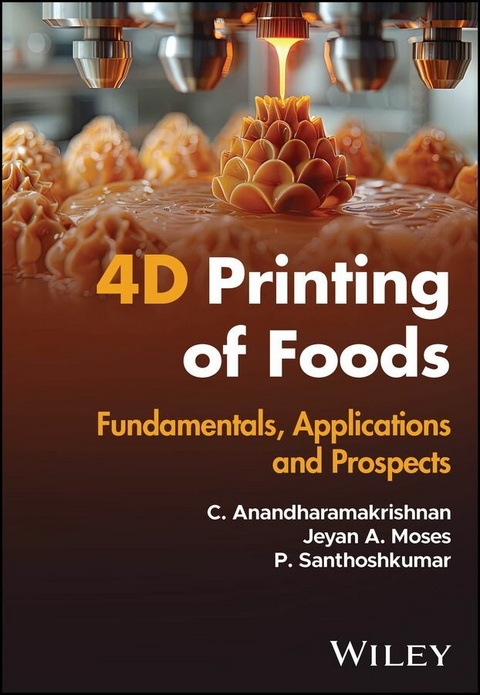
4D Printing of Foods (eBook)
335 Seiten
Wiley (Verlag)
978-1-394-30531-5 (ISBN)
An up-to-date and authoritative discussion of 4D food printing and its applications
In 4D Printing of Foods: Fundamentals, Applications and Prospects, a team of distinguished researchers deliver a comprehensive discussion of the fundamentals of food printing approaches, introducing the concept of 4D printing. The book highlights 4D printing's application to the food industry and explains the principles and methodologies involved.
Readers will explore stimulus and material design, modeling and simulation. The authors introduce the global knowledge-base in 4D printing technology and application sectors, and then elaborate on stimulus responsiveness of food, highlighting the scope and approaches to transformations in shape, color, nutritive value, texture, flavor, aroma and cell growth. Key highlights include:
- A thorough introduction to physical, chemical and biological stimuli
- Practical discussions of 4D printing technology, including bibliometric analyses of the state-of-the-art
- Case studies on consumer preferences for food printing technologies
- Prospective applications in 4D, 5D, 6D and 7D printing technologies
Perfect for food engineers, 4D Printing of Foods will also benefit other professionals working in biomaterials, sensory science, gastronomy, and digitalized food manufacturing.
C. Anandharamakrishnan, PhD, is Director, CSIR - National Institute for Interdisciplinary Science and Technology (NIIST), India.
Jeyan A. Moses, PhD, is an Assistant Professor at the National Institute of Food Technology, Entrepreneurship and Management - Thanjavur (NIFTEM -T), India.
P. Santhoshkumar is a PhD researcher at the University of Foggia, Italy.
An up-to-date and authoritative discussion of 4D food printing and its applications In 4D Printing of Foods: Fundamentals, Applications and Prospects, a team of distinguished researchers deliver a comprehensive discussion of the fundamentals of food printing approaches, introducing the concept of 4D printing. The book highlights 4D printing s application to the food industry and explains the principles and methodologies involved. Readers will explore stimulus and material design, modeling and simulation. The authors introduce the global knowledge-base in 4D printing technology and application sectors, and then elaborate on stimulus responsiveness of food, highlighting the scope and approaches to transformations in shape, color, nutritive value, texture, flavor, aroma and cell growth. Key highlights include: A thorough introduction to physical, chemical and biological stimuli Practical discussions of 4D printing technology, including bibliometric analyses of the state-of-the-art Case studies on consumer preferences for food printing technologies Prospective applications in 4D, 5D, 6D and 7D printing technologies Perfect for food engineers, 4D Printing of Foods will also benefit other professionals working in biomaterials, sensory science, gastronomy, and digitalized food manufacturing.
| Erscheint lt. Verlag | 10.11.2025 |
|---|---|
| Sprache | englisch |
| Themenwelt | Naturwissenschaften ► Biologie |
| Wirtschaft ► Betriebswirtschaft / Management | |
| Weitere Fachgebiete ► Land- / Forstwirtschaft / Fischerei | |
| Schlagworte | 3D food printing • 4D printed foods • 4D printing applications • 4D printing book • 4D printing technology • 5D Printing • 6D printing • 7D printing • Bioprinting • color transformation • dynamic customization • food printer configuration • Intelligent Materials • shape transformation • Smart Materials • stimulus responsiveness |
| ISBN-10 | 1-394-30531-1 / 1394305311 |
| ISBN-13 | 978-1-394-30531-5 / 9781394305315 |
| Informationen gemäß Produktsicherheitsverordnung (GPSR) | |
| Haben Sie eine Frage zum Produkt? |
 PDF (Adobe DRM)
Kopierschutz: Adobe-DRM
Adobe-DRM ist ein Kopierschutz, der das eBook vor Mißbrauch schützen soll. Dabei wird das eBook bereits beim Download auf Ihre persönliche Adobe-ID autorisiert. Lesen können Sie das eBook dann nur auf den Geräten, welche ebenfalls auf Ihre Adobe-ID registriert sind.
Details zum Adobe-DRM
Dateiformat: PDF (Portable Document Format)
Mit einem festen Seitenlayout eignet sich die PDF besonders für Fachbücher mit Spalten, Tabellen und Abbildungen. Eine PDF kann auf fast allen Geräten angezeigt werden, ist aber für kleine Displays (Smartphone, eReader) nur eingeschränkt geeignet.
Systemvoraussetzungen:
PC/Mac: Mit einem PC oder Mac können Sie dieses eBook lesen. Sie benötigen eine
eReader: Dieses eBook kann mit (fast) allen eBook-Readern gelesen werden. Mit dem amazon-Kindle ist es aber nicht kompatibel.
Smartphone/Tablet: Egal ob Apple oder Android, dieses eBook können Sie lesen. Sie benötigen eine
Geräteliste und zusätzliche Hinweise
Buying eBooks from abroad
For tax law reasons we can sell eBooks just within Germany and Switzerland. Regrettably we cannot fulfill eBook-orders from other countries.
aus dem Bereich