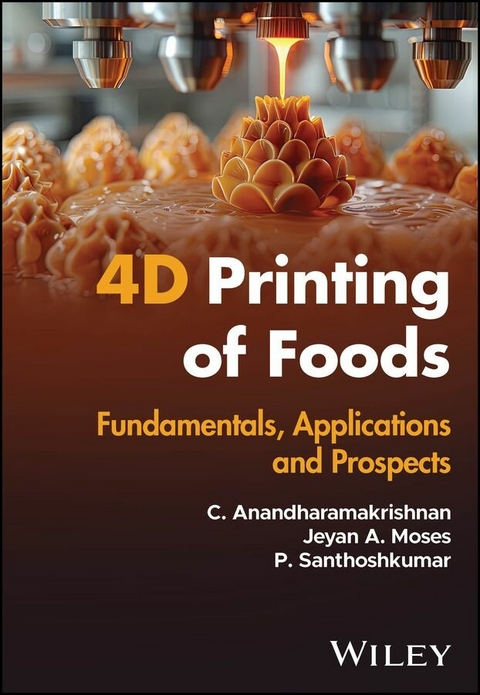
4D Printing of Foods (eBook)
596 Seiten
Wiley (Verlag)
978-1-394-30525-4 (ISBN)

An up-to-date and authoritative discussion of 4D food printing and its applications
In 4D Printing of Foods: Fundamentals, Applications and Prospects, a team of distinguished researchers deliver a comprehensive discussion of the fundamentals of food printing approaches, introducing the concept of 4D printing. The book highlights 4D printing's application to the food industry and explains the principles and methodologies involved.
Readers will explore stimulus and material design, modeling and simulation. The authors introduce the global knowledge-base in 4D printing technology and application sectors, and then elaborate on stimulus responsiveness of food, highlighting the scope and approaches to transformations in shape, color, nutritive value, texture, flavor, aroma and cell growth. Key highlights include:
- A thorough introduction to physical, chemical and biological stimuli
- Practical discussions of 4D printing technology, including bibliometric analyses of the state-of-the-art
- Case studies on consumer preferences for food printing technologies
- Prospective applications in 4D, 5D, 6D and 7D printing technologies
Perfect for food engineers, 4D Printing of Foods will also benefit other professionals working in biomaterials, sensory science, gastronomy, and digitalized food manufacturing.
C. Anandharamakrishnan, PhD, is Director, CSIR - National Institute for Interdisciplinary Science and Technology (NIIST), India.
Jeyan A. Moses, PhD, is an Assistant Professor at the National Institute of Food Technology, Entrepreneurship and Management - Thanjavur (NIFTEM -T), India.
P. Santhoshkumar is a PhD researcher at the University of Foggia, Italy.
1
Introduction to Food Printing Technology
CHAPTER MENU
- 1.1 Introduction
- 1.2 Advances in Food Customization
- 1.3 Additive Manufacturing and 3D Printing
- 1.4 Fundamental Concepts of 3D Food Printing
- 1.5 Nomenclature/Terminologies Related to Food Printing
- 1.6 Food Printability
- 1.7 3D Food Printing Types
- 1.8 Hardware Requirements and 3D Printer Configurations
- 1.9 Software Requirements
- 1.10 Conclusion
- References
1.1 Introduction
Integrating food personalization with additive manufacturing (AM) has been a notable breakthrough in the culinary industry lately. Implementing AM technologies, such as three‐dimensional (3D) printing in the food industry, has greatly expanded the potential for culinary creativity beyond traditional boundaries. AM facilitates the precise fabrication of 3D foods by utilizing digital models, enabling consumers to create attractive shapes and structures of food products that were yet unachievable through conventional food manufacturing techniques. Integrating novel technologies and gastronomy science enables intricate customization of food products, accommodating individual preferences spanning from flavor and consistency to nutritional composition. In contemporary times, food scientists modify specific components at a molecular scale, enabling them to augment food's taste and nutritional composition to cater to individuals' dietary needs and preferences.
Moreover, controlling food texture through 3D printing parameters presents new possibilities for sensory exploration, offering experiences beyond traditional cooking methods' capabilities (D’Souza et al., 2024). Customizing food products to meet specific nutritional requirements can revolutionize dietary practices by offering personalized solutions for health concerns such as allergies, intolerances, and dietary restrictions. Additionally, 3D printing can enhance sustainability in food production by reducing waste and optimizing resources (Chen et al., 2023; Hooi Chuan Wong et al., 2022). Integrating 3D printing with culinary arts represents a substantial shift in our perception and interaction with food beyond basic technological advancements. This chapter examines the evolving environment where innovation and gourmet experiences converge, providing a valuable understanding of the future trajectory of personalizing food through novel manufacturing techniques.
1.2 Advances in Food Customization
Food customization refers to modifying food to conform to a consumer's specific requirements or preferences; it can accommodate a wide range of tastes and nutrition based on dietary requirements. It guarantees contentment and inclusiveness by enabling individuals to customize their dining experience based on their preferences and dietary needs. Customization accommodates diverse dietary preferences as well as limitations (Anandharamakrishnan et al., 2022). Whether an individual follows a vegetarian, vegan, gluten free, or allergy diet, the ability to customize allows restaurants and food services to provide appropriate choices that provide to these requirements. In addition to improving customer satisfaction, this practice fosters inclusivity by enabling all individuals to engage in dining experiences easily. This phenomenon also exemplifies the need for customized experiences in the consumer market. The demand for customized solutions that correspond to consumers' unique preferences and lifestyles is growing sharply.
For instance, customization enables restaurants to distinguish themselves and appeal to a wider range of customers (Hwang et al., 2021). Culinary professionals and food innovators are urged to engage in the exploration of various ingredients, flavors, and cooking methods in order to supply to the varied demands of their customers. This dynamic strategy ensures that menus remain continually updated and captivating, encouraging customers to return and generate positive word‐of‐mouth recommendations. The essence of food customization lies in its adaptability and ability to address the demands of customers promptly. It not only improves the eating experience by guaranteeing that meals are pleasurable and appropriate but also fosters a more inclusive and customer‐focused methodology within the food sector. Consequently, personalization has emerged as a fundamental element of contemporary food service, enhancing customer pleasure and economic performance (Kolb et al., 2014). In recent decades, it has been predominantly utilized to formulate specialized diets for dysphagia patients, astronauts, athletes, parturients, youngsters, military people (Subhasri et al., 2023) and for any other specific job or age requirements.
1.2.1 Customization Approaches
There are diverse approaches encountered to customize foods; conventional approaches, such as the addition of additives, can enhance flavor, color and textures, packaging, and plating modification to attract consumers (Derossi et al., 2020). Alternatively, food structuring techniques have gained prominent focus in food customization. Structuring techniques are gelation, spherification, multidimensional food printing, micronization, encapsulation, texturization, and sous‐vide cooking (Figure 1.1). A concise summary of these processes is presented below:
- Gelation enables the creation of textures in various foods, such as yogurt, cheese, confections, and tofu, as well as in the cooking processes of eggs and meat. It aims to convert food systems from a liquid form to a solid gel. The viscoelastic characteristics of gels significantly influence texture, appearance, and mouthfeel. The gelation process is predominantly affected by the type of gelling agents employed, their characteristics, and the synergistic interactions among different components (Banerjee and Bhattacharya 2012). Gelling agents derived from proteins and polysaccharides are among the most often utilized. Moreover, hydrocolloids serve as crucial structuring agents, esteemed for their functional attributes, including solubility and viscosity, and are fundamental to numerous conventional gelation‐based foods (Bangar et al., 2022).
Figure 1.1 Popular food structuring and customization techniques.
Source: Subhasri et al. (2022) / with permission of Elsevier.
- Spherification, a pioneering technique in molecular gastronomy and one of the most ancient gelation‐based structuring techniques, has achieved extensive utilization in food science. This method entails encapsulating a liquid within an ionic biopolymer solution (Tireki, 2025). The capacity to encapsulate a liquid core within a slender, practically translucent outer membrane has resulted in significant consumer approval. Also, it serves as the foundation for producing diverse forms of customized foods, including caviar, eggs, gnocchi, and ravioli. The approach aims to create robust gels through crosslinking interactions between polysaccharides and alkaline earth metals, predominantly calcium (Mohan et al., 2024; Subhasri et al., 2022).
- Form and composition are essential elements in the design and formulation of food products. Texturization explains the process of modifying food structure through the application of significant mechanical stress and shear, resulting in the formation of textured products through the realignment of components and the establishment of new interactions (Devkota et al., 2025). Extrusion is a popular texturization technique that is used for a variety of products, including pasta, breakfast cereals, savory snacks, and textured proteins. The increasing customer desire for ready‐to‐cook (RTC) foods has made texturized products a convenient and healthier alternative, consistent with contemporary demands for convenience and nutrition (Schmid et al., 2022).
- Sous‐vide cooking depends on regulated cooking and pasteurization methods. The procedure entails cooking food, either independently or with brine, in vacuum‐sealed pouches at either low or high preset temperatures for brief or prolonged durations, followed by rapid cooling and storage (Onyeaka et al., 2022). This method has acquired popularity for cooking meat, vegetables, and shellfish at exact temperatures tailored to each product while facilitating preservation. Scientifically, the decreased oxygen levels in vacuum‐sealed pouches preserve the food's nutritional integrity and sensory attributes by safeguarding bioactive substances (Tura et al., 2025). Microbial proliferation in food is affected by water content and product type; thus, it is crucial to choose suitable cooking and preservation parameters for high‐water activity meals to guarantee safety and quality (Latoch et al., 2023).
- Micronization denotes the process of reducing particle size, wherein liquid particles are commonly reduced through techniques such as...
| Erscheint lt. Verlag | 12.11.2025 |
|---|---|
| Sprache | englisch |
| Themenwelt | Naturwissenschaften ► Biologie |
| Weitere Fachgebiete ► Land- / Forstwirtschaft / Fischerei | |
| Schlagworte | 3D food printing • 4D printed foods • 4D printing applications • 4D printing book • 4D printing technology • 5D Printing • 6D printing • 7D printing • Bioprinting • color transformation • dynamic customization • food printer configuration • Intelligent Materials • shape transformation • Smart Materials • stimulus responsiveness |
| ISBN-10 | 1-394-30525-7 / 1394305257 |
| ISBN-13 | 978-1-394-30525-4 / 9781394305254 |
| Informationen gemäß Produktsicherheitsverordnung (GPSR) | |
| Haben Sie eine Frage zum Produkt? |
 EPUB (Adobe DRM)
Kopierschutz: Adobe-DRM
Adobe-DRM ist ein Kopierschutz, der das eBook vor Mißbrauch schützen soll. Dabei wird das eBook bereits beim Download auf Ihre persönliche Adobe-ID autorisiert. Lesen können Sie das eBook dann nur auf den Geräten, welche ebenfalls auf Ihre Adobe-ID registriert sind.
Details zum Adobe-DRM
Dateiformat: EPUB (Electronic Publication)
EPUB ist ein offener Standard für eBooks und eignet sich besonders zur Darstellung von Belletristik und Sachbüchern. Der Fließtext wird dynamisch an die Display- und Schriftgröße angepasst. Auch für mobile Lesegeräte ist EPUB daher gut geeignet.
Systemvoraussetzungen:
PC/Mac: Mit einem PC oder Mac können Sie dieses eBook lesen. Sie benötigen eine
eReader: Dieses eBook kann mit (fast) allen eBook-Readern gelesen werden. Mit dem amazon-Kindle ist es aber nicht kompatibel.
Smartphone/Tablet: Egal ob Apple oder Android, dieses eBook können Sie lesen. Sie benötigen eine
Geräteliste und zusätzliche Hinweise
Buying eBooks from abroad
For tax law reasons we can sell eBooks just within Germany and Switzerland. Regrettably we cannot fulfill eBook-orders from other countries.
aus dem Bereich