


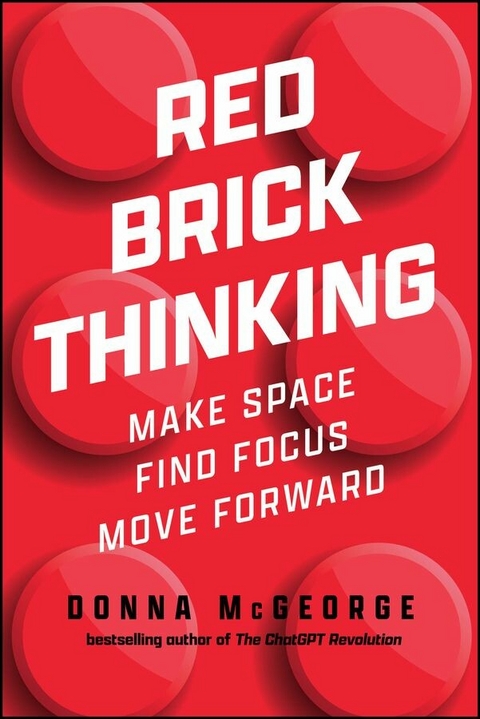
Red Brick Thinking (eBook)
273 Seiten
Wiley (Verlag)
978-1-394-36086-4 (ISBN)
What if success isn't about adding more, but about removing what holds you back?
Do you spend every day wading through too much information, too many choices and too many commitments? Is there always too much to do, but never enough time and energy to do it all? In Red Brick Thinking, bestselling author Donna McGeorge delivers a game-changing philosophy about how to work and live in a way that leaves you more fulfilled and more satisfied. She asks: What if the answer to achieving more is actually to do less?
Red Brick Thinking is a manifesto for smarter, simpler and more powerful decision-making. Inside, you'll learn why our instinct to add complexity is counterproductive to getting things done. Discover what happens when you start to strategically subtract the bricks that weigh you down - from meetings and busy work to the overstimulation and hustle in the design of our daily lives. From Ash Barty to Bottega Veneta, Taylor Swift to Canva, viral trends to global work movements . . . you'll encounter compelling stories, real-world examples and thought-provoking questions that show you how to lighten your load and move forward with greater joy.
- Transform your thinking from 'What else can I do?' to 'What can I stop doing?'
- Learn the power of no and set boundaries that simplify your life and work.
- Boost your focus and combat burnout, inefficiency and overwhelm.
- Find clarity and create space for what truly matters each day.
- Let go of the tasks, habits, obligations and relationships that aren't serving you anymore.
Red Brick Thinking shows how greatness is revealed by removing the excess, like a sculptor carving a masterpiece from a block of marble. If you're ready to stop being overwhelmed and start focusing on what matters, this book shares the mindset and motivation for creating the change you need. What red brick can you let go of today?
DONNA MCGEORGE cuts through the clutter. For over two decades, she has worked with leaders from across the world, creating significant, transformative shifts that help people make space for what matters.
www.donnamcgeorge.com
What if success isn't about adding more, but about removing what holds you back? Do you spend every day wading through too much information, too many choices and too many commitments? Is there always too much to do, but never enough time and energy to do it all? In Red Brick Thinking, bestselling author Donna McGeorge delivers a game-changing philosophy about how to work and live in a way that leaves you more fulfilled and more satisfied. She asks: What if the answer to achieving more is actually to do less? Red Brick Thinking is a manifesto for smarter, simpler and more powerful decision-making. Inside, you'll learn why our instinct to add complexity is counterproductive to getting things done. Discover what happens when you start to strategically subtract the bricks that weigh you down from meetings and busy work to the overstimulation and hustle in the design of our daily lives. From Ash Barty to Bottega Veneta, Taylor Swift to Canva, viral trends to global work movements . . . you'll encounter compelling stories, real-world examples and thought-provoking questions that show you how to lighten your load and move forward with greater joy. Transform your thinking from 'What else can I do?' to 'What can I stop doing?' Learn the power of no and set boundaries that simplify your life and work. Boost your focus and combat burnout, inefficiency and overwhelm. Find clarity and create space for what truly matters each day. Let go of the tasks, habits, obligations and relationships that aren't serving you anymore. Red Brick Thinking shows how greatness is revealed by removing the excess, like a sculptor carving a masterpiece from a block of marble. If you're ready to stop being overwhelmed and start focusing on what matters, this book shares the mindset and motivation for creating the change you need. What red brick can you let go of today?
Chapter 1
Why a brick? And why is it red?
In 2022, in my corporate workshops, I would begin by using a simple, coloured, slightly lopsided LEGO bridge to demonstrate a key idea in productivity.
When I asked participants how to make it level, nearly everyone reached for an extra block.
A few pulled the whole thing apart and rebuilt it from scratch.
Some made it their business to incorporate all the available bricks.
But very few people thought to remove the one, small red brick at the bottom of the right‐hand leg of the bridge. They didn't think to remove the one brick that was causing the imbalance in the first place.
When someone finally does take that brick away, there's always a collective ‘aha’.
In that moment, we discover Red Brick Thinking: the shift from addition to subtraction.
This answers the ‘Why a brick?’ question. As for ‘Why it is red?’, in this exercise, the simple act of removing the red brick is the key — the revelation.
The seed for Red Brick Thinking came in 2021, as part of the research for my book The 1 Day Refund. An article from Harvard Business Review landed on my screen with a title that stopped me in my tracks: ‘When subtraction adds value.’
It described something I had long sensed but hadn't yet named: our default as humans is to solve problems by adding something. For example, we might:
- Add a tool
- Add a feature
- Add another process, person or policy.
The article drew from a powerful piece of research published in Nature earlier that year by Gabrielle Adams and her colleagues. In a series of clever experiments, they found that when people were asked to improve something, they overwhelmingly tried to do so by adding. Subtraction rarely crossed the participants’ minds.
The research suggested that even when removing something is not only possible but clearly the better option, our brains tend to skip that option entirely.
That one detail made me sit up straighter.
Because I'd seen it too, time and again, in boardrooms, team workshops and leadership coaching sessions.
When faced with problems, we throw ‘more’ at them. What happens when we ask: ‘What can I remove?’
THE CASE FOR LETTING GO
We've been conditioned to associate progress with accumulation.
Our calendars fill up, our strategies get bloated, our products grow unwieldy and our brains get overloaded, all in the name of improvement.
But real improvement, the kind that leads to creativity and performance, comes from letting go.
The research from Adams and her team gave scientific backing to something deeply intuitive: subtraction is a powerful, underused tool. In the rush to optimise, we forget the most elegant solutions often come not from doing more, but from doing less.
Think of the sculptor, Michelangelo, who said he saw the angel in the marble and carved until he set it free. He didn't add a thing; he removed what didn't belong. (More on this incredible Red Brick Thinker in Chapter 2.)
Imagine if we approached our work, our time, our lives like a sculptor: an approach not defined by austerity or blanket minimalism but by strategic, intentional subtraction.
- What if leadership was about clearing the path for others?
- What if productivity was defined by doing fewer things —and only those that matter?
- What if clarity came not from learning something new, but from letting go of something old?
This book is an invitation to rethink how we work, lead and live: to notice the red bricks and to consider removal not as a last resort, but as a first move.
WHY WE NEED RED BRICK THINKING RIGHT NOW
In 2019, the World Health Organization (WHO) officially recognised burnout as an occupational phenomenon.
For the first time, the WHO gave language to something that millions had been silently enduring for decades: the slow, grinding depletion of energy, meaning and resilience arising from chronic, unmanaged workplace stress.
Burnout shifted from being a definition to a diagnosis, and now it has a place in the international health lexicon — not as a mental illness, but as a workplace reality with real consequences.
The WHO defined it across three distinct dimensions:
- Exhaustion — not just tired, but empty.
- Cynicism or mental distance from work — the creeping disconnection from what used to matter.
- Reduced efficacy — the feeling that no matter what you do, it's not enough.
The roots of burnout had been growing for decades.
First coined in the 1970s by psychologist Herbert Freudenberger, burnout was originally observed in doctors, nurses, teachers, social workers — those who poured their energy into helping others, often with little left for themselves. Over time, however, it became clear that burnout didn't discriminate. It could hit anyone, anywhere, from frontline staff in care homes to CEOs in corporate offices.
Then, along came COVID‐19 — a global accelerant that turned quiet exhaustion into a public health crisis.
In March 2022, the WHO released a stark update: anxiety and depression had increased by 25 per cent globally during the first year of the pandemic. People weren't just burnt out; they were running on fumes.
- Healthcare workers were reporting skyrocketing emotional fatigue.
- Teachers were being pushed to breaking point.
- Parents were navigating remote learning, job uncertainty and caregiving all at once.
Those already teetering on the edge, who had quietly accepted exhaustion as normal, finally fell over.
- A survey by McKinsey found that, post‐pandemic, one in four employees globally were experiencing symptoms of burnout.
- In Australia, new research from SuperFriend found that 72 per cent of workers experienced burnout symptoms in the past year, with younger generations reporting the highest levels.
The workplace, it seemed, had become not just a source of pressure but a system running on the assumption that depletion is inevitable. In response, many organisations rushed to offer resilience training, trying to fix the symptoms without questioning the system that caused them.
Burnout doesn't just come from working too hard; it comes from working too hard, for too long, on things that no longer feel meaningful, manageable or aligned. It comes from systems that reward availability over value, reactivity over rest, and martyrdom over sustainability.
It was this reality, not just the headlines, that made the WHO's declaration matter. It meant we could stop victim blaming (by suggesting burnout is a personal weakness) and start finding solutions. Once something has a name, it can no longer hide in plain sight.
Burnout is a signal, like a red flag waving from the edge of your capacity, telling you that something needs to change. It's what happens when busy becomes a mark of pride and exhaustion becomes expected. In other words, burnout is the echo of a culture that's forgotten how to rest.
Red Brick Thinking asks: ‘How do we pull back from the edge, not just individually but systemically?’
Through Red Brick Thinking, we can begin to redesign the environments that create the conditions for burnout.
THE SCIENCE OF SPACE: WHY DOING LESS UNLOCKS MORE
While miraculous, our brains weren't built for the level of input modern life demands. In our leisure time alone, we process an estimated 34 gigabytes of information every day, with others saying it could be as high as 74 gigabytes per day, which is the equivalent of watching 16 full‐length movies. Each notification, meeting, choice, tab and tiny decision pulls from the same finite cognitive pool (our working memory), and when that pool overflows, we don't just get distracted — we get worse at everything.
Psychologists call this cognitive overload. It reduces our ability to focus, problem‐solve, empathise and even self‐regulate.
A 2006 study in Neuroscience by a group of University of Oregon researchers found that individuals who limit their attention to fewer stimuli perform exponentially better on working memory tasks than those who try to juggle multiple inputs. Their brains aren't faster; they're quieter.
This is why subtraction matters. Such simplicity is elegant and effective.
Think about elite athletes, top performers, the world's best chess players. They don't try to see everything at once: they reduce the field, cut out distraction and zoom in on their desired outcome.
Having an edge comes from knowing what not to do.
In recent years, companies like Citi, Facebook and Canva have introduced no‐meeting days — not as a perk, but as a performance strategy. They saw what happened when people had room to think: better decisions, clearer strategy, more innovation, less rework and fewer errors. Subtraction works.
Finland, often ranked as having one of the best education systems in the world, builds its entire national curriculum around space to think. Students...
| Erscheint lt. Verlag | 23.10.2025 |
|---|---|
| Sprache | englisch |
| Themenwelt | Sachbuch/Ratgeber ► Beruf / Finanzen / Recht / Wirtschaft |
| Wirtschaft ► Betriebswirtschaft / Management | |
| Schlagworte | books like Atomic Habits • books like Let Them Theory • books like Start with Why • business • Efficiency • Hustle • Minimalism • Motivational • Neuroscience • Noise • Obligation • Productivity • productivity framework • productivity habits • productivity principles • Psychology • Reactivity • Self-Help • Stimulation • sustainability • Sustainable habits • Workplace Productivity |
| ISBN-10 | 1-394-36086-X / 139436086X |
| ISBN-13 | 978-1-394-36086-4 / 9781394360864 |
| Informationen gemäß Produktsicherheitsverordnung (GPSR) | |
| Haben Sie eine Frage zum Produkt? |
 EPUB (Adobe DRM)
Kopierschutz: Adobe-DRM
Adobe-DRM ist ein Kopierschutz, der das eBook vor Mißbrauch schützen soll. Dabei wird das eBook bereits beim Download auf Ihre persönliche Adobe-ID autorisiert. Lesen können Sie das eBook dann nur auf den Geräten, welche ebenfalls auf Ihre Adobe-ID registriert sind.
Details zum Adobe-DRM
Dateiformat: EPUB (Electronic Publication)
EPUB ist ein offener Standard für eBooks und eignet sich besonders zur Darstellung von Belletristik und Sachbüchern. Der Fließtext wird dynamisch an die Display- und Schriftgröße angepasst. Auch für mobile Lesegeräte ist EPUB daher gut geeignet.
Systemvoraussetzungen:
PC/Mac: Mit einem PC oder Mac können Sie dieses eBook lesen. Sie benötigen eine
eReader: Dieses eBook kann mit (fast) allen eBook-Readern gelesen werden. Mit dem amazon-Kindle ist es aber nicht kompatibel.
Smartphone/Tablet: Egal ob Apple oder Android, dieses eBook können Sie lesen. Sie benötigen eine
Geräteliste und zusätzliche Hinweise
Buying eBooks from abroad
For tax law reasons we can sell eBooks just within Germany and Switzerland. Regrettably we cannot fulfill eBook-orders from other countries.
aus dem Bereich


