


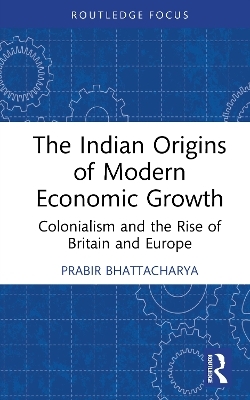
The Indian Origins of Modern Economic Growth
Colonialism and the Rise of Britain and Europe
Seiten
2025
Routledge (Verlag)
978-1-041-20163-2 (ISBN)
Routledge (Verlag)
978-1-041-20163-2 (ISBN)
Modern economic growth first emerged in Britain and then spread to a few other countries in western Europe and the USA. This book argues that it is her control over India which put Britain at the apex of the world economy in the nineteenth century, and it is British policies and actions, based on her Indian foundation, which led to the globalisation of the nineteenth century – a globalisation very different from the previous globalisations in history.
Technological innovations of the nineteenth century were embedded in that globalisation process. It is this which ensured that growth and innovations would not peter out this time, as they had after various “efflorescences” in history. While the increased availability of silver from the Mexican and Peruvian mines in the sixteenth and seventeenth centuries, and the Atlantic slave trade both had important consequences for global development, the decisive disjuncture that opened the path to modern economic growth was the British victory in the Battle of Plassey (1757), which in due course led to the colonisation of the whole of the subcontinent.
The book is likely to be of interest to a diverse readership, beyond those interested in economic history and growth economics.
Technological innovations of the nineteenth century were embedded in that globalisation process. It is this which ensured that growth and innovations would not peter out this time, as they had after various “efflorescences” in history. While the increased availability of silver from the Mexican and Peruvian mines in the sixteenth and seventeenth centuries, and the Atlantic slave trade both had important consequences for global development, the decisive disjuncture that opened the path to modern economic growth was the British victory in the Battle of Plassey (1757), which in due course led to the colonisation of the whole of the subcontinent.
The book is likely to be of interest to a diverse readership, beyond those interested in economic history and growth economics.
Prabir Bhattacharya is an economist affiliated to both Glasgow and Heriot-Watt Universities. He is editor-in-chief of the Journal of Interdisciplinary Economics and was formerly editor-in-chief of the Progress in Development Studies. He has taught at various universities including the University College London, University of Edinburgh, Yokohama National University, Kobe University and the University of Science and Technology Beijing.
Acknowledgements 1. Introduction 2. India in the Rise of Britain and Europe: Convergence and Great Divergence 3. Technological Innovations, Globalisation, and the Emergence of Modern Economic Growth 4. Silver and Slavery 5. Conclusion Index
| Erscheinungsdatum | 22.11.2025 |
|---|---|
| Zusatzinfo | 3 Tables, black and white |
| Verlagsort | London |
| Sprache | englisch |
| Maße | 138 x 216 mm |
| Gewicht | 430 g |
| Themenwelt | Geschichte ► Teilgebiete der Geschichte ► Wirtschaftsgeschichte |
| Wirtschaft ► Volkswirtschaftslehre ► Makroökonomie | |
| ISBN-10 | 1-041-20163-X / 104120163X |
| ISBN-13 | 978-1-041-20163-2 / 9781041201632 |
| Zustand | Neuware |
| Informationen gemäß Produktsicherheitsverordnung (GPSR) | |
| Haben Sie eine Frage zum Produkt? |
Mehr entdecken
aus dem Bereich



aus dem Bereich
wie Tech-Konzerne und Großmächte die Welt unter sich aufteilen
Buch | Hardcover (2025)
C.H.Beck (Verlag)
CHF 39,20


