


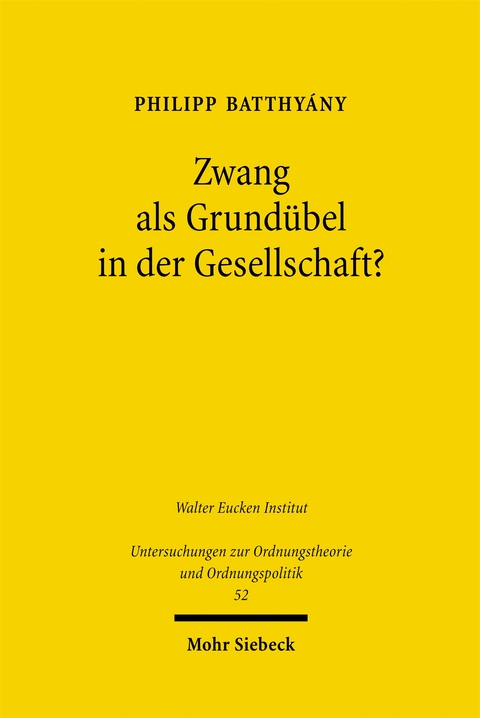
Zwang als Grundübel in der Gesellschaft?
Der Begriff des Zwangs bei Friedrich August von Hayek
2007
Mohr Siebeck (Hersteller)
978-3-16-151477-7 (ISBN)
Mohr Siebeck (Hersteller)
978-3-16-151477-7 (ISBN)
Grundbegriff des klassischen Liberalismus ist der Begriff der negativen Freiheit: Freiheit ist die Abwesenheit von Zwang. Doch was ist Zwang? Warum ist Zwang in freiheitlicher Sicht ein Übel? Philipp Batthyány unternimmt eine werkimmanente Definition des Zwangsbegriffs Hayeks und schließt damit eine wichtige Lücke in der Hayek-Forschung.
The basic concept of classical liberalism is a concept of negative freedom: freedom as an absence of coercion. But what is coercion? Why is coercion regarded as evil from the perspective of freedom? Friedrich A. von Hayek developed a definition of the terms freedom and coercion which however remained incomplete and which raised some basic questions regarding his moral philosophy and his theory of cultural evolution. Philipp Batthyány gives a definition of Hayek's concept of coercion and the reasons for the reprehensibleness of coercion as a basic evil in society. Including substantial parts of Hayek's unpublished works, he analyzes Hayek's complete works with regard to the conception of freedom and coercion on which they are based and in doing so fills a large gap in Hayek research.
The basic concept of classical liberalism is a concept of negative freedom: freedom as an absence of coercion. But what is coercion? Why is coercion regarded as evil from the perspective of freedom? Friedrich A. von Hayek developed a definition of the terms freedom and coercion which however remained incomplete and which raised some basic questions regarding his moral philosophy and his theory of cultural evolution. Philipp Batthyány gives a definition of Hayek's concept of coercion and the reasons for the reprehensibleness of coercion as a basic evil in society. Including substantial parts of Hayek's unpublished works, he analyzes Hayek's complete works with regard to the conception of freedom and coercion on which they are based and in doing so fills a large gap in Hayek research.
Geboren 1968 in Genf; Studium der Philosophie an der Jesuitenuniversität Hochschule für Philosophie S.J., München; 2006 Promotion; 2018 Habilitation; Professor für Sozial- und Moralphilosophie an der Internationalen Akademie für Philosophie des Fürstentums Liechtenstein, IAP.
| Erscheint lt. Verlag | 3.12.2007 |
|---|---|
| Reihe/Serie | Untersuchungen zur Ordnungstheorie und Ordnungspolitik |
| Verlagsort | Tübingen |
| Sprache | deutsch |
| Themenwelt | Wirtschaft ► Volkswirtschaftslehre ► Wirtschaftspolitik |
| Schlagworte | Grundübel • Mohr Siebeck • Zwang |
| ISBN-10 | 3-16-151477-7 / 3161514777 |
| ISBN-13 | 978-3-16-151477-7 / 9783161514777 |
| Zustand | Neuware |
| Informationen gemäß Produktsicherheitsverordnung (GPSR) | |
| Haben Sie eine Frage zum Produkt? |


