


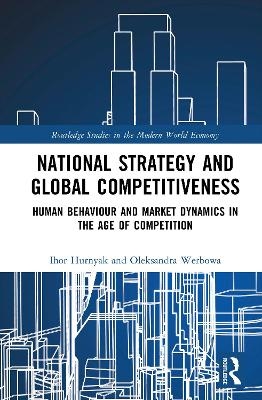
National Strategy and Global Competitiveness
Human Behaviour and Market Dynamics in the Age of Competition
Seiten
2025
Routledge (Verlag)
978-1-041-11484-0 (ISBN)
Routledge (Verlag)
978-1-041-11484-0 (ISBN)
This book demonstrates how diverse analytical tools illuminate the complex interconnections between markets, institutional dynamics, and state behaviour. Central to this approach is econothinking, a mindset that recognizes economic decisions as deeply intertwined with politics, geopolitical strategies, and societal outcomes.
In a world shaped by geopolitical rivalries, technological disruptions, and economic volatility, strategic thinking has become essential for sustaining national competitiveness. This book demonstrates how diverse analytical tools – including game theory, econophysics, financial econometrics, multidimensional clustering, and machine learning – illuminate the complex interconnections between markets, institutional dynamics, and state behaviour. Central to this approach is econothinking, a mindset that recognizes economic decisions as deeply intertwined with politics, geopolitical strategies, and societal outcomes.
Analyses span various global regions, revealing how nations balance sovereignty with integration into international systems, how power asymmetries influence strategic choices, and how the rising significance of technological industries, clean energy, and digital economies is reshaping the foundations of future competitiveness. Financial markets emerge as sensitive indicators of geopolitical tensions and institutional resilience, reflecting how different regional contexts shape market behaviour, risk profiles, and strategic priorities. The findings underscore that there is no universal blueprint for competitiveness; rather, success hinges on strategic adaptability and the ability to interpret diverse signals from both economic models and geopolitical realities.
Whether examining dynamics across different parts of the world, the research highlights that maintaining competitive advantage in the twenty-first century requires an interdisciplinary perspective that bridges rigorous quantitative analysis with a nuanced understanding of global politics and institutional transformation.
In a world shaped by geopolitical rivalries, technological disruptions, and economic volatility, strategic thinking has become essential for sustaining national competitiveness. This book demonstrates how diverse analytical tools – including game theory, econophysics, financial econometrics, multidimensional clustering, and machine learning – illuminate the complex interconnections between markets, institutional dynamics, and state behaviour. Central to this approach is econothinking, a mindset that recognizes economic decisions as deeply intertwined with politics, geopolitical strategies, and societal outcomes.
Analyses span various global regions, revealing how nations balance sovereignty with integration into international systems, how power asymmetries influence strategic choices, and how the rising significance of technological industries, clean energy, and digital economies is reshaping the foundations of future competitiveness. Financial markets emerge as sensitive indicators of geopolitical tensions and institutional resilience, reflecting how different regional contexts shape market behaviour, risk profiles, and strategic priorities. The findings underscore that there is no universal blueprint for competitiveness; rather, success hinges on strategic adaptability and the ability to interpret diverse signals from both economic models and geopolitical realities.
Whether examining dynamics across different parts of the world, the research highlights that maintaining competitive advantage in the twenty-first century requires an interdisciplinary perspective that bridges rigorous quantitative analysis with a nuanced understanding of global politics and institutional transformation.
Ihor Hurnyak, Ph.D., is Associate Professor at the Department of International Economic Analysis and Finance, Faculty of International Relations, Ivan Franko National University of Lviv, Lviv, Ukraine. Oleksandra Werbowa, Ph.D., is Assistant Professor at the Department of Political Science and Security Studies, Institute of Political Science, Faculty of Social Sciences, University of Warmia and Mazury in Olsztyn, Poland.
Preface 1. Evolving Strategic Tools and Models for the Modern Economy 2. Human Behaviour and Market Dynamics in the Age of Competition 3. National Strategy and Global Competitiveness: Economic Insights for Policymakers 4. Postface
| Erscheinungsdatum | 05.12.2025 |
|---|---|
| Reihe/Serie | Routledge Studies in the Modern World Economy |
| Zusatzinfo | 43 Tables, black and white; 36 Line drawings, black and white; 36 Illustrations, black and white |
| Verlagsort | London |
| Sprache | englisch |
| Maße | 156 x 234 mm |
| Gewicht | 470 g |
| Themenwelt | Wirtschaft ► Allgemeines / Lexika |
| Wirtschaft ► Betriebswirtschaft / Management ► Unternehmensführung / Management | |
| Wirtschaft ► Volkswirtschaftslehre | |
| ISBN-10 | 1-041-11484-2 / 1041114842 |
| ISBN-13 | 978-1-041-11484-0 / 9781041114840 |
| Zustand | Neuware |
| Informationen gemäß Produktsicherheitsverordnung (GPSR) | |
| Haben Sie eine Frage zum Produkt? |
Mehr entdecken
aus dem Bereich

aus dem Bereich
warum etablierte Unternehmen den Wettbewerb um bahnbrechende …
Buch | Softcover (2025)
Vahlen (Verlag)
CHF 48,85
wie Teams funktionieren und wann sie effektiv arbeiten
Buch | Softcover (2024)
Vahlen (Verlag)
CHF 45,95
ein Navigationssystem für Führungskräfte
Buch (2023)
Carl-Auer Verlag
CHF 48,90


