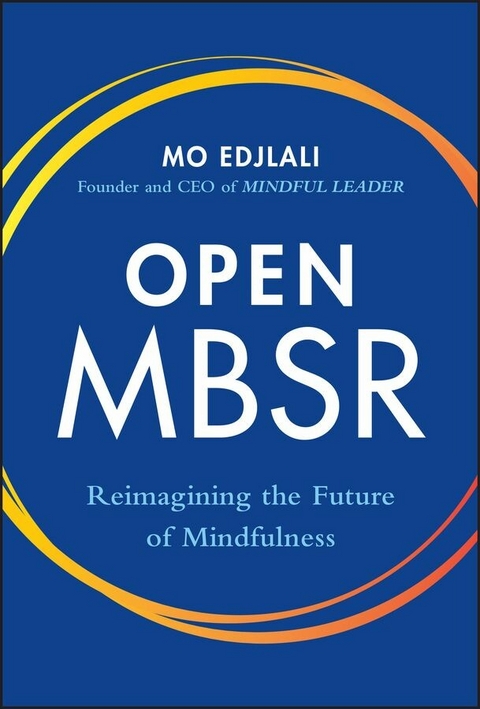
Open MBSR (eBook)
294 Seiten
Wiley (Verlag)
978-1-119-98864-9 (ISBN)
In Open MBSR: Reimagining the Future of Mindfulness, author Mo Edjlali charts a bold new path for mindfulness-based stress reduction. Building on Jon Kabat-Zinn's foundational work, this book addresses the systemic challenges undermining mindfulness today, from power concentration and Buddhist entanglement to rigid frameworks and one-dimensional thinking.
Drawing from diverse sources including, the Agile Methodology, Quaker traditions and Acceptance and Commitment Therapy (ACT), Edjlali offers a transformative framework built on open collaboration, collective wisdom, and genuine secular integrity.
Inside, you'll discover:
- Clear-eyed critique of the challenges facing contemporary mindfulness
- Framework bridging neuroscience, psychology, and contemplative practice with secular clarity
- Practical strategies for adapting mindfulness programs across diverse settings and populations
- Open-source principles for collaborative learning and community-driven development
MO EDJLALI is a mindfulness innovator, technology entrepreneur, and founder/CEO of Mindful Leader, the world's leading provider of MBSR training. With 25+ years cross-industry experience spanning NASA, FICO, and Accenture, he has pioneered workplace mindfulness integration globally, certifying over 550 facilitators and creating Meditate Together, the largest meditation community of practice platform.
A Community-Centric Framework for Learning, Teaching, and Sharing Mindfulness In Open MBSR: Reimagining the Future of Mindfulness, author Mo Edjlali charts a bold new path for mindfulness-based stress reduction. Building on Jon Kabat-Zinn's foundational work, this book addresses the systemic challenges undermining mindfulness today, from power concentration and Buddhist entanglement to rigid frameworks and one-dimensional thinking. Drawing from diverse sources including, the Agile Methodology, Quaker traditions and Acceptance and Commitment Therapy (ACT), Edjlali offers a transformative framework built on open collaboration, collective wisdom, and genuine secular integrity. Inside, you'll discover: Clear-eyed critique of the challenges facing contemporary mindfulness Framework bridging neuroscience, psychology, and contemplative practice with secular clarity Practical strategies for adapting mindfulness programs across diverse settings and populations Open-source principles for collaborative learning and community-driven development Written for meditation teachers, mindfulness program administrators, and wellness professionals, Open MBSR provides a unifying and adaptable framework for evolving mindfulness teachings and practices to meet contemporary needs.
Chapter 2
What Is MBSR?
In 1979, a revolutionary approach to stress management emerged from an unlikely place: a basement office at the University of Massachusetts Medical Center. Jon Kabat‐Zinn, a molecular biologist with a deep passion for meditation, had just planted the seeds of what would become a global phenomenon: Mindfulness‐Based Stress Reduction (MBSR).
MBSR is more than just a program; it's a paradigm shift in how people approach well‐being. It's the bridge between ancient wisdom and modern science, offering a practical, evidence‐based path to resilience and inner peace. This isn't about escaping life's challenges, but developing the tools to navigate them with grace and clarity.
The journey into MBSR begins with Jon Kabat‐Zinn himself. His story is one of curiosity, innovation, and a relentless pursuit of truth. This chapter explores how his unique blend of scientific rigor and spiritual insight shaped MBSR's development and propelled it onto the world stage.
At its core, MBSR is a carefully crafted curriculum, each element precisely calibrated to cultivate mindfulness and self‐awareness. This chapter dissects this curriculum, examining how each component contributes to the whole. The MBSR Authorized Curriculum Guide and Standards of Practice (Santorelli et al., 2017) serves as the guardrails, ensuring consistency and quality across MBSR programs worldwide.
But MBSR's impact extends far beyond individual well‐being. Today it is reshaping entire industries:
- Healthcare: Revolutionizing approaches to chronic pain, stress, and mental health
- Education: Fostering emotional intelligence and resilience in students
- Workplace: Enhancing productivity, creativity, and employee satisfaction
Central to MBSR's success are its teachers; the torchbearers of mindfulness. This chapter explores the landscape of MBSR Teacher Training, uncovering the rigorous pathways available to those called to share this transformative practice. From leading institutions to core competencies, I examine what it takes to become an effective MBSR instructor.
By the end of this exploration, you'll have a comprehensive understanding of MBSR: its origins, practices, and profound implications for the future of well‐being. Yet, like any pioneering approach, MBSR isn't without its limitations. As you progress through this book, you'll learn how Open MBSR aims to build on MBSR's solid foundation while addressing some of its challenges.
Note: As you delve into MBSR, pay attention to what resonates with you. Notice the elements that spark your curiosity or challenge your assumptions. These insights will be invaluable as you later examine how Open MBSR seeks to create a more inclusive, ethical, and adaptable approach to mindfulness.
For now, get ready to immerse yourself in the world of MBSR, the program that brought mindfulness out of the monastery and into hospitals, boardrooms, and classrooms around the globe. It's time to uncover the story behind this influential approach and understand why it continues to captivate millions worldwide.
What Is MBSR?
In 1979, Jon Kabat‐Zinn unleashed a revolution from the basement of the University of Massachusetts Medical Center. His creation, Mindfulness‐Based Stress Reduction (MBSR), would go on to reshape our understanding of mental health and well‐being.
MBSR isn't just another self‐help fad. It's a rigorous mental training program, as demanding and transformative as any physical regimen. Over eight weeks, participants engage in a combination of mindfulness meditation, gentle yoga, and group dialogue. The goal? To fundamentally alter how they engage with stress, pain, and the complexities of daily life.
This isn't about passive learning. MBSR demands active participation. It's a full‐contact sport for the mind, where theory meets practice in real time. Through a series of formal practices, participants develop a new relationship with their thoughts and experiences. They learn to observe without judgment, to respond rather than react.
The MBSR blueprint:
- An eight‐week intensive program, featuring weekly 2.5‐hour sessions and a full‐day retreat
- Formal mindfulness practices: body scans, sitting meditation, walking meditation, and gentle yoga
- Group discussions to deepen understanding and share experiences
- Daily home practice to integrate mindfulness into everyday life
- A focus on experiential learning and practical application
- Emphasis on stress reduction and enhanced quality of life
These practices are guided by the nine attitudes of mindfulness that Kabat‐Zinn articulated in his seminal work, Full Catastrophe Living (2013): nonjudging, patience, beginner's mind, trust, non‐striving, acceptance, letting go, gratitude, and generosity. These attitudes shape how the practices are taught and experienced throughout the program.
What sets MBSR apart?
- MBSR's distinctly secular: Evidence‐based approach marries ancient wisdom with modern science, presenting mindfulness in a universal, nonreligious context. It's built on a foundation of rigorous research and medical understanding.
- An intensive, structured curriculum: MBSR isn't a quick fix. It's a deep dive into mindfulness, demanding commitment and consistency. Like learning a new language, full immersion is key.
- Widespread application: From its origins in chronic pain management, MBSR has found positive application in hospitals, classrooms, and corporate boardrooms. Its adaptability has fueled its global impact.
MBSR challenges participants to reconsider their relationships with their own minds. It asks participants to confront habitual patterns of thought and behavior, to question the stories they tell themselves about who they are and what they're capable of.
As you contemplate MBSR, consider this: How might your life change if you could observe your thoughts and feelings without being controlled by them? What possibilities might open up if you could respond to life's challenges with clarity and compassion, rather than knee‐jerk reactions?
The power of MBSR lies not just in its techniques, but in its potential to fundamentally alter your perspective. It offers a new lens through which to view yourself and the world around you. In a society obsessed with external solutions and dubious “life hacks,” MBSR dares to suggest that the most profound changes come from within.
Jon Kabat‐Zinn and the History of MBSR
In 1944, a child was born in New York City who would go on to revolutionize our understanding of the mind. Jon Kabat‐Zinn, the son of a molecular immunologist and a painter, embodied from birth the fusion of scientific rigor and creative insight that would later define his life's work.
Kabat‐Zinn's early path seemed conventional enough. He excelled in chemistry at Haverford College and dove into molecular biology at MIT. But in 1966, fate intervened. A talk by Zen missionary Philip Kapleau ignited a spark in Kabat‐Zinn that would ultimately set the world ablaze.
Suddenly, meditation wasn't just an esoteric, mystery‐laden Eastern practice. It was a calling, a potential key to unlocking human potential. Kabat‐Zinn immersed himself in Zen and Vipassana meditation, studying under luminaries like Thích Nhất Hạnh and Seung Sahn. These weren't mere spiritual dalliances. Rather, they became the building blocks of a revolutionary vision: mindfulness as a universal practice, adaptable to modern Western society.
In 1979, this vision crystallized into the Stress Reduction Clinic at the University of Massachusetts Medical Center. Here, Kabat‐Zinn forged what would later become MBSR, an eight‐week course that would change the face of mental health.
MBSR was more than just another wellness program. It was a Rosetta Stone, translating ancient wisdom into the language of Western medicine and psychology. It focused on experiential learning, not esoteric teachings. It made mindfulness accessible to everyone, not just to spiritual seekers.
As MBSR gained traction, Kabat‐Zinn became its tireless advocate. His books, like Full Catastrophe Living and Wherever You Go, There You Are, brought mindfulness to the masses. His scientific background lent credibility. His charisma made it irresistible.
The evolution of MBSR:
- 1979: Kabat‐Zinn establishes the Stress Reduction Clinic at UMass Medical Center with a stress reduction program.
- 1990: The publication of Full Catastrophe Living brings the principles of mindfulness and stress reduction to a wider audience.
- 1993: Bill Moyers's PBS series “Healing and the Mind” introduces MBSR to mainstream America.
- 1995: UMass Center for Mindfulness established at UMass Medical School to advance MBSR research and training.
- 2000s: A growing body of research validates MBSR's effectiveness across multiple domains.
- 2010s: MBSR becomes widely adopted in healthcare, education, and corporate settings.
Kabat‐Zinn's approach, a potent blend of science, Buddhist wisdom, and social consciousness, didn't just create a...
| Erscheint lt. Verlag | 4.8.2025 |
|---|---|
| Sprache | englisch |
| Themenwelt | Sachbuch/Ratgeber ► Gesundheit / Leben / Psychologie ► Esoterik / Spiritualität |
| Wirtschaft ► Betriebswirtschaft / Management | |
| Schlagworte | Jon Kabat-Zinn • MBSR • Mindful Leadership • Mindfulness-Based Stress Reduction • mindfulness curriculum • mindfulness meditation • mindfulness program development • mindfulness teacher training • teaching mindfulness • workplace mindfulness |
| ISBN-10 | 1-119-98864-0 / 1119988640 |
| ISBN-13 | 978-1-119-98864-9 / 9781119988649 |
| Informationen gemäß Produktsicherheitsverordnung (GPSR) | |
| Haben Sie eine Frage zum Produkt? |
 EPUB (Adobe DRM)
Kopierschutz: Adobe-DRM
Adobe-DRM ist ein Kopierschutz, der das eBook vor Mißbrauch schützen soll. Dabei wird das eBook bereits beim Download auf Ihre persönliche Adobe-ID autorisiert. Lesen können Sie das eBook dann nur auf den Geräten, welche ebenfalls auf Ihre Adobe-ID registriert sind.
Details zum Adobe-DRM
Dateiformat: EPUB (Electronic Publication)
EPUB ist ein offener Standard für eBooks und eignet sich besonders zur Darstellung von Belletristik und Sachbüchern. Der Fließtext wird dynamisch an die Display- und Schriftgröße angepasst. Auch für mobile Lesegeräte ist EPUB daher gut geeignet.
Systemvoraussetzungen:
PC/Mac: Mit einem PC oder Mac können Sie dieses eBook lesen. Sie benötigen eine
eReader: Dieses eBook kann mit (fast) allen eBook-Readern gelesen werden. Mit dem amazon-Kindle ist es aber nicht kompatibel.
Smartphone/Tablet: Egal ob Apple oder Android, dieses eBook können Sie lesen. Sie benötigen eine
Geräteliste und zusätzliche Hinweise
Buying eBooks from abroad
For tax law reasons we can sell eBooks just within Germany and Switzerland. Regrettably we cannot fulfill eBook-orders from other countries.
aus dem Bereich