


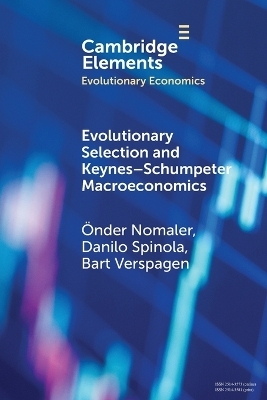
Evolutionary Selection and Keynes–Schumpeter Macroeconomics
Seiten
2025
Cambridge University Press (Verlag)
978-1-009-61952-3 (ISBN)
Cambridge University Press (Verlag)
978-1-009-61952-3 (ISBN)
This Element mentions the development of a stock-flow consistent agent-based macroeconomic model with Schumpeterian and Keynesian characteristics. In the long run, an evolutionary stable R&D strategy of firms emerges, leading to endogenous productivity growth. This title is also available as Open Access on Cambridge Core.
This Element develops a stock-flow consistent agent-based macroeconomic model with Schumpeterian and Keynesian characteristics. On the Schumpeterian side, technological change is modelled as productivity growth as a result of research and development (R&D). The R&D strategies of firms are determined by an evolutionary selection process. On the Keynesian side, demand is endogenous on current income and the stock of households' financial wealth. In the long run, an evolutionary stable R&D strategy of firms emerges, leading to endogenous productivity growth. Demand adjusts endogenously to match labour-saving productivity growth, so that the employment rate is stationary, although with business cycle fluctuations. The authors use Monte Carlo simulations to analyze the emergence of an evolutionary stable R&D strategy, as well as the long-run properties of the model and the nature of business cycles. This title is also available as Open Access on Cambridge Core.
This Element develops a stock-flow consistent agent-based macroeconomic model with Schumpeterian and Keynesian characteristics. On the Schumpeterian side, technological change is modelled as productivity growth as a result of research and development (R&D). The R&D strategies of firms are determined by an evolutionary selection process. On the Keynesian side, demand is endogenous on current income and the stock of households' financial wealth. In the long run, an evolutionary stable R&D strategy of firms emerges, leading to endogenous productivity growth. Demand adjusts endogenously to match labour-saving productivity growth, so that the employment rate is stationary, although with business cycle fluctuations. The authors use Monte Carlo simulations to analyze the emergence of an evolutionary stable R&D strategy, as well as the long-run properties of the model and the nature of business cycles. This title is also available as Open Access on Cambridge Core.
1. Introduction; 2. Background and literature review; 3. Keynesian economics: the model for a stationary economy; 4. Introducing R&D-based productivity growth; 5. Exploring the full model: Monte Carlo simulations; 6. Conclusions and outlook; 7. List of variables, parameters and parameter settings; References.
| Erscheinungsdatum | 08.10.2025 |
|---|---|
| Reihe/Serie | Elements in Evolutionary Economics |
| Zusatzinfo | Worked examples or Exercises |
| Verlagsort | Cambridge |
| Sprache | englisch |
| Gewicht | 152 g |
| Themenwelt | Wirtschaft ► Betriebswirtschaft / Management ► Unternehmensführung / Management |
| Wirtschaft ► Volkswirtschaftslehre ► Makroökonomie | |
| ISBN-10 | 1-009-61952-7 / 1009619527 |
| ISBN-13 | 978-1-009-61952-3 / 9781009619523 |
| Zustand | Neuware |
| Informationen gemäß Produktsicherheitsverordnung (GPSR) | |
| Haben Sie eine Frage zum Produkt? |
Mehr entdecken
aus dem Bereich


aus dem Bereich
warum etablierte Unternehmen den Wettbewerb um bahnbrechende …
Buch | Softcover (2025)
Vahlen (Verlag)
CHF 48,85
wie Teams funktionieren und wann sie effektiv arbeiten
Buch | Softcover (2024)
Vahlen (Verlag)
CHF 45,95
ein Navigationssystem für Führungskräfte
Buch (2023)
Carl-Auer Verlag
CHF 48,90


