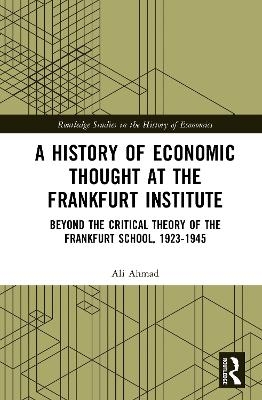
A History of Economic Thought at the Frankfurt Institute
Routledge (Verlag)
978-1-041-08953-7 (ISBN)
Drawing on new archival research, this book brings to the forefront the sidelined and long-neglected economic ideas of Franz L. Neumann, Otto Kirchheimer, Friedrich Pollock, Carl Grünberg, Henryk Grossmann, Arkadij Gurland, Gerhard Meyer, Kurt Mandelbaum, and Karl A. Wittfogel. Viewing the work of the Institute through these figures highlights the fact that material, historical, and empirical approaches to economic theory were central to its work. Being primarily a work of intellectual history, the book contextualises the Institute’s economic theories within the historical settings of the Weimar Republic and Nazi Germany.
The book emphasises the role of these underappreciated economists in shaping economic discourse around the structural characteristics of capitalist economies during the twentieth century and offers a renewed perspective on the intricate interplay between economics, politics, history, and epistemology, which lay at the heart of the Institute’s endeavours. This book will be of interest to researchers on twentieth-century economic history, intellectual history, political philosophy, history of economic thought, epistemology, and critical theory.
Ali Ahmad holds a PhD in Economic and Intellectual History from the University of Cambridge, having worked under the supervision of Martin Ruehl. He has received awards from the Economic History Society, the Cambridge Political Economy Society, and the Ellen MacArthur Fund. He previously earned a dual BA in Business Administration and Economics from the American University of Beirut, where he was on the Dean’s Honour List, and an MA in Politics and International Relations from Durham University with Distinction. His research approaches the study of capitalism from multiple angles including epistemology, ideology, intellectual history, politics, economics, and financial analysis.
Introduction
Chapter 1: Materialism and Economic Theory in the Institute’s Early Years
1.1 Intellectual Origins of the Frankfurt Institute for Social Research
1.2 The Law of Accumulation of Capital
1.3 The Asiatic Mode of Production
Chapter 2: The Weimar Republic’s Economic Structure and Legal Constitution
2.1 Monopoly Capitalism in the Weimar Republic
2.2 The Influence of Private Economic Interests
Chapter 3: Against the Logic of Market Economics
3.1 Epistemological Reflections during the Institute’s Early Phase
3.2 Soviet Planning
3.3 The End of Liberal Capitalism in the West
3.4 Prospects for a Planned Economy
Chapter 4: The Economic System of National Socialism
4.1 The State Capitalism Thesis
4.2 Monopoly Capitalism in the Third Reich
Conclusion
| Erscheinungsdatum | 19.11.2025 |
|---|---|
| Reihe/Serie | Routledge Studies in the History of Economics |
| Zusatzinfo | 2 Halftones, black and white; 2 Illustrations, black and white |
| Verlagsort | London |
| Sprache | englisch |
| Maße | 156 x 234 mm |
| Gewicht | 770 g |
| Themenwelt | Geschichte ► Teilgebiete der Geschichte ► Wirtschaftsgeschichte |
| Wirtschaft ► Allgemeines / Lexika | |
| Wirtschaft ► Volkswirtschaftslehre | |
| ISBN-10 | 1-041-08953-8 / 1041089538 |
| ISBN-13 | 978-1-041-08953-7 / 9781041089537 |
| Zustand | Neuware |
| Informationen gemäß Produktsicherheitsverordnung (GPSR) | |
| Haben Sie eine Frage zum Produkt? |
aus dem Bereich