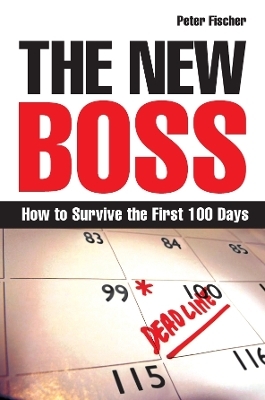
The New Boss
Kogan Page Ltd (Verlag)
978-0-7494-4764-9 (ISBN)
- Titel erscheint in neuer Auflage
- Artikel merken
For senior managers making a leadership transition, it is critical to engage with the new role rapidly to permit a seamless changeover and to ensure that the staff remains engaged and focused. This handy guide provides you with the structure and guidance you need to minimise disruption and maximise performance during the crucial first 100 days.
Written by Peter Fischer, an industrial psychologist and psychotherapist, the book provides you with tried and tested models and self-assessment techniques which allow you to manage expectations, build key relationships and drive through change during your first three months "in charge".
The first part of the book deals with the common problems faced by new managers in the early days of a new post, shows the right questions to ask and also provides really helpful advice on issues such as how to deal with a disappointed contender.
The second part of the book looks at the problems faced by new appointees in different scenarios, including: internal promotion; external hire; big predecessor and little successor, the young high-potential manager and the overseas assignment.
If you are a new manager, no matter the circumstances of your appointment, this book identifies all the problems you are likely to face, shows you how to deal with them, and allows you to "hit the ground running" in your new role.
Peter Fischer is an industrial psychologist and psychotherapist. He is the founder of FGi and for more then 15 years has supported senior executives in taking over new assignments, in change processes and in personal transitions. He has extensive experience in the implementation of performance management systems and has directed numerous cultural change projects.
Part I The seven building blocks of successful leadership transition Building Block 1 Managing expectations proactively 'Have a go at it - I have full confidence in you!' The expectations of the employees The expectations of colleagues Expectations entailed in taking over a managerial position in a foreign country Develop expectations actively Building Block 2 Developing the key relationships On dealing with disappointed rivals and hidden competitors The significance of colleagues in the change of leadership The predecessor - the hidden competition Invitations better refused Networking - developing power and influence Building Block 3 Constructively analysing the initial situation Discover the corporate culture Sort through the issues Gather the facts Determine the potential for innovation Seek resources on which you can build Building Block 4 Establishing a set of motivating goals What do employees look for in a change of leadership? Designing a communicable set of goals Avoiding the pitfalls when formulating goals Visions - looking to the future Building Block 5 Fostering a positive climate for change Ask an appreciative question, get an appreciative response Deal positively with scepticism Climate - the basis of all change Building Block 6 Initiating changes effectively Strong signals for change If I want to change something, I must do something different Timing in leadership transition Some obstacles to the management of change Building Block 7 Using symbols and rituals The significance of symbols and rituals in the process of leadership transition Rituals of transition and change Symbols and rituals of a new corporate culture Part II Seven case studies illustrating successful leadership transition Case Study 1 The internal promotion The initial situation: 'It's good that nothing has changed' The typical problems of internal promotions What can you do? Case Study 2 Entrepreneur wanted: the external candidate The initial situation of the newcomer The typical problems of the external manager What can you do? Case Study 3 The big predecessor and the little successor The initial situation: in the shadow of the predecessor The typical problems of the successor What can you do? Case Study 4 The young high-potential manager The initial situation: scepticism and reserve The typical problems of the high-potential manager What can you do? Case Study 5 The long-drawn-out start The initial situation: the long-drawn-out start The typical problems of the long-drawn-out start What can you do? Case Study 6 The assignment abroad The initial situation: the expatriate The typical problems of the expatriate What can you do? Case Study 7 Learning at headquarters: the challenge of managers from foreign subsidiaries The initial situation: the manager from a foreign subsidiary The typical problems of the manager from a foreign subsidiary What can you do?
| Erscheint lt. Verlag | 3.4.2007 |
|---|---|
| Verlagsort | London |
| Sprache | englisch |
| Maße | 1 x 1 mm |
| Gewicht | 1 g |
| Themenwelt | Wirtschaft ► Betriebswirtschaft / Management ► Unternehmensführung / Management |
| ISBN-10 | 0-7494-4764-8 / 0749447648 |
| ISBN-13 | 978-0-7494-4764-9 / 9780749447649 |
| Zustand | Neuware |
| Informationen gemäß Produktsicherheitsverordnung (GPSR) | |
| Haben Sie eine Frage zum Produkt? |
aus dem Bereich