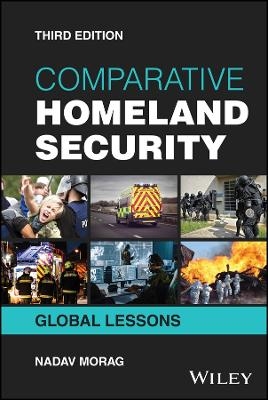
Comparative Homeland Security
John Wiley & Sons Inc (Verlag)
978-1-394-32352-4 (ISBN)
Comparative Homeland Security: Global Lessons, Third Edition, offers critical insights into how democratic nations around the world approach homeland security (HS) threats. As the scope and complexity of HS challenges continue to expand—ranging from terrorism and public health crises to nation-state cyber operations and disinformation campaigns—this much-need book fills a crucial gap by systematically comparing international responses and offering lessons that can be adapted for the American context. Author Nadav Morag, an acknowledged expert with extensive experience both in the U.S. and internationally, structures the text around key functional areas within homeland security, such as counterterrorism, critical infrastructure protection, emergency management, and civil-military coordination.
The third edition significantly updates previous material, integrating fresh analyses on grey zone threats and post-pandemic public health security strategies. New discussions on emerging threats, including cyber-enabled subversion of democratic institutions and infrastructure, provide timely frameworks for understanding modern hybrid warfare. Each chapter presents case studies from multiple democracies, including the UK, Israel, Canada, Australia, France, Germany, and Japan, emphasizing actionable strategies and institutional frameworks. This global perspective enables readers to critically assess the transferability of foreign approaches to enhance U.S. homeland security through informed, cross-national learning.
Exploring how nations around the world address security challenges and what the U.S. can learn from their experiences, this book:
Expands understanding of homeland security through comparative analysis of democratic nations’ policies and strategies
Incorporates up-to-date discussions of urgent threats including cyberattacks and disinformation operations
Explores international public health preparedness and lessons learned from global responses to COVID-19
Highlights critical infrastructure protection strategies from nations with diverse threat landscapes
Includes analysis of interagency coordination and civil-military relations in a global context
Organized by thematic policy areas to enable quick reference to relevant case studies and strategic insights, this is essential reading for graduate-level students in homeland security, emergency management, criminal justice, and public policy programs, particularly in courses such as Comparative Homeland Security, International Security Policy, and Emergency Preparedness. Practitioners in government, defense, and civil security roles will find the book’s global perspective and practical applications a valuable resource in real-world practice.
Nadav Morag is Professor and Chair of the Department of Security Studies at Sam Houston State University. He also serves on the faculty of the Center for Homeland Defense and Security (CHDS) at the Naval Postgraduate School. Previously, he was a Senior Director at Israel’s National Security Council. He has written extensively on terrorism, homeland security, and Middle East policy, including previous editions of Comparative Homeland Security: Global Lessons.
Preface to the Third Edition
Preface to the Second Edition
Preface to the First Edition
INTRODUCTION: STUDYING HOMELAND SECURITY POLICIES FOLLOWED BY OTHER COUNTRIES
What is Homeland Security?
Homeland Security Versus National Security
International Comparative Homeland Security
The Comparative Method and Comparative Homeland Security
Structure of the Book
Issues to Consider
1 COUNTRY OVERVIEW
State of Israel (Medinat Yisrael)
United Kingdom of Great Britain and Northern Ireland
Canada
The Commonwealth of Australia
The Federal Republic of Germany (Bundesrepublik Deutschland)
The French Republic (République Française)
Kingdom of the Netherlands (Koninkrijk Der Nederlanden)
Republic of Italy (Repubblica Italiana)
Japan (Nippon]koku)
Conclusion
Issues to Consider
2 COUNTERTERRORISM STRATEGIES, LAWS, AND INSTITUTIONS 77
Defining and Categorizing Terrorism and the
Evolution of Counterterrorism Legislation
Counterterrorism Laws
Precharge Detention and other Restrictions of Freedom of
Movement of Terrorism Suspects
Denial of Access, Removal of Citizenship, and Deportation
of Citizens as Counterterrorism Tools
Conduct of Investigations and Judicial Proceedings
Interrogation of Terrorism Suspects
Counterterrorism Warfighting
Institutional, Organizational, and Strategic
Aspects of Counterterrorism Efforts
Conclusion
Issues to Consider
3 LAW ENFORCEMENT INSTITUTIONS AND STRATEGIES
Israel
United Kingdom
Canada
Germany
France
Japan
Conclusion
Issues to Consider
4 EMERGENCY PREPAREDNESS AND EMERGENCY RESPONSE AND MANAGEMENT
Emergency Medical Services and Incident Response
Hospital Preparedness and Response
Scene Response, Command, and Management
Emergency Management Strategies and Institutions
Post]Event Social Services
Crisis Communication and Resiliency Promotion
Media Relations
Conclusion
Issues to Consider
5 THE ROLE OF THE MILITARY IN SECURITY AND SUPPORT
OF CIVIL AUTHORITIES
Legal Frameworks for the Domestic Use of the Military
Overview of the Military Role in Homeland Security
Types of Military Forces and Missions
Disaster Response and Infrastructure Protection
Conclusion
Issues to Consider
6 Immigration, NATURALIZATION,
ASYLUM, and Border Security
Background
Models of National Identity and Immigration Policy
The EU: An Overview
The EU: Borders and Immigration
The Schengen System
EU Border Security
EU Asylum and Naturalization Policies
Immigration Policies in EU Member States: The Cases of Germany, France, and the Netherlands
Immigration, Asylum, and Border Security Outside the EU
Conclusion
Issues to Consider
7 Critical Infrastructure Protection and Transportation Security
Critical Infrastructure Protection: Introduction
Overall Approaches to CIP and the Private Sector
Public-Private Security Partnerships
Private Sector Critical Infrastructure Responsibilities
Cybersecurity
Aviation and Maritime Security
Conclusion
Issues to Consider
8 PUBLIC HEALTH STRATEGIES AND INSTITUTIONS
Health Systems and Institutions Overview
Epidemiological Systems and Contingency Planning in
Epidemics and Pandemics
Quarantine and Isolation Powers
Coping with Covid-1
Conclusion
Issues to Consider
9 Foreign Actor Gray Zone Threats and International Comparative Responses
Threats to Critical Infrastructure – Cyber Attacks
Threats to Critical Infrastructure –Kinetic Attacks (Physical Sabotage)
Threats to Critical Infrastructure – Espionage.
Threats to Political and Societal Stability – Disinformation
Legal and Regulatory Frameworks to Combat Disinformation
Conclusion
Issues to Consider
Conclusion
Bibliography
Index
| Erscheinungsdatum | 01.11.2025 |
|---|---|
| Verlagsort | New York |
| Sprache | englisch |
| Maße | 158 x 231 mm |
| Gewicht | 907 g |
| Themenwelt | Wirtschaft ► Betriebswirtschaft / Management |
| ISBN-10 | 1-394-32352-2 / 1394323522 |
| ISBN-13 | 978-1-394-32352-4 / 9781394323524 |
| Zustand | Neuware |
| Informationen gemäß Produktsicherheitsverordnung (GPSR) | |
| Haben Sie eine Frage zum Produkt? |
aus dem Bereich