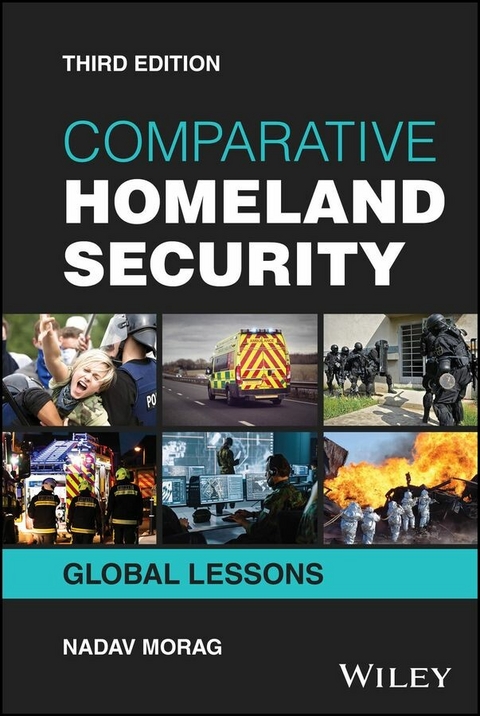
Comparative Homeland Security (eBook)
810 Seiten
Wiley (Verlag)
978-1-394-32353-1 (ISBN)
Provides practical, globally informed solutions for a stronger U.S. homeland security framework
Comparative Homeland Security: Global Lessons, Third Edition, offers critical insights into how democratic nations around the world approach homeland security (HS) threats. As the scope and complexity of HS challenges continue to expand-ranging from terrorism and public health crises to nation-state cyber operations and disinformation campaigns-this much-need book fills a crucial gap by systematically comparing international responses and offering lessons that can be adapted for the American context. Author Nadav Morag, an acknowledged expert with extensive experience both in the U.S. and internationally, structures the text around key functional areas within homeland security, such as counterterrorism, critical infrastructure protection, emergency management, and civil-military coordination.
The third edition significantly updates previous material, integrating fresh analyses on grey zone threats and post-pandemic public health security strategies. New discussions on emerging threats, including cyber-enabled subversion of democratic institutions and infrastructure, provide timely frameworks for understanding modern hybrid warfare. Each chapter presents case studies from multiple democracies, including the UK, Israel, Canada, Australia, France, Germany, and Japan, emphasizing actionable strategies and institutional frameworks. This global perspective enables readers to critically assess the transferability of foreign approaches to enhance U.S. homeland security through informed, cross-national learning.
Exploring how nations around the world address security challenges and what the U.S. can learn from their experiences, this book:
- Expands understanding of homeland security through comparative analysis of democratic nations' policies and strategies
- Incorporates up-to-date discussions of urgent threats including cyberattacks and disinformation operations
- Explores international public health preparedness and lessons learned from global responses to COVID-19
- Highlights critical infrastructure protection strategies from nations with diverse threat landscapes
- Includes analysis of interagency coordination and civil-military relations in a global context
Organized by thematic policy areas to enable quick reference to relevant case studies and strategic insights, this is essential reading for graduate-level students in homeland security, emergency management, criminal justice, and public policy programs, particularly in courses such as Comparative Homeland Security, International Security Policy, and Emergency Preparedness. Practitioners in government, defense, and civil security roles will find the book's global perspective and practical applications a valuable resource in real-world practice.
Nadav Morag is Professor and Chair of the Department of Security Studies at Sam Houston State University. He also serves on the faculty of the Center for Homeland Defense and Security (CHDS) at the Naval Postgraduate School. Previously, he was a Senior Director at Israel's National Security Council. He has written extensively on terrorism, homeland security, and Middle East policy, including previous editions of Comparative Homeland Security: Global Lessons.
Introduction
Studying Homeland Security Policies Followed by Other Countries
What Is Homeland Security?
Homeland security is a uniquely American concept. While a number of other countries around the world have employed the term since its entrance into common usage in the wake of the monstrous terrorist attacks against the World Trade Center and Pentagon on 11 September 2001, they have done so essentially because they were following America’s lead. Despite the fact that many such countries have partially adopted the term, they have yet to really internalize the discipline of homeland security in the way that it is being understood and applied in the United States. Of course, disciplines, both in terms of their practitioner and academic components, take several decades at a minimum in order to become fully developed and accepted, and consequently, it is no surprise that homeland security as an enterprise is still evolving and that there are a wide range of definitions for this discipline. It is not the purpose of this volume to provide a definitive definition of homeland security but rather to focus on the approaches and policies followed by a select group of countries within the realm of what is generally considered to be homeland security. However, in order to do this, we must begin with some sort of baseline working definition in order to determine which types of overseas policies should be surveyed and which should not.
As homeland security is an American concept, there is some logic in turning to the National Strategy for Homeland Security, originally issued in July 2022 and revised in October 2007, in order to shed some light on the concept. According to the National Strategy, homeland security is defined as “…a concerted national effort to prevent terrorist attacks within the United States, reduce America’s vulnerability to terrorism, and minimize the damage and recover from the attacks that do occur” (Bush, 2007, p. 3).
Based on this definition, homeland security would appear to essentially be focused on counterterrorism and thus recognizable overseas as essentially a national strategy for counterterrorism. Indeed, the British government issued such a strategy in 2006 (with the latest revision in 2023), known as Countering International Terrorism: The United Kingdom’s Strategy, which will be discussed in Chapter 1.
All the countries surveyed in this work have either written strategies or unwritten approaches to dealing with terrorism, and hence, in this context, the United States would appear to be just another country with just another counterterrorism strategy. Of course, in the wake of 9/11, homeland security may have indeed been viewed by many as an alternative term for counterterrorism. Nevertheless, on page 6 of the National Strategy, it is noted that preparedness in a homeland security context also requires coping with “…future catastrophes – natural and man‐made…” (Bush, 2007, p. 6), and page 10 of the document notes that catastrophic natural disasters and public health emergencies are part of the homeland security threat menu (Bush, 2007, p. 10). The National Strategy goes on to refer to a broad range of other policy issues, including transportation security, policing, border security, critical infrastructure protection, countering radicalization, and cybersecurity, to mention a few. Looking at this document as a central reference point and viewing it holistically thus suggests that homeland security, as interpreted by the leadership of the executive branch of government in the United States, Includes many diverse issues.
In terms of actual policies and institutions, one of the most important outcomes of the National Strategy and a slew of other federal strategy documents that have been produced and updated over the years since 2001 is the creation of homeland security agencies (or homeland security functions within existing agencies) at all levels of American government. The most significant of these institutional changes was, naturally, the creation of the Department of Homeland Security (DHS) in November of 2002. Thus, in order to help define homeland security, and in addition to looking at the National Strategy, one can also look at the policy areas for which DHS is responsible, as DHS is the principle federal agency with homeland security duties, though by no means the exclusive one. On 6 June 2002, then President George W. Bush, in an address to the nation, outlined the four essential missions of the newly proposed DHS: (i) border and transportation security, (ii) emergency preparedness and response, (iii) coping with the threat of weapons of mass destruction, and (iv) intelligence gathering and analysis designed to create an integrated intelligence picture (DHS, 2008, p. 5). These missions have evolved to some degree since then. In 2016, DHS also expanded its list of missions to include (i) preventing terrorism and enhancing security, (ii) securing and managing US borders, (iii) immigration, (iv) cybersecurity, and (v) disaster preparedness (DHS, 2016). In the Department’s strategic plan for fiscal years 2014–2018, and falling within the five missions noted above, areas of focus included (i) preventing terrorist travel, strengthening aviation security, preventing the smuggling and use of nuclear weapons and materials, and protecting key leaders, facilities, and events; (ii) securing the US southern border and combatting international organized crime; (iii) strengthening the immigration system (to include combatting immigration fraud and enhancing detention and removal efforts); (iv) reducing cyber risk and enhancing critical infrastructure resilience, both physical and cyber-related; and (v) enhancing preparedness and response to threats and hazards (DHS, 2014a, pp. 6–20).
In view of the above, and without attempting to produce a perfect and definitive definition of homeland security, a functional categorization of the policy areas that fall within the sphere of homeland security, based on DHS’s 2014 Quadrennial Homeland Security Review, may appear as follows:
- Policies directed at mitigating the threat of terrorism and large‐scale criminality (of the type that threatens social and economic stability) to include:
- Counterterrorism strategy.
- Intelligence sharing and coordination.
- Policing strategies.
- Countering homegrown radicalization.
- Policies directed at enhancing security measures, to include:
- Border security and immigration enforcement.
- Transportation security (air, maritime, and surface).
- Critical infrastructure protection (including cooperation between the private and public sectors).
- Cybersecurity.
- Policies directed at the management of the immediate and long‐term effects of acts of terrorism, natural disasters, and/or public health emergencies to include:
- Emergency and disaster preparedness and response.
- Mitigating, responding, and recovering from biological threats.
- Development of political, social, and economic resiliency (DHS, 2014b, pp. 76–80).
The Third Quadrennial Homeland Security Review of April 2023 included an additional focus on combatting crimes of exploitation as a sixth mission area (DHS, 2023, p. 6). Thus, at least from the perspective of the DHS, homeland security is now just as much about fighting human trafficking, ensuring access to immigration benefits, preventing foreign espionage, building resilience in the face of climate change, and coping with infectious diseases (to name just a few sub-missions), as it is about fighting terrorism. This hodgepodge of missions, only some of which are seemingly related, may lead one to question whether there is any glue that holds the entire enterprise together. To be fair, there are many departments and agencies in the federal government that engage in a wide range of disparate missions. The US Department of the Interior, for example, has a wide range of disparate missions, including land management, stewardship of national parks, provision of services to Native American tribes, conservation, and environmental protection.
If there is a common denominator to the homeland security enterprise, it can be argued that this involves addressing most threats to the country’s sovereignty, stability, and the normal operation of government and society at local, state, and/or federal levels of government – perhaps barring strictly economic threats such as the collapse of the stock market or consumer spending, the breakdown of credit markets, and other such issues that are not necessarily directly brought about by disasters, health emergencies, cyber-attacks by hostile foreign actors, criminal actors, or terrorism. Thus, various DHS mission areas can be interpreted as preparing for, mitigating, responding to, and/or recovering from threats to sovereignty, stability, and the normal operation of government and society. In this way, human trafficking, for example, can be viewed as a threat to sovereignty (including border security), and large-scale criminal enterprises, in general, can threaten stability and the normal operation of government and society – at least in a local area. Similarly, a pandemic threatens social stability and impacts the operation of government and the economy. Immigration too, while arguably not a homeland security issue when the system operates correctly, can become one in cases of immigration fraud, particularly those related to individuals suspected of being a threat in...
| Erscheint lt. Verlag | 27.8.2025 |
|---|---|
| Sprache | englisch |
| Themenwelt | Sozialwissenschaften ► Politik / Verwaltung |
| Technik | |
| Schlagworte | comparative homeland security policy • emergency management insights • global security case studies • homeland security insights • homeland security lessons • homeland security strategies • international security strategy • US critical infrastructure |
| ISBN-10 | 1-394-32353-0 / 1394323530 |
| ISBN-13 | 978-1-394-32353-1 / 9781394323531 |
| Informationen gemäß Produktsicherheitsverordnung (GPSR) | |
| Haben Sie eine Frage zum Produkt? |
 EPUB (Adobe DRM)
Kopierschutz: Adobe-DRM
Adobe-DRM ist ein Kopierschutz, der das eBook vor Mißbrauch schützen soll. Dabei wird das eBook bereits beim Download auf Ihre persönliche Adobe-ID autorisiert. Lesen können Sie das eBook dann nur auf den Geräten, welche ebenfalls auf Ihre Adobe-ID registriert sind.
Details zum Adobe-DRM
Dateiformat: EPUB (Electronic Publication)
EPUB ist ein offener Standard für eBooks und eignet sich besonders zur Darstellung von Belletristik und Sachbüchern. Der Fließtext wird dynamisch an die Display- und Schriftgröße angepasst. Auch für mobile Lesegeräte ist EPUB daher gut geeignet.
Systemvoraussetzungen:
PC/Mac: Mit einem PC oder Mac können Sie dieses eBook lesen. Sie benötigen eine
eReader: Dieses eBook kann mit (fast) allen eBook-Readern gelesen werden. Mit dem amazon-Kindle ist es aber nicht kompatibel.
Smartphone/Tablet: Egal ob Apple oder Android, dieses eBook können Sie lesen. Sie benötigen eine
Geräteliste und zusätzliche Hinweise
Buying eBooks from abroad
For tax law reasons we can sell eBooks just within Germany and Switzerland. Regrettably we cannot fulfill eBook-orders from other countries.
aus dem Bereich