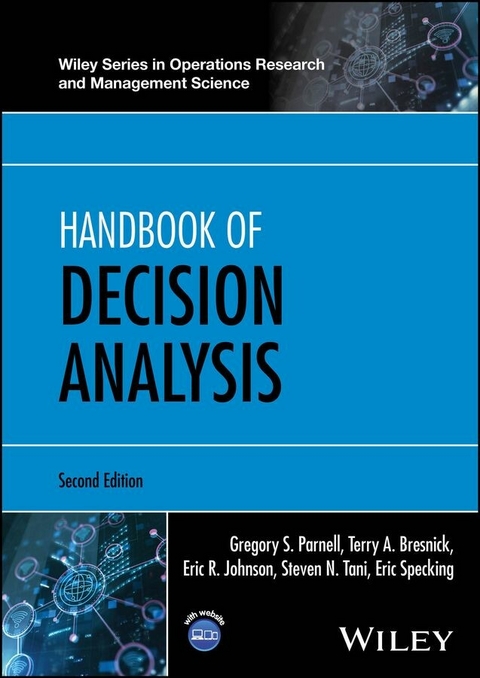
Handbook of Decision Analysis (eBook)
763 Seiten
Wiley (Verlag)
978-1-394-28389-7 (ISBN)
Qualitative and quantitative techniques to apply decision analysis to real-world decision problems, supported by sound mathematics, best practices, soft skills, and more
With substantive illustrations based on the authors' personal experiences throughout, Handbook of Decision Analysis describes the philosophy, knowledge, science, and art of decision analysis. Key insights from decision analysis applications and behavioral decision analysis research are presented, and numerous decision analysis textbooks, technical books, and research papers are referenced for comprehensive coverage.
This book does not introduce new decision analysis mathematical theory, but rather ensures the reader can understand and use the most common mathematics and best practices, allowing them to apply rigorous decision analysis with confidence. The material is supported by examples and solution steps using Microsoft Excel and includes many challenging real-world problems. Given the increase in the availability of data due to the development of products that deliver huge amounts of data, and the development of data science techniques and academic programs, a new theme of this Second Edition is the use of decision analysis techniques with big data and data analytics.
Written by a team of highly qualified professionals and academics, Handbook of Decision Analysis includes information on:
- Behavioral decision-making insights, decision framing opportunities, collaboration with stakeholders, information assessment, and decision analysis modeling techniques
- Principles of value creation through designing alternatives, clear value/risk tradeoffs, and decision implementation
- Qualitative and quantitative techniques for each key decision analysis task, as opposed to presenting one technique for all decisions.
- Stakeholder analysis, decision hierarchies, and influence diagrams to frame descriptive, predictive, and prescriptive analytics decision problems to ensure implementation success
Handbook of Decision Analysis is a highly valuable textbook, reference, and/or refresher for students and decision professionals in business, management science, engineering, engineering management, operations management, mathematics, and statistics who want to increase the breadth and depth of their technical and soft skills for success when faced with a professional or personal decision.
Gregory S. Parnell, PhD, is a Professor of Practice in the Department of Industrial Engineering at the University of Arkansas in Fayetteville, AR.
Terry A. Bresnick, MBA, is President of Innovative Decision Analysis, and Lecturer in the Department of Industrial Engineering at the University of Arkansas.
Eric R. Johnson, PhD, is Director of Decision Science at GSK, where he supports drug development decision making.
Steven N. Tani, PhD, is a retired Partner and Fellow of Strategic Decisions Group.
Eric Specking, PhD, is a Principal Engineer for Infinity Labs and a Lecturer in the College of Engineering at the University of Arkansas in Fayetteville, AR.
Qualitative and quantitative techniques to apply decision analysis to real-world decision problems, supported by sound mathematics, best practices, soft skills, and more With substantive illustrations based on the authors personal experiences throughout, Handbook of Decision Analysis describes the philosophy, knowledge, science, and art of decision analysis. Key insights from decision analysis applications and behavioral decision analysis research are presented, and numerous decision analysis textbooks, technical books, and research papers are referenced for comprehensive coverage. This book does not introduce new decision analysis mathematical theory, but rather ensures the reader can understand and use the most common mathematics and best practices, allowing them to apply rigorous decision analysis with confidence. The material is supported by examples and solution steps using Microsoft Excel and includes many challenging real-world problems. Given the increase in the availability of data due to the development of products that deliver huge amounts of data, and the development of data science techniques and academic programs, a new theme of this Second Edition is the use of decision analysis techniques with big data and data analytics. Written by a team of highly qualified professionals and academics, Handbook of Decision Analysis includes information on: Behavioral decision-making insights, decision framing opportunities, collaboration with stakeholders, information assessment, and decision analysis modeling techniques Principles of value creation through designing alternatives, clear value/risk tradeoffs, and decision implementation Qualitative and quantitative techniques for each key decision analysis task, as opposed to presenting one technique for all decisions. Stakeholder analysis, decision hierarchies, and influence diagrams to frame descriptive, predictive, and prescriptive analytics decision problems to ensure implementation success Handbook of Decision Analysis is a highly valuable textbook, reference, and/or refresher for students and decision professionals in business, management science, engineering, engineering management, operations management, mathematics, and statistics who want to increase the breadth and depth of their technical and soft skills for success when faced with a professional or personal decision.
Foreword to the 1st Edition
This handbook represents a significant advance for decision professionals. Written for practitioners by practitioners who respect the theoretical foundations of decision analysis, it provides a useful map of the tools and capabilities of effective practitioners. I anticipate that this and future editions will become the primary repository of the body of knowledge for practicing decision professionals.
This Handbook Is Timely
The practice of decision analysis (DA) is at a major inflection point. That high‐quality decisions can generate immense value is being demonstrated again and again. Leaders of organizations are increasingly aware of how opportunities are lost by making “satisficing” decisions – that is, decisions that are “good enough.” The benefit‐to‐cost ratio of investing in better decisions is frequently a thousand to one. I know of no better opportunity for value creation anywhere. As Frank Koch,1 president of the Society of Decision Professionals (SDP), has said, “Benefit to cost ratios ... are immense simply because the added cost of doing DA is negligible. We would still be paying the analysts and decision makers without DA; they would simply be talking about different things. The incremental cost of having a better, more relevant conversation is zero, so regardless of the benefit, the ratio is infinite! Even if I throw in the cost of training and learning some software, that's measured in thousands and the benefits are clearly measured in millions.”
Why is this huge opportunity still a secret from most decision makers? It is because we humans are wired to believe that we are making good decisions even when we leave value on the table. We are wired to be satisfied with good enough. We shape our memories with hindsight and rationalization. The burgeoning set of literature from the behavioral decision sciences documents many of our biases and draws attention to the gap between true decision quality (DQ) (see Chapter 5) and our natural decision‐making tendencies.
Our individual cognitive biases are amplified by social behavior, like groupthink. We assume that advocacy decision processes in use by most organizations produce good decisions, yet they are designed to suppress good alternatives. We assume that agreement is the same as DQ, yet we see a lot of agreement around nonsense. It is not uncommon to hear statements like, “I can't believe it – what were we thinking?”
If DQ can create immense additional value in specific decisions, can we develop DQ as an organizational competence? The answer is yes, and Chevron has shown the way. Over the period in which it has implemented a deep and broad adoption of DQ, Chevron has outperformed its peer group of major oil companies in creating shareholder value. While many organizations have pockets of organizational decision quality (ODQ), to my knowledge, Chevron has the broadest and deepest adoption to date. And by “adoption,” I don't just mean better analytics. All the major oil companies have the analytics to address uncertainties and risk. The difference is that the whole Chevron organization seems to be in a passionate and collaborative pursuit of value creation based on quality decisions linked with effective execution. I believe that Chevron's success is the beginning of a big wave of broad adoption of organizational DQ.2
The immense value left behind by our satisficing behaviors represents the biggest opportunity for our business and societal institutions in the coming decades. If we begin to think of these opportunity losses as an available resource, we will want to mine this immense value potential. The courts – led by the Delaware Supreme Court – are raising the bar in their interpretation of a board director's duty of “good faith.” In the coming years, board and top management's best defense is their documented practice of DQ.
Decision Professionals: The Practitioner Perspective
The SDP3 states that the mission of decision professionals is to:
- Bring DQ to important and complex decisions.
- Provide quality insights and direction through the use of practical tools and robust methodologies.
- Promote high professional standards and integrity in all work done by decision professionals.
- Advance the profession to the benefit of mankind through helping decision makers.
The role of a decision professional as a practitioner of DA and facilitator of organizational alignment is gaining acceptance. Dozens of organizations have established internal groups of professionals, designed career ladders, and developed specific competency requirements. The recently formed SDP has created a certification process and career ladder that specifies increasing competency levels for practitioners.
While there are important similarities between becoming a successful practitioner and becoming a tenured academic, there are also major differences. The decision professional is motivated by bringing clarity to complex decision situations and creating value potential in support of decision makers. He or she is less interested in the specialization required for peer‐reviewed publication. Instead, the practitioner wants to acquire practical tools and relevant skills that include both analytical and facilitation skills (project management, conflict resolution, and other so‐called “soft skills”).
The ability to address both organizational and analytical complexity (see Figure F.1) are of great importance to the practitioner. As I like to say, “If you can only deal with the analytical complexity, you can get the right answer – but nobody cares. If you can only facilitate in the face of organizational complexity, you can resolve conflicts and gain agreement – but it can be agreement around nonsense.” To bring full value, we need to deliver the combination – agreement around the best answer, the answer that generates the greatest value potential.
Figure F.1 Two Dimensions of Competence.
Individual decision professionals can deliver this if they have the competency in both areas. However, many practitioners are significantly better in one or the other – either strong analytical capabilities or strong social/emotional intelligence and facilitation skills. Therefore, many practitioners find it best to team up with others to deliver the full value of DQ. To make such teaming effective, there must be mutual respect for the other competency and a recognition that value creation from the combination is the goal. It bears repeating: We need to gain alignment around the best answer – the answer that creates the greatest value potential.
As practitioners, we are always approximating and simplifying. We are practical decision engineers and decision facilitators who want robust solutions that are effective in creating a lot of potential value. We are organizational facilitators who are not satisfied unless the best decision is owned by the decision makers and implementers. Incisiveness with tools that produce insight and processes that foster effective engagement is more important to us than another refinement to the axioms of normative decision theory. In my experience, the academic debates at the edges of decision science over the last two decades have contributed surprisingly little to the practice. Seldom is the primary challenge in solving real decision problems a matter of advanced theory.
Our goal should be to make our concepts and methods as simple and accessible as possible. As I am writing this, I am participating in a 2‐week program to teach incoming high school freshmen the basics of DQ and help them apply the concepts to significant school decision projects. I recommend that all decision professionals become engaged with spreading decision skills to youth4 for the simple reason that it will make one a better decision professional. Senior executives and ninth graders have about the same attention span (albeit for different reasons) and want to get to the essence simply and clearly. Even when we employ advanced tools, our results should always be made transparent.
Our Profession
What does it mean to be in a profession? A profession differs from a trade. In providing a professional service, we recognize that the customer cannot fully judge our service and must trust the integrity of the professional to act in the customer's best interest – even when the customer does not wish to hear it. Our customers are the decision makers – the leaders of organizations. We have the responsibility to speak “truth to power.”
We also have the obligation to not “fake it.” Decision professionals must be able to recognize which tools are normative (that is consistent with the norms of decision theory) and which are not but may be useful in practice. We also have to recognize destructive or limited practices. A true decision professional avoids making claims that can be proven to violate the basic norms of decision theory.
As with the medical field, we have to protect our profession from quackery. The profession is beginning to step up to this challenge, taking measures to assure quality and certify competence. This is, of course, a sensitive area in a field that incorporates science, art, and engineering. While I recognize the risks of trying to come to agreement on a definition of decision competence, I support...
| Erscheint lt. Verlag | 24.4.2025 |
|---|---|
| Reihe/Serie | Wiley Series in Operations Research and Management Science |
| Sprache | englisch |
| Themenwelt | Wirtschaft ► Betriebswirtschaft / Management ► Planung / Organisation |
| Schlagworte | Behavioral Decision Making • collaboration stakeholder • data analytics • Data Science • Decision Analytics • decision framing • decision hierarchies • information assessment • predictive analytics • Value Creation • value risk tradeoffs |
| ISBN-10 | 1-394-28389-X / 139428389X |
| ISBN-13 | 978-1-394-28389-7 / 9781394283897 |
| Informationen gemäß Produktsicherheitsverordnung (GPSR) | |
| Haben Sie eine Frage zum Produkt? |
 EPUB (Adobe DRM)
Kopierschutz: Adobe-DRM
Adobe-DRM ist ein Kopierschutz, der das eBook vor Mißbrauch schützen soll. Dabei wird das eBook bereits beim Download auf Ihre persönliche Adobe-ID autorisiert. Lesen können Sie das eBook dann nur auf den Geräten, welche ebenfalls auf Ihre Adobe-ID registriert sind.
Details zum Adobe-DRM
Dateiformat: EPUB (Electronic Publication)
EPUB ist ein offener Standard für eBooks und eignet sich besonders zur Darstellung von Belletristik und Sachbüchern. Der Fließtext wird dynamisch an die Display- und Schriftgröße angepasst. Auch für mobile Lesegeräte ist EPUB daher gut geeignet.
Systemvoraussetzungen:
PC/Mac: Mit einem PC oder Mac können Sie dieses eBook lesen. Sie benötigen eine
eReader: Dieses eBook kann mit (fast) allen eBook-Readern gelesen werden. Mit dem amazon-Kindle ist es aber nicht kompatibel.
Smartphone/Tablet: Egal ob Apple oder Android, dieses eBook können Sie lesen. Sie benötigen eine
Geräteliste und zusätzliche Hinweise
Buying eBooks from abroad
For tax law reasons we can sell eBooks just within Germany and Switzerland. Regrettably we cannot fulfill eBook-orders from other countries.
aus dem Bereich