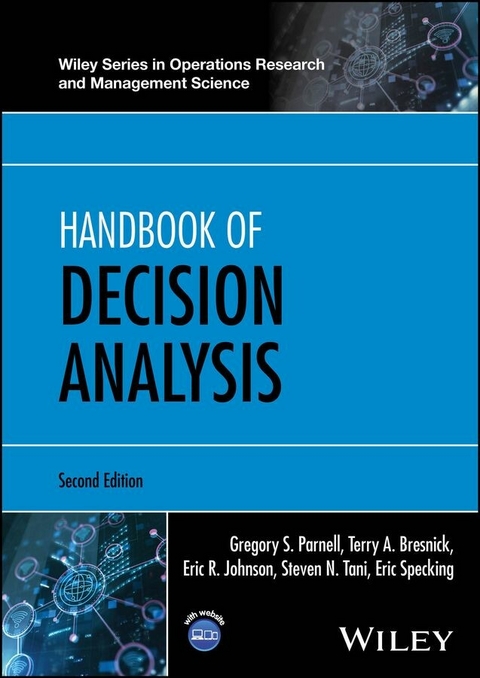
Handbook of Decision Analysis (eBook)
401 Seiten
Wiley (Verlag)
978-1-394-28390-3 (ISBN)
Qualitative and quantitative techniques to apply decision analysis to real-world decision problems, supported by sound mathematics, best practices, soft skills, and more
With substantive illustrations based on the authors' personal experiences throughout, Handbook of Decision Analysis describes the philosophy, knowledge, science, and art of decision analysis. Key insights from decision analysis applications and behavioral decision analysis research are presented, and numerous decision analysis textbooks, technical books, and research papers are referenced for comprehensive coverage.
This book does not introduce new decision analysis mathematical theory, but rather ensures the reader can understand and use the most common mathematics and best practices, allowing them to apply rigorous decision analysis with confidence. The material is supported by examples and solution steps using Microsoft Excel and includes many challenging real-world problems. Given the increase in the availability of data due to the development of products that deliver huge amounts of data, and the development of data science techniques and academic programs, a new theme of this Second Edition is the use of decision analysis techniques with big data and data analytics.
Written by a team of highly qualified professionals and academics, Handbook of Decision Analysis includes information on:
- Behavioral decision-making insights, decision framing opportunities, collaboration with stakeholders, information assessment, and decision analysis modeling techniques
- Principles of value creation through designing alternatives, clear value/risk tradeoffs, and decision implementation
- Qualitative and quantitative techniques for each key decision analysis task, as opposed to presenting one technique for all decisions.
- Stakeholder analysis, decision hierarchies, and influence diagrams to frame descriptive, predictive, and prescriptive analytics decision problems to ensure implementation success
Handbook of Decision Analysis is a highly valuable textbook, reference, and/or refresher for students and decision professionals in business, management science, engineering, engineering management, operations management, mathematics, and statistics who want to increase the breadth and depth of their technical and soft skills for success when faced with a professional or personal decision.
Gregory S. Parnell, PhD, is a Professor of Practice in the Department of Industrial Engineering at the University of Arkansas in Fayetteville, AR.
Terry A. Bresnick, MBA, is President of Innovative Decision Analysis, and Lecturer in the Department of Industrial Engineering at the University of Arkansas.
Eric R. Johnson, PhD, is Director of Decision Science at GSK, where he supports drug development decision making.
Steven N. Tani, PhD, is a retired Partner and Fellow of Strategic Decisions Group.
Eric Specking, PhD, is a Principal Engineer for Infinity Labs and a Lecturer in the College of Engineering at the University of Arkansas in Fayetteville, AR.
Qualitative and quantitative techniques to apply decision analysis to real-world decision problems, supported by sound mathematics, best practices, soft skills, and more With substantive illustrations based on the authors personal experiences throughout, Handbook of Decision Analysis describes the philosophy, knowledge, science, and art of decision analysis. Key insights from decision analysis applications and behavioral decision analysis research are presented, and numerous decision analysis textbooks, technical books, and research papers are referenced for comprehensive coverage. This book does not introduce new decision analysis mathematical theory, but rather ensures the reader can understand and use the most common mathematics and best practices, allowing them to apply rigorous decision analysis with confidence. The material is supported by examples and solution steps using Microsoft Excel and includes many challenging real-world problems. Given the increase in the availability of data due to the development of products that deliver huge amounts of data, and the development of data science techniques and academic programs, a new theme of this Second Edition is the use of decision analysis techniques with big data and data analytics. Written by a team of highly qualified professionals and academics, Handbook of Decision Analysis includes information on: Behavioral decision-making insights, decision framing opportunities, collaboration with stakeholders, information assessment, and decision analysis modeling techniques Principles of value creation through designing alternatives, clear value/risk tradeoffs, and decision implementation Qualitative and quantitative techniques for each key decision analysis task, as opposed to presenting one technique for all decisions. Stakeholder analysis, decision hierarchies, and influence diagrams to frame descriptive, predictive, and prescriptive analytics decision problems to ensure implementation success Handbook of Decision Analysis is a highly valuable textbook, reference, and/or refresher for students and decision professionals in business, management science, engineering, engineering management, operations management, mathematics, and statistics who want to increase the breadth and depth of their technical and soft skills for success when faced with a professional or personal decision.
| Erscheint lt. Verlag | 22.4.2025 |
|---|---|
| Reihe/Serie | Wiley Series in Operations Research and Management Science |
| Sprache | englisch |
| Themenwelt | Wirtschaft ► Betriebswirtschaft / Management ► Planung / Organisation |
| Schlagworte | Behavioral Decision Making • collaboration stakeholder • data analytics • Data Science • Decision Analytics • decision framing • decision hierarchies • information assessment • predictive analytics • Value Creation • value risk tradeoffs |
| ISBN-10 | 1-394-28390-3 / 1394283903 |
| ISBN-13 | 978-1-394-28390-3 / 9781394283903 |
| Informationen gemäß Produktsicherheitsverordnung (GPSR) | |
| Haben Sie eine Frage zum Produkt? |
 PDF (Adobe DRM)
Kopierschutz: Adobe-DRM
Adobe-DRM ist ein Kopierschutz, der das eBook vor Mißbrauch schützen soll. Dabei wird das eBook bereits beim Download auf Ihre persönliche Adobe-ID autorisiert. Lesen können Sie das eBook dann nur auf den Geräten, welche ebenfalls auf Ihre Adobe-ID registriert sind.
Details zum Adobe-DRM
Dateiformat: PDF (Portable Document Format)
Mit einem festen Seitenlayout eignet sich die PDF besonders für Fachbücher mit Spalten, Tabellen und Abbildungen. Eine PDF kann auf fast allen Geräten angezeigt werden, ist aber für kleine Displays (Smartphone, eReader) nur eingeschränkt geeignet.
Systemvoraussetzungen:
PC/Mac: Mit einem PC oder Mac können Sie dieses eBook lesen. Sie benötigen eine
eReader: Dieses eBook kann mit (fast) allen eBook-Readern gelesen werden. Mit dem amazon-Kindle ist es aber nicht kompatibel.
Smartphone/Tablet: Egal ob Apple oder Android, dieses eBook können Sie lesen. Sie benötigen eine
Geräteliste und zusätzliche Hinweise
Buying eBooks from abroad
For tax law reasons we can sell eBooks just within Germany and Switzerland. Regrettably we cannot fulfill eBook-orders from other countries.
aus dem Bereich