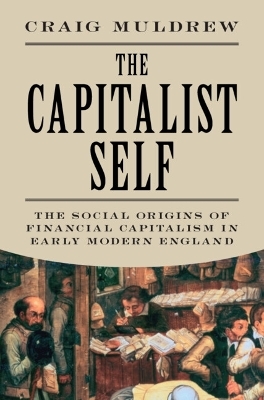
The Capitalist Self
Cambridge University Press (Verlag)
978-1-009-64447-1 (ISBN)
In this radical reinterpretation of the Financial Revolution, Craig Muldrew redefines our understanding of capitalism as a socially constructed set of institutions and beliefs. Financial institutions, including the Bank of England and the stock market, were just one piece of the puzzle. Alongside institutional developments, changes in local credit networks involving better accounting, paper notes and increased mortgaging were even more important. Muldrew argues that, before a society can become capitalist, most of its members have to have some engagement with 'capital' as a thing – a form of stored intangible financial value. He shows how previous oral interpersonal credit was transformed into capital through the use of accounting and circulating paper currency, socially supported by changing ideas about the self which stressed individual savings and responsibility. It was only through changes throughout society that the framework for a concept like capitalism could exist and make sense.
Craig Muldrew is Professor of Early Modern Social and Economic History at the University of Cambridge. He is the author of The Economy of Obligation (1998), which transformed the way we think of the relation of local credit to society.
Introduction: capitalism and dependence; 1. Early modern capitalism: a concept too big to fail?; 2. Value in motion: the inheritance of merchant capital and debates over credit; 3. The financial revolution in the provinces: the creation of local paper currencies; 4. Little land banks: the mortgaging revolution; 5. An ethical fulcrum: from participation in the body of Christ to the happy self; 6. Practical ethics, the self, and the economy in an era of religious dissent; 7. Litigation decline and the transformation of legal culture; 8. The dark side of thrift: capital and class formation – institutional stability and ethical inequality; 9. The success of the first 'modern' banks: Scotland and the thirteen colonies, and failure in France; 10. The emergence of local bankers in England, savings and Adam Smith's 'Capitalism'; Conclusion; Epilogue: the phantom of liberty.
| Erscheinungsdatum | 11.11.2025 |
|---|---|
| Zusatzinfo | Worked examples or Exercises |
| Verlagsort | Cambridge |
| Sprache | englisch |
| Maße | 159 x 236 mm |
| Gewicht | 800 g |
| Themenwelt | Geschichte ► Teilgebiete der Geschichte ► Wirtschaftsgeschichte |
| Wirtschaft ► Volkswirtschaftslehre ► Finanzwissenschaft | |
| Wirtschaft ► Volkswirtschaftslehre ► Makroökonomie | |
| ISBN-10 | 1-009-64447-5 / 1009644475 |
| ISBN-13 | 978-1-009-64447-1 / 9781009644471 |
| Zustand | Neuware |
| Informationen gemäß Produktsicherheitsverordnung (GPSR) | |
| Haben Sie eine Frage zum Produkt? |
aus dem Bereich