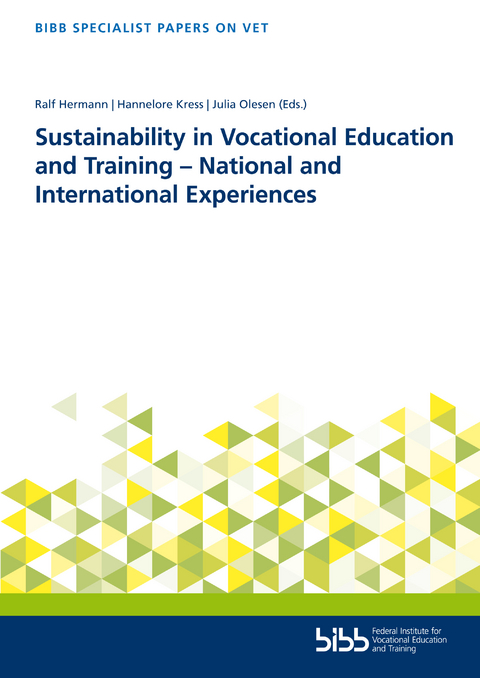
Sustainability in Vocational Education and Training – National and International Experiences
Verlag Barbara Budrich
978-3-8474-2832-9 (ISBN)
Professor Dr Friedrich Hubert Esser, President of BIBB: Preface: Experiencing transformation through sustainability in work and vocational training
Ralf Hermann, Hannelore Kress, Julia Olesen: Introduction: Sustainability in the context of international technical and vocational education and training – Analyses, best practices and experiences
Sustainability in vocational education – Macro level, systemic and structural
Moritz Ansmann, Maria Schwarz, Christian Melzig, Barbara Hemkes: Professional competencies for sustainable transformation
Tobias Schlömer, Karina Kiepe, Gerrit Rüdebusch, Niklas Günther, Jennifer Liehr: Pilot projects: Phenomena and key points of transfer of vocational education and training for sustainable development (VETSD)
Presha Ramsarup: Just transition: A call for a transformative approach to skills
Precious Lisulo: Sustainability as a driver for transformation in vocational education and training
Hannelore Kress: Uzbekistan – Bridge country on a CO2-neutral path
Hannelore Kress, Julia Giebeler Santos: Pioneer of climate-neutral energy generation – Brazil
Bruno Backes: The Kenyan vocational training system from 2008 to 2023. A big step forward to sustainability
Constanza Correa Sarmiento, Emmanuel Winkler: Integral sustainability concepts for strengthening vocational education and training in a development context – Case studies from vocational education and training, Mexico and dual higher education, Latin America
Kirsten Freimann, Gerda Magnus: Skills for a just transition to a green future: Analysis and support of the South African TVET system
Gert Zinke: Vocational training as a framework condition for a successful energy transition using hydrogen as an example
Matching system and implementation: Perspectives from sustainability – Meso level: The institutions and organisations
Roberto Díaz Páez: Best practices to implement dual training in the Costa Rican National Institute of Apprenticeship (INA) during the period 2020–2023
Nikolas Hubel: Learning settings for future-oriented training – Insight and didactic principles of the training series „KlimaKompetenz” [ClimateCompetence]
Vijayen D. Naidoo: Towards sustainable vocational education and training in South Africa: A QCTO response
Christina Strotmann, Julia Kastrup, Marc Casper, Werner Kuhlmeier, Marie Nölle-Krug, Anna-Franziska Kähler: A model for structuring and describing sustainability-related competencies for trainees in the food crafts and food industry
Michael Rothe: Daily bread – Sustainability as a driver for change in the craft of baking
Fred Kyei Asamoah: From strategy to implementation: Developing institutional greening plans for TVET institutions
Eduardo Ulate Alpízar, Karla Astorga Castro: Applications of Costa Rica‘s national bioeconomy strategy into vocational training by the Costa Rican National Institute of Apprenticeship
Making sustainability possible – Micro level. Perspectives from VET schools
Klaus Pellmann: Sustainability projects at the Peter Lenné School
Hannelore Kress, Christian Wittrock: Teaching green content in Berlin VET schools
Harald Hantke, Karina Kiepe: Teachers and trainers in dual vocational training as change agents for sustainable development!? – Questions on the professionalisation of in-company trainers and vocational school teachers
Charles Chikunda, Ruth Mulenga: The change project approach: A response for reorienting TVET education towards sustainability in Southern Africa
Making sustainability possible – Micro level. Perspectives from training companies
Mareike Beer, Dietmar Frommberger, Helmut Steinkamp: Sustainable management and training – Approaches to qualifying trainees and in-company vocational training staff in the dual system
Joachim Raschke: How ESD gets an impact in VET and human resources development – lessons learned from the ANLIN² project
Authors
Abstract
| Erscheinungsdatum | 29.01.2025 |
|---|---|
| Reihe/Serie | Fachbeiträge zur beruflichen Bildung |
| Verlagsort | Leverkusen-Opladen |
| Sprache | englisch |
| Maße | 170 x 240 mm |
| Gewicht | 550 g |
| Themenwelt | Sozialwissenschaften ► Pädagogik ► Berufspädagogik |
| Sozialwissenschaften ► Pädagogik ► Erwachsenenbildung | |
| Wirtschaft ► Betriebswirtschaft / Management | |
| Schlagworte | Berufsbildung • Greening in (T)VET • Nachhaltige Entwicklung • Nachhaltigkeit • Nachhaltigkeit in der (technischen) Berufsbildung • sustainability • Sustainability in (T)VET • sustainable development • Technical Vocational Education and Training (TVET) • technische Berufsbildung • Transformation • vocational education and training (VET) |
| ISBN-10 | 3-8474-2832-2 / 3847428322 |
| ISBN-13 | 978-3-8474-2832-9 / 9783847428329 |
| Zustand | Neuware |
| Informationen gemäß Produktsicherheitsverordnung (GPSR) | |
| Haben Sie eine Frage zum Produkt? |
aus dem Bereich