


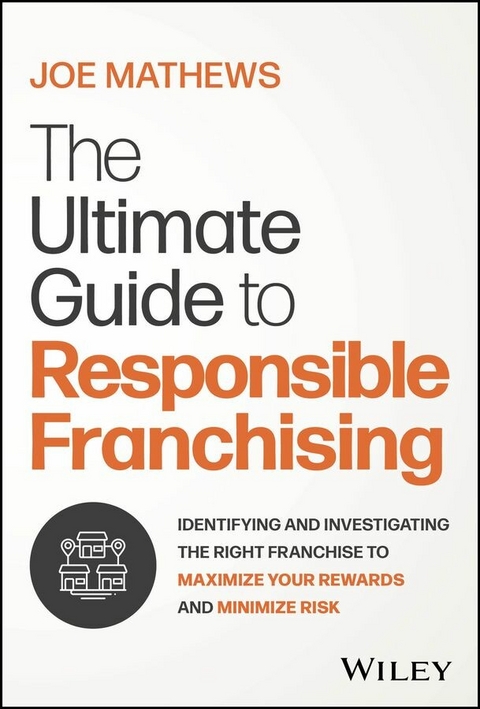
The Ultimate Guide to Responsible Franchising (eBook)
379 Seiten
Wiley (Verlag)
978-1-394-24327-3 (ISBN)
A no-nonsense, start-to-finish roadmap for aspiring franchisees
In The Ultimate Guide to Franchising, straight-shooting author Joe Mathews delivers a practical and hands-on 'how-to' guide for aspiring franchisees seeking to start their own businesses. In the book, you'll explore real-life stories from the franchising trenches that illustrate how to effectively look past the obvious and dig deep into the bones of a franchise to establish fit, predict success, and mitigate risk. You'll discover the personality types most likely to experience success and failure at franchising and identify the entrepreneurial traits that can expose you to additional risk.
You'll also find:
- All the info you need to know about franchising before you start looking for the right fit
- Strategies for properly and fully investigating a franchise opportunity in your area
- Techniques for conducting proper diligence to determine a franchisor's skills and viability.
Perfect for budding entrepreneurs, founders, and other business-minded professionals, as well as employees, leaders, and suppliers to franchise brands who want a better understanding and appreciation for how franchising works, The Ultimate Guide to Franchising will earn a place on the bookshelves of anyone serious about opening their own franchise as well as those who have already begun their franchising journeys.
JOE MATHEWS has nearly forty years' experience working in franchising, sales, and leadership roles. He has worked with companies like Subway, Fantastic Sams, Marco's Pizza, and other world-renowned franchisors. He has written five books on franchising, including Street Smart Franchising.
A no-nonsense, start-to-finish roadmap for aspiring franchisees In The Ultimate Guide to Franchising, straight-shooting author Joe Mathews delivers a practical and hands-on how-to guide for aspiring franchisees seeking to start their own businesses. In the book, you'll explore real-life stories from the franchising trenches that illustrate how to effectively look past the obvious and dig deep into the bones of a franchise to establish fit, predict success, and mitigate risk. You'll discover the personality types most likely to experience success and failure at franchising and identify the entrepreneurial traits that can expose you to additional risk. You'll also find: All the info you need to know about franchising before you start looking for the right fit Strategies for properly and fully investigating a franchise opportunity in your area Techniques for conducting proper diligence to determine a franchisor's skills and viability. Perfect for budding entrepreneurs, founders, and other business-minded professionals, as well as employees, leaders, and suppliers to franchise brands who want a better understanding and appreciation for how franchising works, The Ultimate Guide to Franchising will earn a place on the bookshelves of anyone serious about opening their own franchise as well as those who have already begun their franchising journeys.
Chapter 1
Introduction to Franchising
Before I get into what it takes to invest into individual brands, I want to establish some terminology and define some terms.
Definition of Terms
According to Dictionary.com, a franchise is “the right or license granted by a company to an individual or group to market its products or services in a specific territory.”
I find this definition insufficient to the point of being laugh-out-loud funny.
True, a franchise is a legal contract, but when a franchisor is skilled, it takes more the shape of an intangible social contract than a tangible legal contract. The social contract is simple. Franchisees agree to execute the business model to the best of their ability, to build the brand locally consistent with the intention of brand leadership, and to add more value to products and services than it charges customers in price. The franchisor agrees to continually refine processes and systems and go to work each day to add more value to the franchisees’ business than it extracts in royalties.
Put it another way, the social contract says, “We each have roles and responsibilities that impact each other. We are in this together and the common bond is building value in the brand.” Within this social contract, there is no assumed hierarchy, no parent company that lords over the lesser-than, childlike, dependent franchisees.
Franchisees and the franchisor only pull out the legal contract when this social contract breaks down.
Because the textbook definition of “franchise” describes what the relationship looks like when the franchisor relationship is failing, I want to take the time to create more intelligent and workable definitions.
- From this point forward, I use the terms franchise and franchise system to describe the legal and social contract binding all stakeholders of the brand, its franchisees, supply chain, and franchisor’s executives and employees.
- I use the term franchise agreement when I refer to the actual license. I use the term franchising industry to describe the estimated almost $800 billion ecosystem of franchisors, franchisees, suppliers, and other stakeholders, such as the IFA.
- The Franchise Performance Group (FPG) defines franchising as a brand expansion strategy entailing recruiting, training, developing, resourcing, and leading a team of successful entrepreneurs in order to build a brand.
- FPG defines the franchisee-franchisor relationship as the totality of the contractual, commercial, and interpersonal relationships between the franchisor and franchisees.
- FPG defines franchisor as the company that licenses a business system and trademarks to a franchisee and the franchisee as the licensee of the same.
- FPG describes the brand as the meaning and value customers assign to a particular business. In other words, it’s everything that customers, franchisees, franchisors, and suppliers perceive about a business – what the business represents, the service it offers, and the value customers receive by patronizing the business.
Franchising Is a Business unto Itself
Throughout this book, I repeat this again and again. Franchisors are in two businesses, and they need to be brilliant at both to succeed.
- The consumer-facing model: The brand competes in the industry in which it distributes its products and services. This is how well the brand sells its products and services to the marketplace.
- The business of franchising: I define the business of franchising as “recruiting, training, developing, resourcing, and leading a team of entrepreneurs to successfully build a brand.” Notice the product or service is not mentioned in the business of franchising. The business of franchising is about delivering effective training, coaching, and expertise of the consumer-facing model to new franchisees who presumably are new to the industry and business model.
I briefly describe these two businesses and continue to develop these important themes throughout the book.
The Customer-Facing Model
For simplicity, I call the end user “the customer,” whether the business is business-to-business or business-to-consumer. Virtually every brand is faced with stiff competition within their respective industries. This appears self-evident. However, what does it mean to compete effectively?
A brilliant franchisor will have built a consumer-facing business model, which on balance should receive high marks on all the following criteria:
- Their consumer offer is unique (or copycats will crowd the market and drive down revenues and margins).
- The business model is profitable (delivering acceptable returns for franchisees).
- Their offer is defensible (so franchisees can carve out and defend a position in their marketplace and distance themselves from copycat concepts).
- Their business is resilient (so franchisees can weather any coming economic storms).
- The business is replicable and scalable (so an average franchisee will predictably earn an acceptable return on their time, money, and energy, regardless of whether they are opening in existing markets or pioneering a new market).
- The business offers long-term sustainability (so once the brand is built, the business creates a flywheel that generates predictable and recurring income for franchisees).
The following sections look at each of these points in more detail.
The Consumer Offer Is Unique
Businesses that offer commoditized products and services will ultimately engage in a war of convenience and price. If the customer can’t distinguish one brand’s offer from the next, then ultimately business will be won by which brand offers the lowest price, is nearest to the customer, or can get to the customer the fastest. The market becomes a war of price and convenience and franchisees struggle to remain profitable.
As a franchisee, you never want a business involved in a price war. Years ago, Subway offered $5 subs. The brand essentially trained the customer to spend no more than $5 on their product. As proteins, commodities, and labor costs increased, franchisees had a brutal time trying to pass these costs to their customers, who wanted $5 subs. Margins shrank. Franchisees became less profitable. The goals of the franchisor – who makes their money on the top line revenue and not on the bottom line cash flow – were not aligned with their franchisees, and thus were slow to respond. Franchisee dissatisfaction soared. Many franchisees started diversifying into other food concepts rather than reinvesting into opening more Subways, to the detriment of the brand.
The Consumer Model Is Profitable
A small business exists for the mutual benefit of the customer and the business owner. Whether the franchisee is an owner-operator or runs an empire, the business needs to consistently hit their financial objectives or it’s a bad investment. The franchisor does not get to say what is or isn’t a good investment any more than the business owner gets to tell a customer what they should value. The franchisee alone determines what is and isn’t an acceptable return on time, money, and energy.
The Offer Is Defensible
One of my favorite brands is Sandler, a business training franchise operating inside a nearly $80-billion industry where more than 60% of businesses outsource their training. While their franchise agreement is only five years, many franchisees have a 15–20 year tenure, meaning they keep renewing their agreements and doing business with the brand. Franchisees love what they do. Since the brand markets sales knowledge and experience as its core product, think about the brand’s competitive advantage of sustaining a team of highly skilled and experienced Sandler sales zealots around the country.
Sandler, at the time of this writing, is one of the nation’s leaders in sales training, with systemwide sales reported to be about $150 million. No brand operating in the training space appears to have more than 1% market share, so it’s a dominant brand in a fragmented industry, giving franchisees a real competitive advantage over independents in the same space.
Other than Dale Carnegie, Miller Heiman, and a few other brands, Sandler franchisees compete against a cottage industry of motivational speakers and success coaches who may have personality but often lack valuable intellectual property and sales systems to impart to their clients.
Why do I like dominant brands in a fragmented market? Simple. When a new Sandler franchisee opens in a new market, what competitor can keep the franchisee out? What competitor can make it rough for the franchisee to acquire new business?
The Business Is Resilient
The business is not subject to dramatic market fluctuations, or the model is adaptable. Take hair care, for instance. Stylist.com once published a study that showed the average woman spends $50,000 coloring her hair during her lifetime. Whether the stock market is up or down or interest rates are high or low, whether it’s raining or snowing, a universal truth remains. Many women don’t want gray hair.
The Business Offers...
| Erscheint lt. Verlag | 8.10.2024 |
|---|---|
| Sprache | englisch |
| Themenwelt | Sachbuch/Ratgeber ► Beruf / Finanzen / Recht / Wirtschaft |
| Wirtschaft ► Betriebswirtschaft / Management | |
| Schlagworte | franchise brand opportunities • franchise brands • franchise due diligence • franchise opportunities • Opening a franchise • should I open a franchise • should I start a franchise • what's it like to franchise • what's it like to start a franchise |
| ISBN-10 | 1-394-24327-8 / 1394243278 |
| ISBN-13 | 978-1-394-24327-3 / 9781394243273 |
| Informationen gemäß Produktsicherheitsverordnung (GPSR) | |
| Haben Sie eine Frage zum Produkt? |
 EPUB (Adobe DRM)
Kopierschutz: Adobe-DRM
Adobe-DRM ist ein Kopierschutz, der das eBook vor Mißbrauch schützen soll. Dabei wird das eBook bereits beim Download auf Ihre persönliche Adobe-ID autorisiert. Lesen können Sie das eBook dann nur auf den Geräten, welche ebenfalls auf Ihre Adobe-ID registriert sind.
Details zum Adobe-DRM
Dateiformat: EPUB (Electronic Publication)
EPUB ist ein offener Standard für eBooks und eignet sich besonders zur Darstellung von Belletristik und Sachbüchern. Der Fließtext wird dynamisch an die Display- und Schriftgröße angepasst. Auch für mobile Lesegeräte ist EPUB daher gut geeignet.
Systemvoraussetzungen:
PC/Mac: Mit einem PC oder Mac können Sie dieses eBook lesen. Sie benötigen eine
eReader: Dieses eBook kann mit (fast) allen eBook-Readern gelesen werden. Mit dem amazon-Kindle ist es aber nicht kompatibel.
Smartphone/Tablet: Egal ob Apple oder Android, dieses eBook können Sie lesen. Sie benötigen eine
Geräteliste und zusätzliche Hinweise
Buying eBooks from abroad
For tax law reasons we can sell eBooks just within Germany and Switzerland. Regrettably we cannot fulfill eBook-orders from other countries.
aus dem Bereich


