Problem Structuring (eBook)
562 Seiten
Wiley (Verlag)
978-1-119-74484-9 (ISBN)
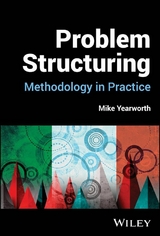
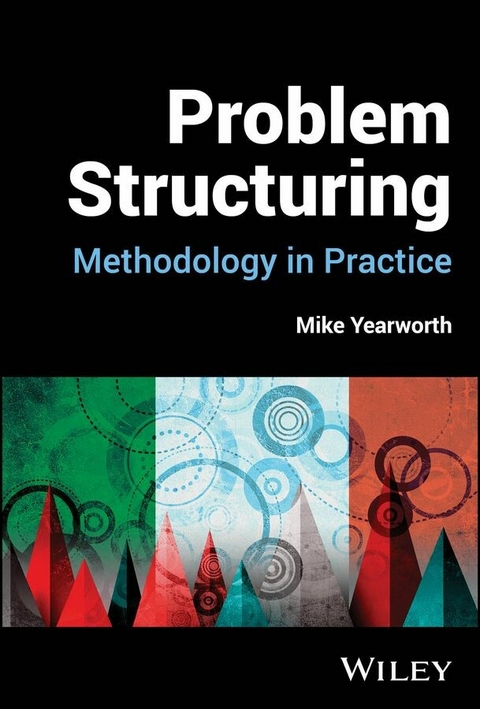
Current perspectives on approaches to problem structuring in operational research and engineering and prospects for problem structuring methods applicable to a wide range of practice.
Bridging between operational research (OR) and engineering practice, Problem Structuring: Methodology in Practice is grounded in the emergence of soft OR and its development over time as a distinctively new field, broadening the scope of OR to deal with issues of transforming, strategising, and planning in the context of wicked problems. The book is centred on a methodological framing of intervention processes known as problem structuring methods (PSMs) and the techniques presented are suitable for practitioners across a broad range of disciplines.
Written by a highly qualified professor of engineering and management, Problem Structuring: Methodology in Practice contains four linked sections that cover:
- I. Problem formulation when dealing with wicked problems, justification for a methodological approach, the emergence of soft OR, the relevance of pragmatic philosophy to OR practice.
- II. Traces debates and issues in OR leading to the emergence of soft OR, comparative analysis of PSMs leading to a generic framework for soft OR practice, addressing practical considerations in delivering PSM interventions.
- III. Charts the emergence of a problem structuring sensibility in engineering practice, introduces a new PSM based on hierarchical process modelling (HPM) supported by teaching and case studies, makes the case for a processual turn in engineering practice supported by HPM with relevance to OR practice.
- IV. Evaluation of PSM interventions, survey of applications, use of group support systems, new developments supported by machine learning, recontextualising soft OR practice.
Problem Structuring: Methodology in Practice is a thought-provoking and highly valuable resource relevant to all 'students of problems.' It is suitable for any UK Level 7 (or equivalent) programme in OR, engineering, or applied social science where a reflective, methodological approach to dealing with wicked problems is an essential requirement for practice.
Mike Yearworth BSc, PhD, MBA, MBCS, CEng, is Emeritus Professor of Management Science at the University of Exeter Business School. He is Co-Editor-in-Chief of the European Journal of Operational Research and the Systems Engineering Field Editor for Systems Research and Behavioral Science.
Current perspectives on approaches to problem structuring in operational research and engineering and prospects for problem structuring methods applicable to a wide range of practice. Bridging between operational research (OR) and engineering practice, Problem Structuring: Methodology in Practice is grounded in the emergence of soft OR and its development over time as a distinctively new field, broadening the scope of OR to deal with issues of transforming, strategising, and planning in the context of wicked problems. The book is centred on a methodological framing of intervention processes known as problem structuring methods (PSMs) and the techniques presented are suitable for practitioners across a broad range of disciplines. Written by a highly qualified professor of engineering and management, Problem Structuring: Methodology in Practice contains four linked sections that cover: I. Problem formulation when dealing with wicked problems, justification for a methodological approach, the emergence of soft OR, the relevance of pragmatic philosophy to OR practice. II. Traces debates and issues in OR leading to the emergence of soft OR, comparative analysis of PSMs leading to a generic framework for soft OR practice, addressing practical considerations in delivering PSM interventions. III. Charts the emergence of a problem structuring sensibility in engineering practice, introduces a new PSM based on hierarchical process modelling (HPM) supported by teaching and case studies, makes the case for a processual turn in engineering practice supported by HPM with relevance to OR practice. IV. Evaluation of PSM interventions, survey of applications, use of group support systems, new developments supported by machine learning, recontextualising soft OR practice. Problem Structuring: Methodology in Practice is a thought-provoking and highly valuable resource relevant to all students of problems. It is suitable for any UK Level 7 (or equivalent) programme in OR, engineering, or applied social science where a reflective, methodological approach to dealing with wicked problems is an essential requirement for practice.
Preface
‘We are not students of some subject matter, but students of problems. And problems may cut right across the borders of any subject matter or discipline.’
(Popper, 1963, p. 67)
The discipline of Operational Research (OR) emerged in the period between roughly the mid-1930s and the years encompassing the Second World War. The fact that an entire applied scientific endeavour focused on addressing operational issues came into existence and was crafted for the singular purpose of delivering interventions in support of winning a war is striking. The notion of addressing operational issues can be understood simply as conducting the research necessary for achieving the greatest effect from the limited resources available. The purpose was clearly self-evident and provided ample motivation. Much of the post-war diffusion of OR practices into government and industry reflected this single-minded purpose, leading to a great deal of success for the methods, tools and techniques at its core. Goodeve (1948a,b,c) provides an early account of the emergence of OR in the United Kingdom, and Kittel (1947) relates a similar story for the United States. Keys (1995, pp. 1–76) also provides a detailed account of these early years. As is the nature of knowledge gained from empirical work, OR became codified as a discipline and subject to formal teaching and research (for example, as presented in Churchman, Ackoff and Arnoff (1957)), leading to what Keys (1995, pp. 77–148) refers to as the period of growth and stability in the years 1945–1970.
Why go back over the emergence of a discipline that was initially shaped by fighting a war? What is the relevance? The answer is simple and is located in the challenges arising from new existential threats such as climate change, water shortages, flooding, resource depletion, pandemics of disease and diet, housing, waste accumulation, etc.1 These are perhaps not as self-evident to all as a global conflict and some still remain contested by certain constituencies – that are either isolated from the effects, choose not to look, or have some other motivation for denialism – but they are ample motivation for those who do choose to act. The contribution that OR can make today is the same as when it emerged – conducting the operational research necessary for achieving the greatest effect for its clients using the limited resources available. However, today, it must make itself relevant to problem contexts that are not so singular in nature, where there are different, often contested, viewpoints and perspectives on the problems and the means to address them; such problems are wicked (Rittel & Webber, 1973). In short, it needs to demonstrate that it can also operate as an applied social-science, an endeavour capable of moderating its positivism into accommodating a softer, more humanist framing. Thankfully, much of the groundwork has already been done by a small group of practitioners/scholars who emerged from the mainstream of OR in the 1970s and 1980s to pioneer a field colloquially known as Soft OR and centred on a methodological framing of techniques known as problem structuring methods (PSMs) (Rosenhead, 1989c).
This book is grounded in the history of the emergence of Soft OR and its development over time as a distinctively new endeavour. The origins of OR in the years leading up to and including the Second World War had already shown how knowledge of the ‘hard’ physical sciences and mathematics could be applied to pressing operational issues. The notion of ‘soft’ was intended to convey a further inclusion of ideas from the applied social sciences, broadening the scope of OR to deal with the more complex issues of transforming, strategising and planning – rather than just optimising. Although rooted in OR, the ideas presented here, together with practical methods and supporting case studies, are suitable for engineering students, OR practitioners that are not aware of soft methods and early notions of problem formulation, systems thinkers and, as is argued later, to applied social scientists. The first part of Chapter 7 is devoted to an account of how the evolution of Soft OR can be read into engineering practice leading to an equivalent notion of ‘soft engineering’, which would have been a highly useful label had it not already been taken. The uptake of PSMs can also be found in areas of project management, environmental management, sustainability transitions and energy policy amongst many others. Chapter 13 surveys some of these applications and also discusses similarities between PSMs and applied techniques in the social sciences that have emerged from a completely different research tradition. The fact that communities of researchers and practitioners have traversed disciplinary landscapes and arrived at doing similar work should be no surprise to those aware of the chaos of disciplines (Abbott, 2005).
The content addresses the knowledge requirement to select and apply, a range of problem structuring methods to understand complex problems across a range of duties for an OR practitioner in the recently launched Operational Research Specialist Degree Apprenticeship specification by the Institute for Apprenticeships & Technical Education (2021). It is is also suitable for engineering students at UK Level M/7 and above, i.e. final-year MEng, MSc, EngD/PhD and their equivalents as well as to support CPD for engineering practitioners. Students at schools or faculties signed up to the Council of Engineering Systems Universities (CESUN) should find the material of interest, offering an interpretive modelling perspective complementary to their main reading lists. The historical account of the emergence of Soft OR (in Chapter 4) and of a problem structuring sensibility in an engineering context (in Chapters 7 and 8) provides some insight into what might be involved to address recent calls for changes in engineering education (Sorby, Fortenberry, & Bertoline, 2021). The material presented in Chapters 9 and 10 was, in part, developed and used in teaching such M-level modules in Civil Engineering Systems and Sustainable Systems, and for an EngD in Systems taught programme at the University of Bristol between 2009 and 2016. This material was further adapted to provide an accessible approach to structuring an operations strategy problem for MBA students at the University of Exeter Business School from 2017 to 2022.
The approach to thinking about problem structuring presented in this book is intended for broad application. Whilst many of the developments in the field were the result of learning from consulting engagements, it is not just consultants who should benefit from studying problem structuring methods. Perhaps there has been a de-skilling taking place across businesses and the public sector that has left them in need of the services of the management consultant to help them deal with complex problems. However, in Chapter 6, the argument is put forward that there is both an abundance of everyday problem structuring taking place in organisations that could become more formalised and rigorous. It is also possible that quite often the keys to unlocking the understanding of a complex organisational problem can unwittingly be given away to consultants in the ‘liminal’ space before a contract for services is signed. Therefore, building up organisation capability in problem structuring skills is unlikely to be a waste of resource even if, at the end of the day, organisations only go as far as becoming more discerning purchasers of the consultants’ services.
The necessity for delivering an MBA programme online during the COVID pandemic in 2020 and 2021 provided further empirical evidence for the use of group support systems (GSS) to enable geographically distributed teams to work together effectively using PSMs and contributed material for Chapter 14. Further developments of platforms to support problem structuring in same time/different places workshops are also discussed in Chapter 14, especially in the light of more dynamic working environments that will need to support hybrid working and reduced flying.
Within OR, there has been a long history of borrowing, overlap and intersection with Systems Thinking (Ackoff, 2001; Keys, 1991; Mingers & White, 2010). The emergence of Soft OR can be viewed as a recognition that a broad systemicity was (and is) needed in the practice of OR. Soft systems methodology (SSM) is claimed by the Soft OR community to be a PSM, and I must acknowledge the significant influence that Systems Thinking, Systems Practice (Checkland, 1981) has had on my own work, generally, not just in this book – every now and then we come across works that have such a profound effect. The use of hierarchical process modelling (HPM) in problem structuring that is presented in Chapter 9 was developed by academic practitioners and colleagues working in Engineering Systems at the University of Bristol. The similarities and differences between HPM and the Purposeful Activity System models from SSM are also discussed within the wider context of using HPM in an interpretivist sense, largely inspired by the argument presented by Checkland and Holwell (2004). The book is therefore of relevance to students on Systems Thinking, Systems Engineering (or, indeed, Engineering Systems) programmes, who may...
| Erscheint lt. Verlag | 6.9.2024 |
|---|---|
| Sprache | englisch |
| Themenwelt | Wirtschaft ► Betriebswirtschaft / Management ► Unternehmensführung / Management |
| Schlagworte | Complex Systems • Engineering Ethics • Engineering practice • engineering systems • Group Support Systems • hierarchical process modelling • Operational Research • problem structuring • problem structuring methods • soft operational research • Soft Systems Methodology • Systems Engineering • systems thinking • the practice of operational research • Wicked Problems |
| ISBN-10 | 1-119-74484-9 / 1119744849 |
| ISBN-13 | 978-1-119-74484-9 / 9781119744849 |
| Informationen gemäß Produktsicherheitsverordnung (GPSR) | |
| Haben Sie eine Frage zum Produkt? |
 EPUB (Adobe DRM)
Kopierschutz: Adobe-DRM
Adobe-DRM ist ein Kopierschutz, der das eBook vor Mißbrauch schützen soll. Dabei wird das eBook bereits beim Download auf Ihre persönliche Adobe-ID autorisiert. Lesen können Sie das eBook dann nur auf den Geräten, welche ebenfalls auf Ihre Adobe-ID registriert sind.
Details zum Adobe-DRM
Dateiformat: EPUB (Electronic Publication)
EPUB ist ein offener Standard für eBooks und eignet sich besonders zur Darstellung von Belletristik und Sachbüchern. Der Fließtext wird dynamisch an die Display- und Schriftgröße angepasst. Auch für mobile Lesegeräte ist EPUB daher gut geeignet.
Systemvoraussetzungen:
PC/Mac: Mit einem PC oder Mac können Sie dieses eBook lesen. Sie benötigen eine
eReader: Dieses eBook kann mit (fast) allen eBook-Readern gelesen werden. Mit dem amazon-Kindle ist es aber nicht kompatibel.
Smartphone/Tablet: Egal ob Apple oder Android, dieses eBook können Sie lesen. Sie benötigen eine
Geräteliste und zusätzliche Hinweise
Buying eBooks from abroad
For tax law reasons we can sell eBooks just within Germany and Switzerland. Regrettably we cannot fulfill eBook-orders from other countries.
aus dem Bereich