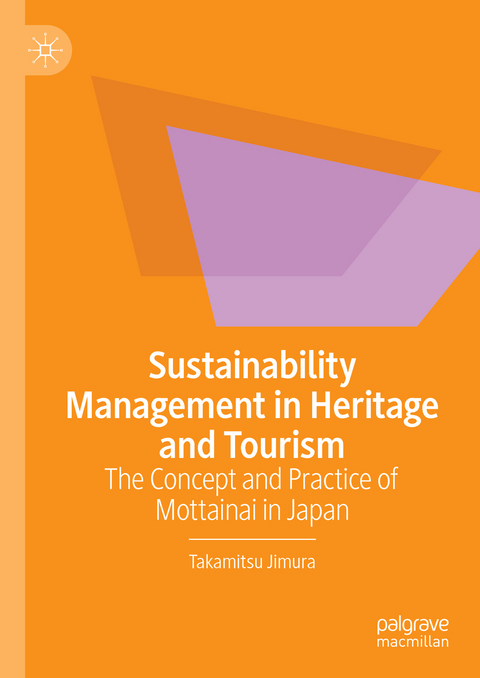
Sustainability Management in Heritage and Tourism
Springer International Publishing (Verlag)
978-3-031-40268-5 (ISBN)
Increasingly, the tourism industry is looking towards sustainability, responding to public demand and local environmental policy. This monograph explores the concept of sustainability in the context of heritage and tourism studies, as well as examining the practices adopted to realize or enhance the sustainability of these industries. Beginning with a broad overview, outlining the theory and scholarly landscape, this book then focuses on cases of sustainable tourism in Japan, exploring the concept of 'mottainai'. Mottainai is a traditional Japanese term and means an ethical attitude towards the use of a range of resources needed for human life. This Japanese word can be understood as 'what a waste', and can promote the environmentally-friendly way of life, encouraging reduce, reuse and recycle.
This book will be of interest to scholars and students of heritage, tourism, and sustainability management; both those interested in Japan specifically, and those who are interested in new approaches for sustainability in tourism management.
lt;b>Takamitsu Jimura is Programme Manager for MSc International Tourism Management and Senior Lecturer in Tourism at Liverpool John Moores University, UK. Takamitsu holds a PhD in Tourism and Cultural Heritage Management and an MSc in Tourism, Conservation and Sustainable Development. His key research interests include cultural heritage and tourism, tourism marketing and sustainable tourism. Takamitsu is especially interested in exploring the impacts of World Heritage Site designation on tourism development, local communities, and heritage management and conservation activities.
d in exploring the impacts of World Heritage Site designation on tourism development, local communities, and heritage management and conservation activities.
d in exploring the impacts of World Heritage Site designation on tourism development, local communities, and heritage management and conservation activities.
d in exploring the impacts of World Heritage Site designation on tourism development, local communities, and heritage management and conservation activities.
d in exploring the impacts of World Heritage Site designation on tourism development, local communities, and heritage management and conservation activities.
Part I Introduction.-1 Introduction - Sustainability and Japan's Heritage and Tourism.-Part II Sustainability of Heritage.-2 Sustainability of Japan's Tangible Cultural Heritage.-3 Sustainability of Japan's Intangible Cultural Heritage.-4 Sustainability of Japan's Natural Heritage.-Part III Sustainability of Tourism.-5 Sustainability of Japan's Transport Sector.-6 Sustainability of Japan's Accommodation Sector.-7 Sustainability of Food and Beverage Sector in Japan.-8 Sustainability of Visitor Attractions and Events Sector in Japan.-9 Sustainability of Tourism Intermediaries in Japan.-Part IV Conclusions.-10 Conclusions - Reflections and Futures
| Erscheinungsdatum | 08.10.2023 |
|---|---|
| Zusatzinfo | XIX, 330 p. 30 illus. |
| Verlagsort | Cham |
| Sprache | englisch |
| Maße | 148 x 210 mm |
| Gewicht | 553 g |
| Themenwelt | Wirtschaft ► Betriebswirtschaft / Management ► Unternehmensführung / Management |
| Schlagworte | Business Ethics • Corporate Social Responsibility • heritage management • Japan • museum management • Regional studies |
| ISBN-10 | 3-031-40268-5 / 3031402685 |
| ISBN-13 | 978-3-031-40268-5 / 9783031402685 |
| Zustand | Neuware |
| Informationen gemäß Produktsicherheitsverordnung (GPSR) | |
| Haben Sie eine Frage zum Produkt? |
aus dem Bereich