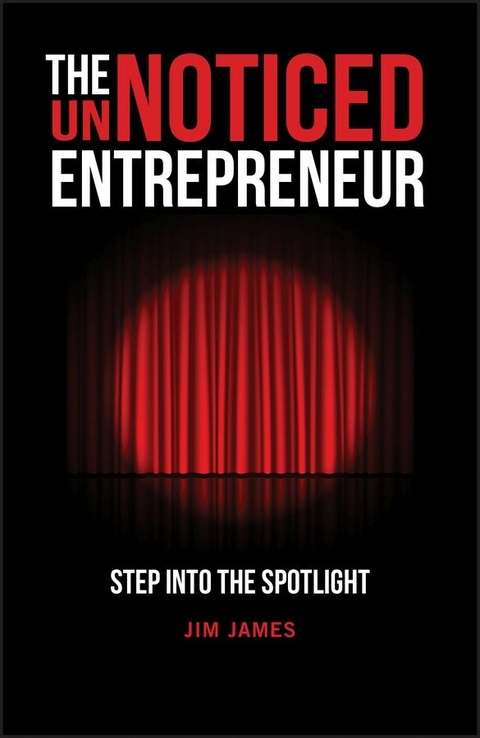
The UnNoticed Entrepreneur, Book 1 (eBook)
John Wiley & Sons (Verlag)
978-0-85708-964-9 (ISBN)
Classic and outside-the-box tactics for taking your company to the next level
The UnNoticed Entrepreneur: Step Into the Spotlight gives you practical advice for drawing customers into your vision and rising above the rabble. Specifically, this book shows you how you can share the vision for your company, the why behind your product or service. If you can do that, customers will come. The secret? You already have everything you need to become famous in your market. You don't need expensive ad agencies and faddish strategies. After all, you started your business, so you have the best understanding of what you're doing. This book shows you how to communicate your purpose creatively, simply, and authentically through telling your story, personalising your marketing, engaging with customers and prospects, and getting the attention of the right people in the right channels.
If you're passionate about creating value, making a difference, and benefitting others, this is the book for you. This collection of essays will give you ideas, help you make connections, and motivate you to put in the work you need to get noticed for all the good that you do. You'll learn how to:
- Construct a unique story around your business and communicate that story through effective branding
- Stand out from the competition by creating more compelling marketing materials and reaching out in a more targeted way
- Generate buzz around your business with creative offerings like podcasts, media interviews, surveys, AI content, and more
- Rise to the top of your market by using marketing technology, leveraging digital platforms, and understanding today's marketing work
This is the perfect book for business owners and budding entrepreneurs looking for no-nonsense advice on how to really get ahead. You've got the ambition, and The UnNoticed Entrepreneur can help you realize it.
Classic and outside-the-box tactics for taking your company to the next level The UnNoticed Entrepreneur: Step Into the Spotlight gives you practical advice for drawing customers into your vision and rising above the rabble. Specifically, this book shows you how you can share the vision for your company, the why behind your product or service. If you can do that, customers will come. The secret? You already have everything you need to become famous in your market. You don t need expensive ad agencies and faddish strategies. After all, you started your business, so you have the best understanding of what you're doing. This book shows you how to communicate your purpose creatively, simply, and authentically through telling your story, personalising your marketing, engaging with customers and prospects, and getting the attention of the right people in the right channels. If you re passionate about creating value, making a difference, and benefitting others, this is the book for you. This collection of essays will give you ideas, help you make connections, and motivate you to put in the work you need to get noticed for all the good that you do. You ll learn how to: Construct a unique story around your business and communicate that story through effective branding Stand out from the competition by creating more compelling marketing materials and reaching out in a more targeted way Generate buzz around your business with creative offerings like podcasts, media interviews, surveys, AI content, and more Rise to the top of your market by using marketing technology, leveraging digital platforms, and understanding today's marketing work This is the perfect book for business owners and budding entrepreneurs looking for no-nonsense advice on how to really get ahead. You've got the ambition, and The UnNoticed Entrepreneur can help you realize it.
Chapter Two
Which of the Four Villains Are You?
Oscar Trimboli, Author Listener & Speaker of Oscar Trimboli Pty Limited, Greater Sydney Area, Australia.
Oscar Trimboli is on a quest to create 100 million Deep Listeners in the world. He is an author, host of the Apple award‐winning podcast–Deep Listening', and a sought‐after keynote speaker. He is passionate about using the gift of listening to bring positive change in homes, workplaces, and the world.
Through his work with chairs, boards of directors and executive teams in local, regional, and global organisations, Oscar has experienced first hand the transformational impact leaders and organisations can have when they listen.
The four villains of listening are the Dramatic, the Interrupting, the Lost, and the Shrewd. When you're dealing with complex collaborative, constrained, or conflict situations, listening is one of the most important superpowers you have as an entrepreneur.
The Importance of Listening
Many of us haven't been taught how to listen. Most people know Mathematics, wines, and cheese. However, there is no language around listening.
Through his listening quiz, Oscar is trying to honour a conversation he had with a vice president, who once took him aside at the end of a meeting. The vice president told him back then, “If you could code the way you listen, you could change the world.” At that moment, it did not make sense to him because all he did was cheer knowing that he wasn't fired (he initially thought that he'd get fired).
As a marketing director of Microsoft at the time, he eventually pondered on the question: Is it possible to code how people listen? Because it can be done for Maths, English, or Chemistry.
Afterwards, he set up an assessment tool that features 20 questions as a way of coding how to listen longer term. Now, he'd also love to have automated tools or applications within Zoom, for example, that could tell one's listening ratio. For instance, he imagines a percentage bar at the top of the screen.
Listening is crucial because the more senior you are in the organisation, the more listening you should do during your day. The more sales you do, the more your listening should also be. Unfortunately, this is not the case.
When you're dealing with complex collaborative, constrained, or conflicted situations, listening is one of the most important superpowers that you'll have as an entrepreneur. Without that, you can't bring people along in the journey with you.
The difference between hearing and listening is the action you take. A lot of employees get frustrated with business owners to whom they keep telling the same thing yet get nothing. For business owners, listening is when you act on something you're told about.
The Four Villains of Listening
Oscar and his team have done a lot of work with behavioural scientists, market research companies, computer software professionals, and academicians for two and a half years. The goal was not only to create a quiz but to prove it's valid across English‐speaking cultures.
One important thing to know about listening is it's situational, relational, and contextual. You'll listen differently in many different situations. You'll listen differently to a police officer than you will to a school principal, actor, or accountant.
According to their research, there are four villains of listening: the dramatic, the interrupting, the lost, and the shrewd.
The Lost Listener. If you're a lost listener, you would forget everything you're listening to because you're drifting off somewhere else. You might be thinking about something related to what you're told about. The lost listener is completely lost in their devices or something in the conversation that triggers them to think about, for instance, a holiday that they wish they had. Of the 11 000 people who took their quiz so far, 22% belong to this category.
The Dramatic Listener.Dramatic listeners love listening to your story. They engage with you really well and often do too much of connecting with you. If you say to them that you're struggling with a staff member, they'd say that you have to wait and listen to their problem about their staff member. Simply put, they love the spotlight being back on them. Though they love having a connection, they don't understand the difference between empathy and sympathy.
The Interrupting Listener. The interrupting listening villain is the most overt listening villain. They're the quiz show contestant who presses the buzzer, anticipates the question and the answer, but gets it wrong. They value time, and productivity matters to them. They have a mindset that they've already heard something before, so they tend to jump in and get to it quicker. While their intention isn't wrong, they're still considered impatient.
The Shrewd Listener. The shrewd listeners are problem‐solving machines. Although they give you a great face and you feel like they're really engaged in listening, in reality, this is what could be on their mind: I studied this long. I'm such an expert in this field and you've got such a basic problem. I'm going to think about three to six problems that you haven't even thought about. However, speakers can sense this. They can see the cogs going on in these listeners' wheels, turning over and going through the issues. Their mindset then is to stop these listeners from trying to fix those and get them to listen to what they've got to say.
The shrewd listener could also be thinking that they're that kind of listener at work, but they're a lost listener at home. When you take Oscar's quiz, you'll get a primary type of listening and a secondary one. The former is who you are at work; the latter, at home.
He always points out that labels are good on food jars and pharmaceutical products, but not on people. That's why during the episode, he reiterated that they're not labelling you but your behaviour.
On Self‐Awareness
When it comes to listening, many people think that they're above average. Oscar mentioned that around 74.9% consider themselves as well above average or a long way above average. And this shows an issue with selfawareness.
There are five levels of listening. The first level is knowing what your barriers are.
Most people aren't even aware of what gets in their way because when listening, they're taught that the focus should be on the speaker. However, he's not saying that you shouldn't listen to the speaker; rather, you shouldn't start there. You need to start by listening to yourself.
Until you know your villains, you can't introduce yourself to your superheroes. And for each listening villain, there's an alternate superhero. If you take his quiz and sign up for the 90‐day challenge (which can be found at the bottom of their five‐page report), you'll start to discover which one of those superheroes can emerge from you as you explore the world of listening.
A Little Neuroscience Hack
Oscar mentioned three numbers you need to know: 125, 400, and 900. On average, a person speaks at 125 words a minute (If you're an auctioneer or a horse race caller, you can probably speak at 200 words per minute). Moreover, an individual can listen to up to 400 words a minute. These show that there's a disconnect between the speed at which people listen and the speed at which they talk.
Genetically and neurologically, you'll get distracted. However, Oscar isn't talking about mindfulness; he won't teach you how not to get distracted. Because, ironically, if you'll get distracted, it will help you reset your attention much quicker. Keep in mind that you can only listen continuously for 12 seconds.
The number 900, on the other hand, refers to the number of words you can think of per minute. If you're an entrepreneur talking to a customer, investor, or supplier, the other party is thinking of at least 900 words per minute. If you speak at 125 words per minute, it means that your listener is only listening to 11% of what you're thinking about.
The Three Questions You Need to Ask
You can get a fair advantage and get the next 125 words out if you learn three simple questions. And these will be significant in knowing your customer's problems. As an entrepreneur, you can get a customer for life if you know your customer's problems.
The first question is: Tell me more. The second is: And what else? The latter, especially when saying ‘and’, should be done in a respectful way.
If you notice that your listener takes a breath in, their spine gets erect and their shoulders go back–that's when you can use, ‘actually’ or ‘so’. This will help you talk about your proposition better (e.g. ‘Actually, now that I think about it a little longer, I think it's more important that we talk about this'.)
The third question is the shortest yet the most powerful: silence. If done poorly, however, it can intimidate.
In Mandarin, ‘ting’ means ‘to listen'. If it's not pronounced correctly, it can mean ‘to stop'. When it comes to China, listening is six‐dimensional. It's about seeing, sensing, feeling, respecting, being present, and being...
| Erscheint lt. Verlag | 27.2.2023 |
|---|---|
| Sprache | englisch |
| Themenwelt | Sachbuch/Ratgeber ► Beruf / Finanzen / Recht / Wirtschaft |
| Wirtschaft ► Betriebswirtschaft / Management | |
| Schlagworte | Business & Management • Business Self-Help • Creativity & Innovation Management • Customer Experience • Entrepreneur • entrepreneur books • Entrepreneurship • Innovations- u. Kreativitätsmanagement • Klein- u. mittelständische Unternehmen u. Existenzgründung • Ratgeber Wirtschaft • Small Business • Small Business & Entrepreneurship • small business books • Small business marketing • small business strategy • Social Media Marketing • start-up book • start-up marketing • Start-up strategy • Unternehmer • Wirtschaft /Ratgeber • Wirtschaft u. Management |
| ISBN-10 | 0-85708-964-1 / 0857089641 |
| ISBN-13 | 978-0-85708-964-9 / 9780857089649 |
| Informationen gemäß Produktsicherheitsverordnung (GPSR) | |
| Haben Sie eine Frage zum Produkt? |
 EPUB (Adobe DRM)
Kopierschutz: Adobe-DRM
Adobe-DRM ist ein Kopierschutz, der das eBook vor Mißbrauch schützen soll. Dabei wird das eBook bereits beim Download auf Ihre persönliche Adobe-ID autorisiert. Lesen können Sie das eBook dann nur auf den Geräten, welche ebenfalls auf Ihre Adobe-ID registriert sind.
Details zum Adobe-DRM
Dateiformat: EPUB (Electronic Publication)
EPUB ist ein offener Standard für eBooks und eignet sich besonders zur Darstellung von Belletristik und Sachbüchern. Der Fließtext wird dynamisch an die Display- und Schriftgröße angepasst. Auch für mobile Lesegeräte ist EPUB daher gut geeignet.
Systemvoraussetzungen:
PC/Mac: Mit einem PC oder Mac können Sie dieses eBook lesen. Sie benötigen eine
eReader: Dieses eBook kann mit (fast) allen eBook-Readern gelesen werden. Mit dem amazon-Kindle ist es aber nicht kompatibel.
Smartphone/Tablet: Egal ob Apple oder Android, dieses eBook können Sie lesen. Sie benötigen eine
Geräteliste und zusätzliche Hinweise
Buying eBooks from abroad
For tax law reasons we can sell eBooks just within Germany and Switzerland. Regrettably we cannot fulfill eBook-orders from other countries.
aus dem Bereich