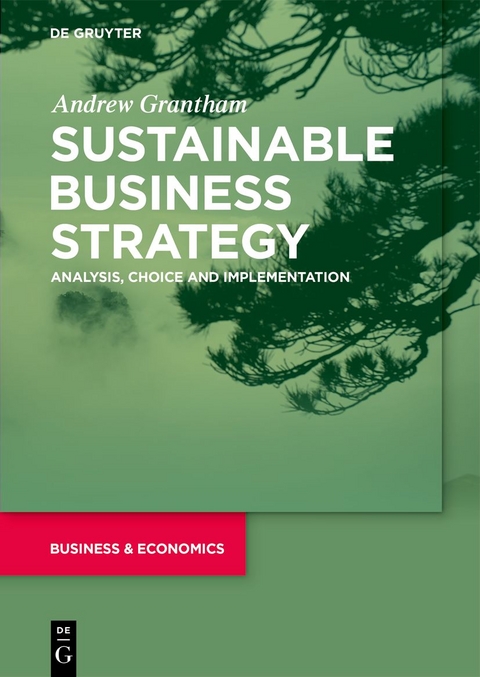
Sustainable Business Strategy
De Gruyter (Verlag)
978-3-11-071818-8 (ISBN)
lt;p>Dr Andrew Grantham is a Senior Lecturer in strategy and Course Leader for UG Business Management at Brighton Business School. Additionally, he has 15 years' experience of leading research at the Centre for Research in Innovation Management at the University of Brighton. His research studies are wide ranging in terms of sectors and firms. He has undertaken micro-level analyses in firms using interventionist methodologies such as investigating change initiatives; implementing continuous improvement; and intellectual property-searching and acquisition. At the macro level studies include scenario building for telecommunications/e-commerce policy makers at the European Commission. Consultancy projects include: investigation into clustering of videogames development companies for South East England Development Agency. His PhD was a comparison of the privatization of the UK rail industry in the 1990s and the industry's rationalization in the 1960s.
He is published in top-rated journals including Research Policy, Public Administration, Technovation and Design Studies.
Chapter 1: Introduction to strategy:
- strategy in the context of climate change: science of climate change and models; alternative economic models such as circular economies (zero waste, carbon negative);
- international organizations and regulatory frameworks;
- key figures in strategy and their ideas
- What is strategy?
- how to use the resource.
Part 1: Analysis
Chapter 2: The macro environment
- PESTEL (method and utilization);
- Scenarios (how to develop scenarios; investigating plausible futures);
- 5-Forces (Porter, criticisms, using the 5-Forces in the context of climate change);
- Industry life cycles
- Strategic groups
Chapter 3: The Micro environment - resources and capabilities
- Resource-based view of the firm (VRIO, contrast with Porter, mitigation, adaptation, VRIO and climate change,
- value chain vis-à-vis supply chains;
- SWOT/TOWS (existing use and methods; emphasizing the T as being the threat of climate change)
- Capabilities (dynamic), competences (core); building new competences necessary for current environment such as sustainability reporting and converting them into strategic resources.
Chapter 4: Stakeholders
- What is a stakeholder?
- Types of stakeholder
- management of and for stakeholders;
- power (3-dimensions)
- stakeholder utility
- stakeholders and environmental sustainability
Part 2: Choice
Chapter 5: Business strategy and models - generic strategies, the clock, competitive strategy, co-operative strategies
- Generic strategies/strategic clock (cost and price)
- Interactive strategies
- Cooperative strategies (beyond competitive advantage)
Chapter 6: Corporate strategy and diversification -
- Ansoff matrix (markets, products - new and existing)
- Vertical and horizontal integration
- portfolio management (BCG matrix, GE McKinsey, etc.)
Chapter 7: International strategy and globalization -
- Yip/drivers of internationalization
- Entry modes
- global value and production networks chains
- international trade
- Rodrik's Trilemma (pure globalization, democratic politics, nation states)
- Collapsing supply chains for sustainability
Chapter 8: Innovation
- models of innovation: product, process and business models
- entrepreneurship, intrapreneurship, real options
Chapter 9: Mergers, acquisitions and alliances
- distinctions and cases for one over another
- SAs as voluntary, time-limited, trust related cooperative approaches for sustainable growth
- Strategic fit and cultural fit in partner searching
- Indicators of success (beyond profit)
Chapter 10: The tools of evaluation - is it fit-for-purpose? Does it meet stakeholder needs, including shareholders? Can it be done?
- Tools of evaluation - performance, gap analysis (beyond profit);
- Addressing key opportunities and threats (TOWS)?
- Financial indicators - DCF, RoI, sensitivity analysis, RoCE.
- Resources and capabilities, opportunity costs
Part 3: Implementation
Chapter 11: Strategy development
- Politics (Mintzberg/power school)
- Deliberate and emerging strategy
Chapter 12: Structures
- structure follows strategy;
- functional, divisional, international, global
- control systems
- optimizing organizational structure
- corporate governance (single vis-à-vis 2-tier boards)
- employee ownership
Chapter 13: Leadership and change - leading and bringing others with you
- Leadership and styles (context, uncertainty, risk, turnaround)
- Types of change - radical/incremental; transformational/realignment
Chapter 14: Doing strategy
- who to involve, when and how
- planning
- project management
Chapter 15: Reflection
- What is strategy?
- First movers in responsible strategy - risks, rewards
- Fast seconds - risks, rewards
- No changers - risks, rewards
- Society - wellbeing. What is business for?
"This book that rethinks strategy for challenges of sustainability and responsible business in the 21st century is very important and desperately needed. We have to develop business strategies that truly create value for society. This book does this job very well and therefore it is a must-read for responsible business managers, but indeed also for business students and future leaders of global companies, firms and corporations".
Professor Jacob Dahl Rendtorff, Roskilde, Denmark
"This is a very timely and relevant contribution to the wider debate on the role of strategy to business organisations. Its positioning and niche are well thought-through and clearly articulated. A textbook of this sort would be of great value in its intended market(s). The sustainability angle is a clear selling point".
Professor Stephen Flowers, Emeritus Professor of Kent Business School, University of Kent, UK
"The main strength of this book is exactly this pluralistic perspective that provides different ways of resolving business strategy dilemmas vis-à-vis challenges such as climate change, global economic sustainability and pandemics. In this sense the book is timely and will help students of business and management to develop their holistic approaches to change in the 21st century".
Prof Theo Papaioannou, Open University, UK
| Erscheinungsdatum | 23.03.2022 |
|---|---|
| Zusatzinfo | 13 b/w and 7 col. ill., 45 b/w tbl. |
| Verlagsort | Berlin/Boston |
| Sprache | englisch |
| Maße | 170 x 240 mm |
| Gewicht | 523 g |
| Themenwelt | Wirtschaft ► Betriebswirtschaft / Management ► Unternehmensführung / Management |
| Schlagworte | Business Strategy • Corporate Strategy • Responsible Enterprise • Strategy • sustainability |
| ISBN-10 | 3-11-071818-9 / 3110718189 |
| ISBN-13 | 978-3-11-071818-8 / 9783110718188 |
| Zustand | Neuware |
| Informationen gemäß Produktsicherheitsverordnung (GPSR) | |
| Haben Sie eine Frage zum Produkt? |
aus dem Bereich