Building Procurement (eBook)
John Wiley & Sons (Verlag)
978-1-119-60952-0 (ISBN)
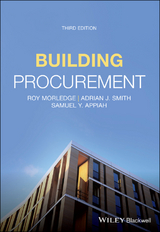
As an industrial process, construction is unique. The procurement processes used to achieve the successful completion of built assets requires a different approach to that adopted in most other industries, due to the design of buildings being bespoke and the sites being geographically varied. The procurement process is central to the success of any construction project and many of the problems which impact construction projects can be traced back to the procurement phase, so a good understanding of the methods of procurement, the development of a procurement strategy and the influence it has on project success is essential for all those working in the industry.
Much has changed in the global construction industry since publication of the second edition of?Building Procurement,?for example the increase in debt burden of many major economies, widespread adoption of Building Information Modelling (BIM) Technology in the industry and the United Kingdom's exit from the European Union. This new edition has been rewritten to take account of these significant developments, but at its core it continues to provide a critical examination and review of current procurement practices in the UK, continental Europe (including EU procurement procedures), China, Middle East and Sub-Saharan Africa and the USA. It retains its original strong emphasis on the need for clients to establish achievable objectives which reflect the project business case and focuses on development of suitable strategies and management structures to meet those objectives in the current construction climate.
Building Procurement will be essential reading for senior undergraduate and postgraduate students of construction management and practitioners working in all areas of construction management.
ABOUT THE AUTHORS Roy Morledge is Professor Emeritus of Construction Procurement, Nottingham Trent University. Adrian Smith is a Senior Consultant in Procurement and Project Management at Stradia Ltd, Sheffield and former Visiting Professor at Nottingham Trent University. Adrian is also a Tutor at the College of Estate Management, Reading. Samuel Appiah is a Director at Stanwell Consulting Ltd and Principal Consultant at HLN Ltd. He is also a Part-time Tutor at Nottingham Trent University.
1 Introduction
2 Procurement strategy: a literature review
3 Principles of Strategic Procurement
4 Public Sector Projects
5 Project Initiation
6 Briefing and the Design Process
7 Procurement Strategies and Procurement Routes
8 Project Team Selection
9 Managing the Procurement Process
10 The Value of Design
11 Risk Management
12 Partnering culture and the management of relationships
13 Privately Financed Public Sector Projects
14 Construction Procurement: Europe
15 Construction Procurement: USA, the Middle East, Africa and China
16 Procurement of Work to Heritage Buildings
17 Summary
Appendix
Index
Preface to the Third Edition
Although the construction of buildings has been commonplace for many thousands of years, the ways in which that construction activity has been procured and managed have all too often been both time consuming and inefficient, and the end result frequently unsatisfactory in terms of failure to meet basic time, cost and quality goals. There are many reasons for these failures, but perhaps the most fundamental arise not only because building is itself a very complex process, but because that complexity is compounded by the fact that most buildings are to some extent unique and bespoke, constructed in the open air by a team assembled especially for that project, and must be completed within demanding time, cost and quality and quality parameters.
In addition, the spectrum of customers of the construction industry is arguably the broadest of any industrial sector, ranging in size from very large organisations to single individual consumers, and in knowledge and expertise from organisations with substantial construction programmes and extensive construction knowledge and experience, to naïve consumers with no previous experience and little or no knowledge of the process.
It is in the context of a continuing search for greater satisfaction of this broad and disparate customer base that considerable amounts of effort and expertise have been expended over many years in an attempt to ensure efficiency and economy in the procurement of construction activity. That procurement process itself is complex, requiring the mobilization and management of an extensive range of professional, managerial, technical and financial expertise, and a successful outcome is frequently elusive. The procurement of construction work is significantly different from purchasing almost any other commodity in that most products are the result of a manufacturing process based in an environment that is permanent and controlled. The product can be designed, prototyped and tested prior to final production, quality can be readily assured, there is the opportunity for prototyping prior to production of the final product, and potential purchasers can view and even try the product before making their final decision to buy. The only sector in which the construction industry comes close to this mass production approach is arguably the construction of residential developments. Projects, and particularly construction projects, generally follow a process that has few of the above characteristics and which can provide none of the benefits.
Experience over the past few decades has shown an increasing demand from regular clients of the industry for significant improvements both in the predictability of construction projects in terms of time, cost, quality and fitness for purpose, and also for a substantial increase in value for money. Value for money in this case has often been characterised by the need for projects to be cheaper in terms of both capital costs and revenue expenditure, and for development and construction periods to be significantly reduced, whilst at the same time maintaining or improving the quality and functionality of the final product. These issues have been further complicated in recent years by the need for the industry as a whole to become ‘greener’ and more environmentally sustainable.
It must be said, however, that although significant improvements have been made, and the performance of the construction industry in satisfying its clients has demonstrably improved in recent years, the successful completion of construction projects, both large and small, within budget, to time and to the satisfaction of customers is still by no means as common as it ought to be in the UK. There is significant evidence that in many cases the way in which the procurement phase has been carried out has proved to be crucial to eventual project success, but also a significant component in project failure.
This book continues the approach set out in the second edition in that it seeks to explore approaches to improving the successful procurement of buildings, whilst incorporating recent developments in both research and contemporary practice.
It is worthy of note that purchasers of construction projects are usually referred to as clients rather than customers. This is appropriate since it suggests that they are purchasing services rather than products – construction is after all primarily a service industry. The distinction also hints at their possible legal position if the project does not meet that requirement of ‘fitness for purpose’ which is inherent in the purchase of other products. The term ‘client’ suggests the difference in approach that needs to be adopted for a satisfactory outcome to be achieved, and in this respect clients increasingly seek a fitness for purpose guarantee, particularly in the case of projects procured on a design and build basis. This issue will therefore continue to impact upon the procurement process.
The importance of understanding the need to establish realistic and measurable objectives, both for clients and contractors, linked to a carefully evaluated business case and supported by rigorous post-project analysis is particularly emphasized. The importance of those early project stages which are so often given insufficient emphasis or time prior to focus upon concept design is also highlighted. The initiation of the project and the need for the development of a justified business case are explored along with the need to identify measurable outcomes against which the completed project can be judged. The value to the client of the project output, a primary driver which is often forgotten as direct project issues such as time and cost dominate the construction phase, is emphasized. Upon completion these issues become historical fact and emphasis returns to the value or performance benefit derived from the completed project.
The UK is an example of an island nation which has steadfastly hung on to those traditional procurement practices with which it is most comfortable. Historically, data regarding the relative use of different types of procurement strategy has indicated a numerical dominance of these traditional approaches with little evident sensitivity to varying client needs, although the relatively few experienced clients often do adopt different approaches. Traditionalism has historically been sustained largely through the conservatism of professional institutions, universities and colleges in terms of the nature of professional education, but this tendency towards the traditional has significantly changed in recent years with a significant rise in the use of design and build approaches and, particularly in the public sector, a growth in approaches requiring increased collaboration and trust.
Project management tools and techniques suitable for adoption in the management of the procurement process are explored and evaluated in this book. Some considered to be innovative and beneficial have existed for many years, but their adoption has been limited largely to those projects where experienced clients understand the benefit and ask their consultants to provide the necessary services. The Construction Act which provides a mandatory framework for payment and dispute resolution within construction contracts in the industry is explored, with particular focus on how the requirements affect the various functions and roles within the contractual framework.
Public sector clients and commissioning authorities are increasingly becoming more imaginative and innovative in considering how they can best maximise the value generated by their projects, not only to themselves as clients, but also to the communities which they serve. This ‘social value’ has, in recent years, become an increasingly important element in the procurement of goods and services in the public sector, and we have therefore included some commentary on the concepts of social value, and the associated concepts of health, safety and ‘wellbeing’, within the public sector procurement process.
In recognition of the increasing interest shown in recent years in many parts of the world in both the preservation and adaptive reuse of historic buildings, we have again included a chapter devoted to the challenges inherent in procuring construction work to historic buildings. It should however be noted that work of this type requires a skilled and specialist understanding of the issues involved, and the employment of specialist skilled expertise in its execution. The information we have presented here is therefore given simply as a guide, and more specialist expertise will usually need to be sought. We have also enhanced the relevant chapter by the inclusion of a second extended case study of a recent very successful project of this type, and the two studies graphically indicate in different ways some of the particular challenges and problems which such projects may pose.
We have already noted that construction clients differ widely in terms of their experience, purpose and size. Numerically, inexperienced clients dominate and on average their projects are relatively small and short-lived. On the other hand, the minority of regular and experienced clients are by far the biggest spenders and they tend to benefit from their experience and buying power. Nevertheless, whether the client is an inexperienced small-to-medium-sized enterprise, a major corporate organisation or a public body, exposure to risk is inherent in the procurement of construction. Perhaps the inexperienced small and medium-sized enterprise (SME) is likely to be proportionally most exposed, but managing that risk is a key part of the process. The...
| Erscheint lt. Verlag | 12.4.2021 |
|---|---|
| Sprache | englisch |
| Themenwelt | Technik ► Bauwesen |
| Wirtschaft | |
| Schlagworte | Baubetrieb • Bauingenieur- u. Bauwesen • BIM technology • building procurement • Civil Engineering & Construction • Construction • Construction Management • Massenermittlung u. Bauökonomie • procurement process • project team developments • project team selection • Quantity Surveying & Construction Economics |
| ISBN-10 | 1-119-60952-6 / 1119609526 |
| ISBN-13 | 978-1-119-60952-0 / 9781119609520 |
| Informationen gemäß Produktsicherheitsverordnung (GPSR) | |
| Haben Sie eine Frage zum Produkt? |
 EPUB (Adobe DRM)
Kopierschutz: Adobe-DRM
Adobe-DRM ist ein Kopierschutz, der das eBook vor Mißbrauch schützen soll. Dabei wird das eBook bereits beim Download auf Ihre persönliche Adobe-ID autorisiert. Lesen können Sie das eBook dann nur auf den Geräten, welche ebenfalls auf Ihre Adobe-ID registriert sind.
Details zum Adobe-DRM
Dateiformat: EPUB (Electronic Publication)
EPUB ist ein offener Standard für eBooks und eignet sich besonders zur Darstellung von Belletristik und Sachbüchern. Der Fließtext wird dynamisch an die Display- und Schriftgröße angepasst. Auch für mobile Lesegeräte ist EPUB daher gut geeignet.
Systemvoraussetzungen:
PC/Mac: Mit einem PC oder Mac können Sie dieses eBook lesen. Sie benötigen eine
eReader: Dieses eBook kann mit (fast) allen eBook-Readern gelesen werden. Mit dem amazon-Kindle ist es aber nicht kompatibel.
Smartphone/Tablet: Egal ob Apple oder Android, dieses eBook können Sie lesen. Sie benötigen eine
Geräteliste und zusätzliche Hinweise
Buying eBooks from abroad
For tax law reasons we can sell eBooks just within Germany and Switzerland. Regrettably we cannot fulfill eBook-orders from other countries.
aus dem Bereich