


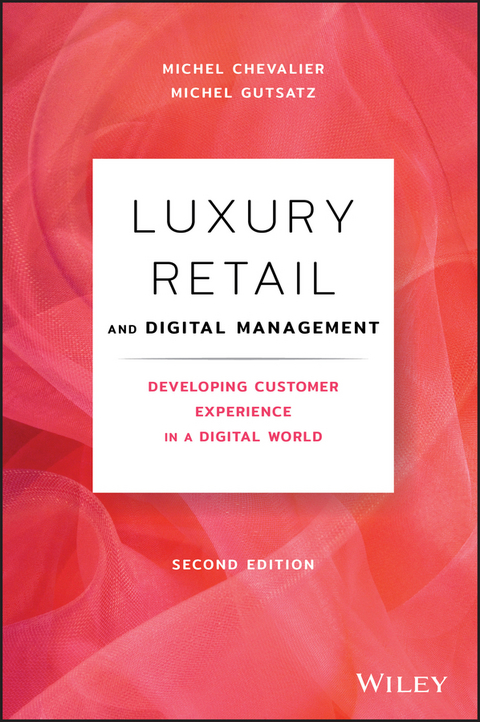
Luxury Retail and Digital Management (eBook)
John Wiley & Sons (Verlag)
978-1-119-54235-3 (ISBN)
Develop a winning customer experience in the digital world
Luxury consumers are changing - they come from all over the world, they are young and they are digital natives. How can luxury brands that have built themselves as pure physical players adapt their business model and practices to address their expectations without abandoning their luxury DNA?
Luxury Retail and Digital Management, 2nd Edition sets focus on the major retailing challenges and customer evolutions luxury brands are facing today: the digitalisation and the emergence of the millennials and Chinese luxury consumers. These major changes have been affecting the distribution and communication channels of luxury brands; they now have to think simultaneously physical stores and e-commerce, global marketing and digital marketing.
• Defines all the tools that are necessary to manage luxury stores including analysis of location and design concept
• Explores the selection, training and motivation of the staff
• Covers everything executives, managers and retail staff need to know in order to enter, expand, understand and succeed in the world of luxury retail
Written by luxury retail experts Michel Chevalier and Michel Gutsatz, who lend their solid academic credentials and professional expertise to the subject, Luxury Retail and Digital Management, 2nd Edition provides deep insight into the main challenges that luxury brands are facing in this digital age.
MICHEL CHEVALIER is an expert in luxury brand management and retailing. He was Executive Vice President of Bluebell Asia Ltd, a distributor of luxury brands, operating retail stores in Asia. He also managed the Paco Rabanne perfumes and fashion companies. He is now the president of Parfums Dusita, Paris, and a visiting professor of Luxury Management at HEC Paris and Universita Cattolica di Milano. He is the co-author of Luxury Brand Management (with Gérald Mazzalovo) and Luxury China (with Pierre-Xiao Lu), both published by Wiley.
MICHEL GUTSATZ is a visiting professor of marketing, brand management and luxury retailing at Kedge Business School, China Europe International Business School and Hong Kong University. He is the president of family-owned Maison de Parfum, created in 1975 by his father, perfumer Yuri Gutsatz. Yuri created the first artisan and niche perfume brand Le Jardin Retrouvé. Prior to that, Michel managed an image strategy agency and was Human Resources and Internal Communication Director of the Bally Group.
MICHEL CHEVALIER is an expert in luxury brand management and retailing. He was Executive Vice President of Bluebell Asia Ltd, a distributor of luxury brands, operating retail stores in Asia. He also managed the Paco Rabanne perfumes and fashion companies. He is now the president of Parfums Dusita, Paris, and a visiting professor of Luxury Management at HEC Paris and Universita Cattolica di Milano. He is the co-author of Luxury Brand Management (with Gérald Mazzalovo) and Luxury China (with Pierre-Xiao Lu), both published by Wiley. MICHEL GUTSATZ is a visiting professor of marketing, brand management and luxury retailing at Kedge Business School, China Europe International Business School and Hong Kong University. He is the president of family-owned Maison de Parfum, created in 1975 by his father, perfumer Yuri Gutsatz. Yuri created the first artisan and niche perfume brand Le Jardin Retrouvé. Prior to that, Michel managed an image strategy agency and was Human Resources and Internal Communication Director of the Bally Group.
Foreword ix
by Luca Solca
Introduction xiii
Part I: Important Choices in Luxury Distribution 1
Chapter 1: The Various Models in Luxury Distribution 3
Chapter 2: Do Luxury Products Still Sell in Stores? 21
Chapter 3: Concept and Design of a Luxury Boutique 39
Chapter 4: Online, Offline or O2O? 67
Part II: Know and Understand the Client 87
Chapter 5: Putting the Customer Back in the Centre 89
Chapter 6: Customer Identification and CRM 107
Chapter 7: The Challenges of Offline and Online Integration 121
Chapter 8: Logistics Adapted to a Digital Culture 135
Part III: Making Client Relationships More Meaningful 151
Chapter 9: Customer Behaviour in the Store or Online 153
Chapter 10: The Importance of Stores for Building Customer Relationships 163
Chapter 11: Customer Experience and Building Loyalty 177
Chapter 12: How the Internet Has Shattered the Traditional Sales Model 203
Part IV: Management Tools for Luxury Stores 219
Chapter 13: Location of Sales Points 221
Chapter 14: Managing Store Personnel: A Toolbox 259
Chapter 15: At What Price Should Products Be Sold? 297
Chapter 16: Financial Analyses of Sales Points 315
Conclusion 339
Bibliography 345
About the Authors 351
Index 353
Introduction
What Is the Reason for This Revision?
January 2012 saw the publication of the English version of our book Luxury Retail Management that we had written in 2010 and 2011. Seven years later, as close observers and players in the luxury industry,1 we realised that the industry had undergone such upheavals since then that we had to revise our book so that it remained relevant in the context of these evolutions. During this rereading, we also realised that the 2012 edition was premonitory in many respects (especially the chapters referring to the Internet and China) but it did need to be completely revamped if we wanted it to preserve its role as a reference book to be read by every specialist of luxury distribution in its English, French or Chinese versions.
We therefore decided to rewrite most of this book, structuring it around the new luxury business model – omnichannel – where the customer is placed at the core of communication and distribution channels, and of organisations. Is, or should be? As we will see while reading through these pages, this will be the major challenge for luxury brands over the next 5 years: placing the customer at the heart and building the organisation and information systems that will allow it around the customer.
It is therefore necessary to start with the client, and to do so one needs to understand the major changes that have taken place in recent years.
Change Is Accelerating: The Luxury Customer Is No Longer the Same
In their 2017 annual study on luxury, Bain & Co. showed that all the structuring trends for the industry are linked to the rise of the millennials – or Generation Y, that is, those born between 1980 and 2000 (Strauss and Howe 2000). Two figures explain the impact of this generation:
- They currently represent 38% of luxury buyers and 30% of the market (in value).
- 85% of the growth in the luxury market in 2017 was generated by them.
Their tastes, behaviour and expectations are therefore shaping the market and influencing other generations. We have identified three behaviour traits that we believe essential:
- The quest for experiences: One no longer consumes a product but lives an experience. Giving a meaning to life is an important goal and customers will look for brands that can bring them these elements of meaning. For example, customers have their own passions and are looking for brands that know how to construct a relationship around those passions.
- Involvement: The closer a brand is to these customers, the more likely they are to become its ambassadors. They want to ‘live the story’ of the brand and not consume it, which in turn allows them to share it – on the Internet.
- Affirming one's own identity: By choosing a personal style, luxury is a means of self-expression.
Therefore, the bricks-and-mortar and Internet boutique duo could be considered the sole epicentre of the brand, a place where the customer will live the story. All the skill of the brand would involve linking the experiences of the customer's life (their passions, communities, personal style) to the experience of the brand (services, transactions, values, the community around the brand).
For this reason, Bain urges leaders of luxury brands to make the customer their ‘obsession’ and to soak in the spirit of the millennials – in six steps that should be on the agenda of every head of the industry:
- Make the history of the brand come to life through inspiring dialogues and experiences.
- Build personalised relationships with customers.
- Rethink the customer's itinerary by adopting a holistic view of distribution – what we hereafter call the omnichannel.
- Understand (and decode) customers' aspirations so that they become relevant to them – which inversely means that any brand that moves further away from customer (and particularly millennial) expectations would become obsolete.
- Develop the individualising of the product, services and messages all through the customer's life.
- Invest in talents and skills to achieve all these goals (Gutsatz and Auguste 2015) and maintain a product-marketing approach.
In short, luxury brands – which have been developing over the last 20 years, partly through the opening of boutiques (that require considerable investment and result in an increase in turnover) – are faced with the challenge of changing their models and rebuilding on marketing and customer relations. This will lead to increasing yearly operational expenses for public relations and promotions, which will consequently weigh down their operating accounts. Luxury brands are thus at a historic turning point: they have to reinvent themselves. The 2017 figures put forward by Bain are disturbing in this respect: whereas, at the time when the luxury sector was flourishing, whether during the period of democratisation (1994/2007) or that of Chinese bulimia (2010/2014), 85 to 95% of the brands showed positive results. Since 2016, only 65% of them are profitable (and only 35% have succeeded in increasing their profitability!). The current period that one can consider the ‘New Normal’ will engender winners and losers.
This book is therefore our contribution towards understanding these new challenges that luxury brands have to face.
Case Study: A Striking Example: ‘See Now / Buy Now’
On 4 February 2016, Burberry announced that they were implementing what proved to be a revolution in the world of fashion: a synchronisation of the dates of the fashion shows and the availability of the new collection in their boutiques (Amed and Abnet 2016). From September 2016 onwards, the collections were reduced to two per year, the women's and men's fashion shows were merged and products were made available in boutiques at the same time. In the wake of this change, other brands announced their intention to follow Burberry's example: Tommy Hilfiger, Tom Ford, Rebecca Minkoff, Vêtements, Mulberry, etc.
Fast forward to 24 February 2017 – Ralph Toledano, Chairman of the French Federation of Ready-to-Wear Dressmakers and Fashion Designers announced that they would not make any changes to the existing schedule, followed in quick succession by Gucci and all the Kering brands.
Christopher Bailey, then CEO and Creative Director of Burberry, justified this choice, citing the desire to draw closer to his customers: in his opinion, he did not see why products should not be available immediately or why fashion should continue to make distinctions between fall and winter and spring and summer when fashion is distributed worldwide (and concerns both hemispheres). For him, at the end of the day, all it required was only an optimisation of the processes of supply and production:
When you break it all down, it's just a shift in your supply chain – that's the crunch. (Amed and Abnett 2016)
He could also have evoked the lower costs that such a decision implied, especially at a time when Burberry's results were poor (for the first six months of 2015 sales and profits were stable; revenue on licences declined by 13%).
But, of course, the story lies elsewhere: the big comeback of luxury and a new episode in the conflict between France and Italy on the one side and the English and Americans on the other.
‘Several people, including designers and retailers, are complaining about the shows. Something is not functioning because of social media, people are lost’, said Diane Von Furstenberg, Chairperson of the Council of Fashion Designers of America (CFDA), announcing that they were looking into the possibility of a ‘See Now, Buy Now’ Fashion Week (Lockwood 2015). It was, of course, an American initiative, presented as though it was done under the pressure of social media and consumers. This point is important. One may recall, for example, that during his last fashion show, Tommy Hilfiger delineated a space dedicated to ‘instagrammers’, to allow them to photograph the show under the best conditions possible and to publish their ‘live’ snapshots by Instagram (Le Luxe est Vivant 2016) and that American fashion shows are now open to the public (against an entrance fee). American fashion shows have thus become ‘democratised’ entertainment.
The reaction of luxury brands (showing in Paris and Milan) was immediate. They reasserted they were luxury brands practising real scarcity management. They projected themselves as ‘creation driven’ – thus consigning the American brands to their ‘marketing-driven’ image. By doing so, they categorically differentiated themselves from the American brands (and Burberry), often presented as being accessible luxury. We thus witnessed on that occasion a general repositioning of brands within the luxury industry itself.
But it was not a rigid position confronting an immovable model on the part of the French and the Italians. Prada immediately made available two models of its bags that were presented during its fashion shows in its boutiques. And Karl Lagerfeld admitted that Chanel's organisation was much smarter than previously thought:
Chanel creates six collections a year, but I just created one more – the ‘capsule’ collection – that we present neither to the press nor to anyone else; it only surfaces when our stores receive the presentation leaflet. But I would like to do something else – it may be too early to talk...
| Erscheint lt. Verlag | 17.3.2020 |
|---|---|
| Sprache | englisch |
| Themenwelt | Wirtschaft ► Betriebswirtschaft / Management ► Marketing / Vertrieb |
| Schlagworte | Business & Management • customer experience in luxury retail management • customer experience in retail • customer experience in retail management • Einzelhandel • Luxury retail • luxury retail management • Michel Chevalier • Michel Gutsatz • Retail • Retailing • Retail Management • Wirtschaft u. Management |
| ISBN-10 | 1-119-54235-9 / 1119542359 |
| ISBN-13 | 978-1-119-54235-3 / 9781119542353 |
| Informationen gemäß Produktsicherheitsverordnung (GPSR) | |
| Haben Sie eine Frage zum Produkt? |
 EPUB (Adobe DRM)
Kopierschutz: Adobe-DRM
Adobe-DRM ist ein Kopierschutz, der das eBook vor Mißbrauch schützen soll. Dabei wird das eBook bereits beim Download auf Ihre persönliche Adobe-ID autorisiert. Lesen können Sie das eBook dann nur auf den Geräten, welche ebenfalls auf Ihre Adobe-ID registriert sind.
Details zum Adobe-DRM
Dateiformat: EPUB (Electronic Publication)
EPUB ist ein offener Standard für eBooks und eignet sich besonders zur Darstellung von Belletristik und Sachbüchern. Der Fließtext wird dynamisch an die Display- und Schriftgröße angepasst. Auch für mobile Lesegeräte ist EPUB daher gut geeignet.
Systemvoraussetzungen:
PC/Mac: Mit einem PC oder Mac können Sie dieses eBook lesen. Sie benötigen eine
eReader: Dieses eBook kann mit (fast) allen eBook-Readern gelesen werden. Mit dem amazon-Kindle ist es aber nicht kompatibel.
Smartphone/Tablet: Egal ob Apple oder Android, dieses eBook können Sie lesen. Sie benötigen eine
Geräteliste und zusätzliche Hinweise
Buying eBooks from abroad
For tax law reasons we can sell eBooks just within Germany and Switzerland. Regrettably we cannot fulfill eBook-orders from other countries.
aus dem Bereich


