


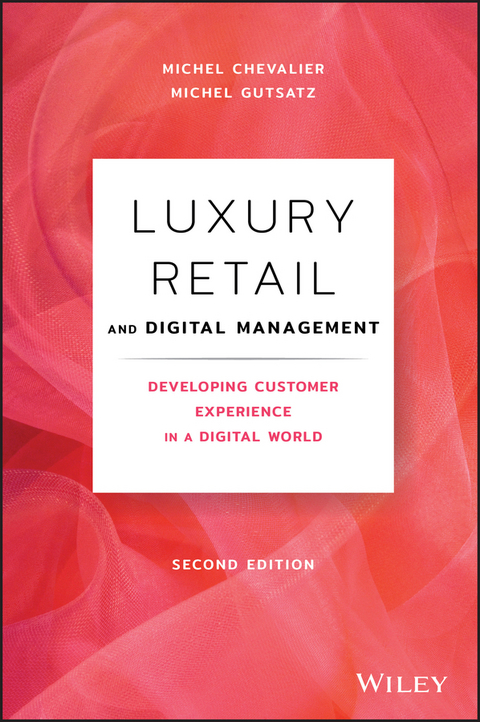
Luxury Retail and Digital Management (eBook)
John Wiley & Sons (Verlag)
978-1-119-54234-6 (ISBN)
Develop a winning customer experience in the digital world
Luxury consumers are changing - they come from all over the world, they are young and they are digital natives. How can luxury brands that have built themselves as pure physical players adapt their business model and practices to address their expectations without abandoning their luxury DNA?
Luxury Retail and Digital Management, 2nd Edition sets focus on the major retailing challenges and customer evolutions luxury brands are facing today: the digitalisation and the emergence of the millennials and Chinese luxury consumers. These major changes have been affecting the distribution and communication channels of luxury brands; they now have to think simultaneously physical stores and e-commerce, global marketing and digital marketing.
• Defines all the tools that are necessary to manage luxury stores including analysis of location and design concept
• Explores the selection, training and motivation of the staff
• Covers everything executives, managers and retail staff need to know in order to enter, expand, understand and succeed in the world of luxury retail
Written by luxury retail experts Michel Chevalier and Michel Gutsatz, who lend their solid academic credentials and professional expertise to the subject, Luxury Retail and Digital Management, 2nd Edition provides deep insight into the main challenges that luxury brands are facing in this digital age.
MICHEL CHEVALIER is an expert in luxury brand management and retailing. He was Executive Vice President of Bluebell Asia Ltd, a distributor of luxury brands, operating retail stores in Asia. He also managed the Paco Rabanne perfumes and fashion companies. He is now the president of Parfums Dusita, Paris, and a visiting professor of Luxury Management at HEC Paris and Universita Cattolica di Milano. He is the co-author of Luxury Brand Management (with Gérald Mazzalovo) and Luxury China (with Pierre-Xiao Lu), both published by Wiley.
MICHEL GUTSATZ is a visiting professor of marketing, brand management and luxury retailing at Kedge Business School, China Europe International Business School and Hong Kong University. He is the president of family-owned Maison de Parfum, created in 1975 by his father, perfumer Yuri Gutsatz. Yuri created the first artisan and niche perfume brand Le Jardin Retrouvé. Prior to that, Michel managed an image strategy agency and was Human Resources and Internal Communication Director of the Bally Group.
Develop a winning customer experience in the digital world Luxury consumers are changing they come from all over the world, they are young and they are digital natives. How can luxury brands that have built themselves as pure physical players adapt their business model and practices to address their expectations without abandoning their luxury DNA? Luxury Retail and Digital Management, 2nd Edition sets focus on the major retailing challenges and customer evolutions luxury brands are facing today: the digitalisation and the emergence of the millennials and Chinese luxury consumers. These major changes have been affecting the distribution and communication channels of luxury brands; they now have to think simultaneously physical stores and e-commerce, global marketing and digital marketing. Defines all the tools that are necessary to manage luxury stores including analysis of location and design concept Explores the selection, training and motivation of the staff Covers everything executives, managers and retail staff need to know in order to enter, expand, understand and succeed in the world of luxury retail Written by luxury retail experts Michel Chevalier and Michel Gutsatz, who lend their solid academic credentials and professional expertise to the subject, Luxury Retail and Digital Management, 2nd Edition provides deep insight into the main challenges that luxury brands are facing in this digital age.
MICHEL CHEVALIER is an expert in luxury brand management and retailing. He was Executive Vice President of Bluebell Asia Ltd, a distributor of luxury brands, operating retail stores in Asia. He also managed the Paco Rabanne perfumes and fashion companies. He is now the president of Parfums Dusita, Paris, and a visiting professor of Luxury Management at HEC Paris and Universita Cattolica di Milano. He is the co-author of Luxury Brand Management (with Gérald Mazzalovo) and Luxury China (with Pierre-Xiao Lu), both published by Wiley. MICHEL GUTSATZ is a visiting professor of marketing, brand management and luxury retailing at Kedge Business School, China Europe International Business School and Hong Kong University. He is the president of family-owned Maison de Parfum, created in 1975 by his father, perfumer Yuri Gutsatz. Yuri created the first artisan and niche perfume brand Le Jardin Retrouvé. Prior to that, Michel managed an image strategy agency and was Human Resources and Internal Communication Director of the Bally Group.
Cover 1
Title Page 5
Copyright 6
Contents 9
Foreword 11
Introduction 15
What Is the Reason for This Revision? 15
Change Is Accelerating: The Luxury Customer Is No Longer the Same 16
Part I Important Choices in Luxury Distribution 27
Chapter 1 The Various Models in Luxury Distribution 29
Direct and Indirect Distribution 30
Evolution and Perspectives of the Various Types of Sales Outlets 36
Advantages and Disadvantages of the Various Distribution Channels 43
Chapter 2 Do Luxury Products Still Sell in Stores? 47
The Owner Becomes a Retailer as Well 49
Different Situations According to the Different Luxury Segments 53
Watch Manufacturers and Niche Perfumers Are Creating Single?Brand Outlets 55
The Future of Multi?Brand Stores 57
The Special Case of Travel Retail 62
Chapter 3 Concept and Design of a Luxury Boutique 65
Relaunching a Brand: The Urgency for a New Concept of Boutiques 66
The Concept of the Boutique: Applying the Brand's Vision 69
Store Formats: Closed or Open? 75
Customising Boutiques and Flagships 81
Visual Merchandising and the Institutional Image of the Brand 87
Chapter 4 Online, Offline or O2O? 93
From Yoox.com to the Merger with NET-A-PORTER.com 94
A Brief History of the Love/Hate Relationship that Luxury Brands Have with the Internet 100
Part II Know and Understand the Client 113
Chapter 5 Putting the Customer Back in the Centre 115
Looking at It from the Customers' Side: Why Have They Logged On and How Do They Use the Internet? 118
The Seven Rules of the Internet and Social Networks 120
Chapter 6 Customer Identification and CRM 133
Managing the Customer Database 135
Marketing Data 136
How Can One Recognise a Client? 140
Using the Customer Database 143
Chapter 7 The Challenges of Offline and Online Integration 147
What Are the Criteria for Offline/Online Integration? 150
Global Tracking of Customers (Especially Chinese) 153
Chapter 8 Logistics Adapted to a Digital Culture 161
The Traditional System 162
Number of Stores in Each City 165
Details Are Important in a Logistics System: An Example 167
The New Logistics Systems 169
Stores Without Sales Staff 173
The Challenges of Logistics 173
Part III Making Client Relationships More Meaningful 177
Chapter 9 Customer Behaviour in the Store or Online 179
Store Behaviour Patterns 181
Expectations and Perceptions in a Store 184
The Basic Rules of Supermarket Merchandising 186
Chapter 10 The Importance of Stores for Building Customer Relationships 189
Why Sales Staff Need to Know Everything About the Brand 190
The Problem of Retail: Retaining One's Clients 192
Managing a Store: A Very Special Job 194
Building a Customer Relationship: The Challenge of Individualised Service 199
Chapter 11 Customer Experience and Building Loyalty 203
Step 1: Focus on the Customer 205
Step 2: The Loyalty Effect – Transforming Regular Customers into Brand Ambassadors 209
Step 3: Offer a Unique Experience – and Anticipate All the Possible Consequences in Terms of Internal Organisation 212
Step 4: Define the Contract Between the Brand and Its Customers and Adopt Four Tools for Business Optimisation 221
Step 5: Define Customer Journeys and Identify Important Contact Points 224
Step 6: Elaborating the Customer Experience in Luxury Brands 225
Chapter 12 How the Internet Has Shattered the Traditional Sales Model 229
Is Selling Online Sufficient in Itself? 230
Is Selling in Stores (Offline) Sufficient in Itself? 232
Part IV Management Tools for Luxury Stores 245
Chapter 13 Location of Sales Points 247
The Classification of Stores in the Mass?Product Market 248
The Case of Luxury: Different Types of Sales Outlets 250
How Many Outlets Should There Be in a Given City? 257
‘A Store Should Be a Place of Worship’ or an ‘Institution’ 258
In Which International Cities Should One Open Stores? 259
The Case of Mainland China 262
Why Choose One City Rather than Another? 264
Trade Areas Analysis 266
Clusters 268
Adapt the Location to the Hallmarks of Luxury 273
The Various Types of Commercial Leases 275
Chapter 14 Managing Store Personnel: A Toolbox 285
Tool No. 1: A Typical Sales Organisation 287
Tool No. 2: Managing the Recruitment of Sales Teams 288
Tool No. 3: Defining the Responsibilities of Store Personnel 292
Tool No. 4: Job Descriptions 294
Tool No. 5: Career Advancement 305
Tool 6: Setting Turnover Targets 310
Tool No. 7: Defining a Fair Retail Compensation System 310
Tool No. 8: Grooming Guidelines for Employees 315
Tool No. 9: Global Business Ethics 317
Chapter 15 At What Price Should Products Be Sold? 323
Pricing Policy Under Normal Conditions 325
Let Us Look at Margins Again 330
The Particular Case of Fashion Retailing 332
Price Reductions and Sales 335
Chapter 16 Financial Analyses of Sales Points 341
Financial Analysis of a Sales Point 344
Applying Key Ratios 351
Turnover Forecasts 352
Inventory and Controlling Margins 356
Analysis of Returns on Investment 361
Information Systems 363
Conclusion 365
Bibliography 371
About the Authors 377
Index 379
EULA 386
| Erscheint lt. Verlag | 17.3.2020 |
|---|---|
| Sprache | englisch |
| Themenwelt | Wirtschaft ► Betriebswirtschaft / Management ► Marketing / Vertrieb |
| Schlagworte | Business & Management • customer experience in luxury retail management • customer experience in retail • customer experience in retail management • Einzelhandel • Luxury retail • luxury retail management • Michel Chevalier • Michel Gutsatz • Retail • Retailing • Retail Management • Wirtschaft u. Management |
| ISBN-10 | 1-119-54234-0 / 1119542340 |
| ISBN-13 | 978-1-119-54234-6 / 9781119542346 |
| Informationen gemäß Produktsicherheitsverordnung (GPSR) | |
| Haben Sie eine Frage zum Produkt? |
 PDF (Adobe DRM)
Kopierschutz: Adobe-DRM
Adobe-DRM ist ein Kopierschutz, der das eBook vor Mißbrauch schützen soll. Dabei wird das eBook bereits beim Download auf Ihre persönliche Adobe-ID autorisiert. Lesen können Sie das eBook dann nur auf den Geräten, welche ebenfalls auf Ihre Adobe-ID registriert sind.
Details zum Adobe-DRM
Dateiformat: PDF (Portable Document Format)
Mit einem festen Seitenlayout eignet sich die PDF besonders für Fachbücher mit Spalten, Tabellen und Abbildungen. Eine PDF kann auf fast allen Geräten angezeigt werden, ist aber für kleine Displays (Smartphone, eReader) nur eingeschränkt geeignet.
Systemvoraussetzungen:
PC/Mac: Mit einem PC oder Mac können Sie dieses eBook lesen. Sie benötigen eine
eReader: Dieses eBook kann mit (fast) allen eBook-Readern gelesen werden. Mit dem amazon-Kindle ist es aber nicht kompatibel.
Smartphone/Tablet: Egal ob Apple oder Android, dieses eBook können Sie lesen. Sie benötigen eine
Geräteliste und zusätzliche Hinweise
Buying eBooks from abroad
For tax law reasons we can sell eBooks just within Germany and Switzerland. Regrettably we cannot fulfill eBook-orders from other countries.
aus dem Bereich


