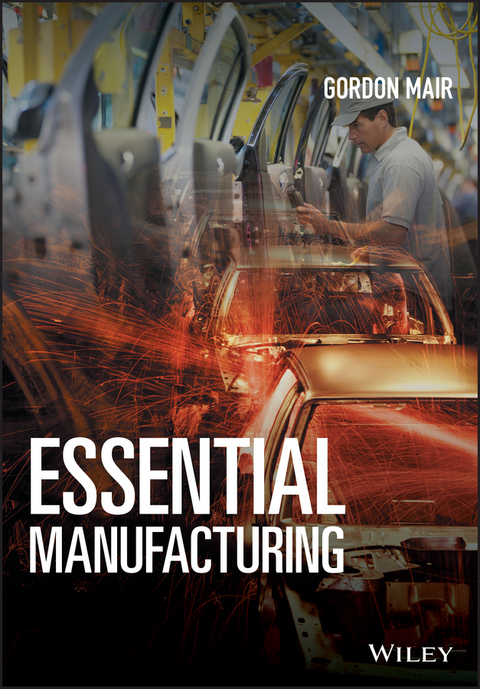
Essential Manufacturing (eBook)
John Wiley & Sons (Verlag)
978-1-119-06167-0 (ISBN)
An introduction to the manufacturing industry
Essential Manufacturing provides a comprehensive introduction to the wide breadth of the manufacturing industry.
There is a need for all engineering and business students to understand the importance and context of the manufacturing industry. An engineer should have a well rounded appreciation of all aspects of the industry they work in, including manufacturing. This is evidenced by professional bodies expecting all accredited engineering courses to provide students with a background that allows them to see their own specific discipline in context. Similarly, business students will often find themselves dealing in some way with manufactured products or even be directly involved in manufacturing operations management. This book will cover the full spectrum of the manufacturing industry to provide a holistic appreciation of the topic but with enough detail to be of practical use.
The book begins with an introduction to the manufacturing industry, its history, and some important manufacturing concepts. The materials used in manufacturing and how they are produced are covered. This is followed by a more detailed description of the more common manufacturing processes, their application, and the types of automation used in the manufacturing industry. Consideration is then given to the important aspects of manufacturing operations management and production planning and control, work study, and manufacturing economics. How to maintain quality in the manufacturing process, including metrology, is examined and this is followed by human factors in manufacturing. Finally, a speculative look at the future of manufacturing is included.
Key features:
- Takes a self-contained approach.
- Includes review questions.
- Suitable as an introduction for more advanced study.
- Satisfies the requirements of college and first and second year university engineering courses.
The book provides a comprehensive, concise introduction to the manufacturing industry for engineering and management students.
GORDON MAIR has carried out teaching, research, and consulting in the Department of Design, Manufacture, and Engineering Management at the University of Strathclyde for almost four decades. He is also a Chartered Engineer, Fellow of the Institution of Engineering and Technology, and Fellow of the Higher Education Academy. His teaching has covered the broad spectrum of manufacturing including its technology, management, and implications for product design. His research interests and publications are in the areas of manufacturing automation and robotics, telepresence, multisensory and multimodal displays, and all aspects of the interaction between humans, products and the environment. He has been a consultant to industry for production engineering, advanced manufacturing technology and operations management projects. He has also served as an expert to the European Commission for various multinational project assessments and reviews.
An introduction to the manufacturing industry Essential Manufacturing provides a comprehensive introduction to the wide breadth of the manufacturing industry. There is a need for all engineering and business students to understand the importance and context of the manufacturing industry. An engineer should have a well rounded appreciation of all aspects of the industry they work in, including manufacturing. This is evidenced by professional bodies expecting all accredited engineering courses to provide students with a background that allows them to see their own specific discipline in context. Similarly, business students will often find themselves dealing in some way with manufactured products or even be directly involved in manufacturing operations management. This book will cover the full spectrum of the manufacturing industry to provide a holistic appreciation of the topic but with enough detail to be of practical use. The book begins with an introduction to the manufacturing industry, its history, and some important manufacturing concepts. The materials used in manufacturing and how they are produced are covered. This is followed by a more detailed description of the more common manufacturing processes, their application, and the types of automation used in the manufacturing industry. Consideration is then given to the important aspects of manufacturing operations management and production planning and control, work study, and manufacturing economics. How to maintain quality in the manufacturing process, including metrology, is examined and this is followed by human factors in manufacturing. Finally, a speculative look at the future of manufacturing is included. Key features: Takes a self-contained approach. Includes review questions. Suitable as an introduction for more advanced study. Satisfies the requirements of college and first and second year university engineering courses. The book provides a comprehensive, concise introduction to the manufacturing industry for engineering and management students.
GORDON MAIR has carried out teaching, research, and consulting in the Department of Design, Manufacture, and Engineering Management at the University of Strathclyde for almost four decades. He is also a Chartered Engineer, Fellow of the Institution of Engineering and Technology, and Fellow of the Higher Education Academy. His teaching has covered the broad spectrum of manufacturing including its technology, management, and implications for product design. His research interests and publications are in the areas of manufacturing automation and robotics, telepresence, multisensory and multimodal displays, and all aspects of the interaction between humans, products and the environment. He has been a consultant to industry for production engineering, advanced manufacturing technology and operations management projects. He has also served as an expert to the European Commission for various multinational project assessments and reviews.
1
Introduction
Most countries need to use the work of their population to create wealth. If they have a significant size of population then for them, a healthy manufacturing industry is an essential ingredient for prosperity. In a general sense, modern manufacturing now covers a broad range of economic activity. As well as including the technology and management of the manufacturing process it also now spans the spectrum from understanding markets through to distribution and services. However, this book will focus on the core aspects of manufacturing and this chapter describes what manufacturing is, considers what is meant by the term ‘prosperity’, shows why manufacturing is an indispensable creator of wealth and concludes by considering the complex global environment in which it exists.
Around 10 000 BC the world population was about 10 million, by 5000 BC it was 100 million, by 1650 AD 500 million and today, in the early decades of the twenty‐first century, it is approximately 7500 million and increasing. Early humans could survive off the land by hunting and gathering but as the population increased so the need for planned agriculture arose to ensure an adequate food supply. However, since the population of just one city such as Shanghai or Karachi is double that of the early world, manufacturing industry has now become an essential factor in creating the wealth necessary to support the world's 7.5 billion people.
Deriving from two Latin words, ‘manus’ meaning ‘hand’, and ‘facere’ meaning ‘to make’, ‘manufacturing’ is the process whereby materials are changed from one state into another by work. The new state is now worth more than the old, thus value has been added. Today the manufacturing process often involves the use of sophisticated machinery and complex organisation. For example, the Airbus A380, see Figure 1.1, is a manufactured product comprised of approximately four million manufactured components. It is the result of nearly 20 years of research, design and development and has its components manufactured by around 1500 companies distributed throughout 30 different countries.
Figure 1.1 The Airbus A380. Source: Reproduced with permission of Pixabay.
Unless you are reading this somewhere in the countryside or beach, everything around you and on you is manufactured, such as the clothes you are wearing and the seat or floor you are sitting on. In fact, whether or not you are using hardcopy or electronic media it is manufacturing that has allowed you to read this book. Without modern manufacturing techniques many products would not be as affordable as they are today. Domestic labour saving devices like washing machines, fridges and vacuum cleaners are only possible at today's prices because of mass production techniques; the same applies to home entertainment equipment such televisions and music systems. The motor car, which may contain around 15 000 individual components, is now regarded in developed countries as an essential possession, but unless produced using carefully designed and selected manufacturing methods and materials it would be an unattainable luxury for most people.
As well as the fabric of our way of life being held together by the use of manufactured goods, so are the economics of our society also dependent on manufacturing. The wealth created by manufacturing industry gives employment to individuals and enables a country to pay for services at a national level, such as health and education.
In order to put the rest of the book in perspective some aspects of these statements are now looked at in more detail.
1.1 Wealth and Prosperity
Consider first the economic environment within which we work. The economies we are concerned with are ‘market economies’, in that they operate on the basis that things, whether they be items or services, are bought and sold to bring benefit to the individual. It works on the basis of supply and demand. The price of material, food, products and labour, is determined by a combination of the demand for them and their availability or supply. Another type of economy, one that has not proved successful, is the ‘centrally planned economy’, in which the state owns the means of production and the means of distribution. In this type of economy the state, rather than market forces, would determine the level of wages and the price of goods.
The standard of living available in a country is determined by that nation's economic wealth. In our type of economy, ‘wealth’ consists of all things that satisfy human wants. These things can be transferred or exchanged and because they are limited in supply they have value in exchange. By this definition not everything that we need and enjoy is ‘wealth’ in the economic sense. For example, without fresh air to breathe we would all die but as air is unlimited in supply to all it is not economic wealth. Sunlight is also essential for life but as it is not limited in supply it would not be regarded as part of economic wealth. Thus, by definition if something cannot be bought or sold it does not count in the measure of a nation's economic wealth. However, it is now realised that the essentials of life such as fresh air and sunlight may no longer be regarded as being in unlimited supply forever. This is due to the manner of creation of the economic wealth and the pursuit of increasing standards of living at the expense of damage to our natural environment. Those involved in manufacturing industry therefore have their part to play in ensuring that industry does not contribute to environmental pollution. It also means that the full life cycle of the product has to be considered, including disposal, or re‐manufacture of the product or recycling of its materials.
The creation of economic wealth on its own is no longer an adequate gauge of a country's true prosperity and quality of life. It is significant that the word ‘wealth’ comes from the Anglo‐Saxon word ‘wela’ meaning ‘wellbeing’, which is the condition of being contented, healthy or successful. It is therefore the resulting quality of life, rather than the material standard of living, that is meaningful. The manner in which the wealth is created, and the equity with which it is distributed throughout the population, contribute to that quality of life. These concepts are not new. In 1862 the scholar John Ruskin wrote the following: ‘There is no wealth but life, life including all its powers of love, of joy, and of admiration. That country is richest which nourishes the greatest number of noble and happy human beings’. It is therefore interesting that 128 years later in 1990, the United Nations Human Development Report was launched in which a country's progress towards true wealth was measured by using a Human Development Index (). The HDI index, revised in 2010, is produced annually and is derived from the factors of life expectancy, education and standard of living based on Gross National Income () per capita, rather than, for example, the overall Gross Domestic Product (). The GDP is one of a number of traditional but important and useful statistics that measures economic wealth and is the total value of all the final goods and services produced annually within the country.
The human perspective of the concept of wealth as well as the purely economic view has been highlighted because throughout the rest of this book we will be focusing on how to increase wealth by making the manufacturing process financially profitable but we should also remember that the purpose of financial success is ultimately to improve the quality, and standard, of life for all. This includes the manufacturing company employees, the company shareholders and the public in general.
1.2 Manufacturing Industry
In an economy, industry is generally regarded as existing at three levels, Primary, Secondary and Tertiary. Sometimes an additional term Quaternary is used to include activities such as consultancy and research and development, however, for our purposes these may simply be considered under tertiary. It is important to realise that the primary and tertiary industries are very much dependent on the secondary manufacturing sector. Estimates suggest that about half of those employed in the primary and tertiary industries depend indirectly on manufacturing industry for their jobs.
Primary industry is the first level and includes agriculture, fishing, forestry and mining; it provides the essentials of food and fuel, plus the raw materials for the secondary industries. Efficient operation of the primary industries is dependent on the availability of manufactured goods. For example, the efficiency of farming owes much to the use of tractors, combine harvesters and other mechanised equipment. Fishing fleets require well‐made vessels with reliable navigation and communication equipment. Forestry workers use machines to cultivate the ground for tree planting and to assist with felling and handling mature trees. Cost effective mining relies on the use of modern automated digging, cutting and tunnelling machines. The primary industries rely on manufactured goods to keep themselves competitive in the world market, and to maintain safe and tolerable conditions for their employees. Food is now often a manufactured item when the...
| Erscheint lt. Verlag | 11.1.2019 |
|---|---|
| Sprache | englisch |
| Themenwelt | Technik ► Bauwesen |
| Technik ► Maschinenbau | |
| Wirtschaft | |
| Schlagworte | Business & Management • Essential Manufacturing • guide to manufacturing industry • Human Factors in Manufacturing • Industrial Engineering • Industrial Engineering / Manufacturing • Industrielle Verfahrenstechnik • introduction to manufacturing industry • Manufacturing Automation • manufacturing concepts • manufacturing economics • manufacturing history • Manufacturing Industries • manufacturing in electronics industry • Manufacturing Operations • Manufacturing Processes • Maschinenbau • Maschinenbau - Entwurf • mechanical engineering • Mechanical Engineering - Design • Production Operations Management • Production planning and control • Produktion • Produktion i. d. Industriellen Verfahrenstechnik • Produktionssteuerung • quality management and assurance • Wirtschaft u. Management |
| ISBN-10 | 1-119-06167-9 / 1119061679 |
| ISBN-13 | 978-1-119-06167-0 / 9781119061670 |
| Informationen gemäß Produktsicherheitsverordnung (GPSR) | |
| Haben Sie eine Frage zum Produkt? |
 EPUB (Adobe DRM)
Kopierschutz: Adobe-DRM
Adobe-DRM ist ein Kopierschutz, der das eBook vor Mißbrauch schützen soll. Dabei wird das eBook bereits beim Download auf Ihre persönliche Adobe-ID autorisiert. Lesen können Sie das eBook dann nur auf den Geräten, welche ebenfalls auf Ihre Adobe-ID registriert sind.
Details zum Adobe-DRM
Dateiformat: EPUB (Electronic Publication)
EPUB ist ein offener Standard für eBooks und eignet sich besonders zur Darstellung von Belletristik und Sachbüchern. Der Fließtext wird dynamisch an die Display- und Schriftgröße angepasst. Auch für mobile Lesegeräte ist EPUB daher gut geeignet.
Systemvoraussetzungen:
PC/Mac: Mit einem PC oder Mac können Sie dieses eBook lesen. Sie benötigen eine
eReader: Dieses eBook kann mit (fast) allen eBook-Readern gelesen werden. Mit dem amazon-Kindle ist es aber nicht kompatibel.
Smartphone/Tablet: Egal ob Apple oder Android, dieses eBook können Sie lesen. Sie benötigen eine
Geräteliste und zusätzliche Hinweise
Buying eBooks from abroad
For tax law reasons we can sell eBooks just within Germany and Switzerland. Regrettably we cannot fulfill eBook-orders from other countries.
aus dem Bereich