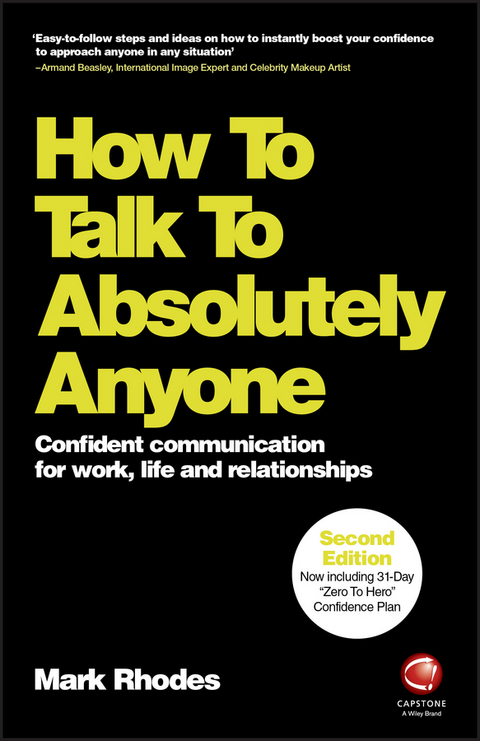
How To Talk To Absolutely Anyone (eBook)
Wiley (Verlag)
978-0-85708-747-8 (ISBN)
How to Talk to Absolutely Anyone is your personal handbook for stepping up your communication game, Part confidence coach and part social manual, this book reveals the reasons behind your reserve and offers real, practical ways to break through the barriers and make a connection, Whether you fear judgement and rejection or just don't know what to say, these simple exercises will equip you with a gold mine of social tools to get you through any situation, This new second edition has been updated to include the complete 30-day Zero to Hero Personal Confidence Course, to help you build your skills and increase your chances of getting what you want out of any conversation, Working step-by-step, you'll learn how to approach strangers, strike up a conversation and exit gracefully; by first changing your outlook, you develop the ability to navigate even tricky situations with confidence and ease,
Conversation skills affect more than your social life - they can impact your career as well, In removing your social hesitance, you open up a whole new world of effective communication with customers and colleagues, and begin building the relationships that get you closer to your goals, This book provides real-world techniques to help you get better and better every day, enabling you to:
- Overcome your fear of rejection,
- Strike up a conversation with anyone, anywhere,
- Open up to make real connections and build strong rapport,
- Carry your confidence into networking, sales and more,
Leave the days of awkwardness behind you, Stop running away from uncomfortable interactions and start getting comfortable instead, Whether you need to close the deal, build contacts or just make small talk at a party, How to Talk to Absolutely Anyone helps you build the confidence and skills you need to talk your way to success,
Mark Rhodes is an Entrepreneur, Business Mentor, Published Author, International Speaker and Trainer in Success, showing individuals and businesses around the world how to massively improve their results with little or no extra effort, He helps people, whether in business or not, to be the best that they can be, He does this by helping people have more confidence and direction and by helping businesses win more sales, get more clients and customers and achieve their business goals, This is done using the very same approaches, ideas and techniques that Mark has used for his own success, It's not about 'in your face' selling either, far from it, in fact Mark's work also includes working with professional firms such as banks, accountants, solicitors and legal firms, for whom Mark's approach is an ideal fit, in addition to more traditional businesses that he also helps covering most industries and sectors you could name, Marks clients include HSBC, Natwest, Lloyds Bank, BooHoo,com, and the Institute of Chartered Accountants, to name a few,
Talk to anyone, anytime, about anything with confidence. How to Talk to Absolutely Anyone is your personal handbook for stepping up your communication game. Part confidence coach and part social manual, this book reveals the reasons behind your reserve and offers real, practical ways to break through the barriers and make a connection. Whether you fear judgement and rejection or just don't know what to say, these simple exercises will equip you with a gold mine of social tools to get you through any situation. This new second edition has been updated to include the complete 30-day Zero to Hero Personal Confidence Course, to help you build your skills and increase your chances of getting what you want out of any conversation. Working step-by-step, you'll learn how to approach strangers, strike up a conversation and exit gracefully; by first changing your outlook, you develop the ability to navigate even tricky situations with confidence and ease. Conversation skills affect more than your social life they can impact your career as well. In removing your social hesitance, you open up a whole new world of effective communication with customers and colleagues, and begin building the relationships that get you closer to your goals. This book provides real-world techniques to help you get better and better every day, enabling you to: Overcome your fear of rejection. Strike up a conversation with anyone, anywhere. Open up to make real connections and build strong rapport. Carry your confidence into networking, sales and more. Leave the days of awkwardness behind you. Stop running away from uncomfortable interactions and start getting comfortable instead. Whether you need to close the deal, build contacts or just make small talk at a party, How to Talk to Absolutely Anyone helps you build the confidence and skills you need to talk your way to success.
Mark Rhodes is an Entrepreneur, Business Mentor, Published Author, International Speaker and Trainer in Success, showing individuals and businesses around the world how to massively improve their results with little or no extra effort. He helps people, whether in business or not, to be the best that they can be. He does this by helping people have more confidence and direction and by helping businesses win more sales, get more clients and customers and achieve their business goals. This is done using the very same approaches, ideas and techniques that Mark has used for his own success. It's not about "in your face" selling either, far from it, in fact Mark's work also includes working with professional firms such as banks, accountants, solicitors and legal firms, for whom Mark's approach is an ideal fit, in addition to more traditional businesses that he also helps covering most industries and sectors you could name. Marks clients include HSBC, Natwest, Lloyds Bank, BooHoo.com, and the Institute of Chartered Accountants, to name a few.
About the Author xi
Foreword by Armand Beasley xiii
Introduction: Why You Should Want to Talk to Absolutely Anyone xvii
Part One: Common Fears and Barriers about Talking to Absolutely Anyone 1
1 Fear - Does It Hold You Back? 3
2 "I Don't Want to Experience Rejection" 19
3 "I Worry about What Other People Might Think" 25
4 "I Hate Talking to Strangers - Why Would I Want to?" 31
Part Two: The Four Stages of an Interaction 37
5 Stage 1 - Your Outcome and Starting a Conversation 39
6 How - How Do You Mentally and Physically Approach? 55
7 What - What Do You Say? 71
8 Stage 2 - Creating Curiosity and Interest 81
9 Stage 3 - Making a Connection and Being Understood 91
10 Stage 4 - Get Them to Take Action 121
Part Three: Making Your Communication Even Better 137
11 Making Your Voice Work for You 139
12 Common Pitfalls 145
13 Difficult Work and Business Conversations 151
14 Final Thoughts 167
Part Four: 31 Day "Zero To Hero" Talk To Absolutely Anyone Plan 171
Blog Articles and YouTube 207
Index 209
"...this book is a well written piece of art, which gives the reader practical skills and tips on how to start and maintain conversations in any situation." (Nursing Times, April 2018)
1
Fear – Does It Hold You Back?
Like most people, you'll have experienced situations where you've held back from saying certain things or starting conversations. It can happen with people you know well and with people you don't. Some of this is due to a lack of skillset – simply not knowing how to start or handle a conversation. But there's another factor that holds many people back and that's fear. Perhaps you don't label it “fear”. Perhaps you call it “uncertainty”, or maybe you pass the moment off because it “just doesn't seem right”. However you justify it though, it is one or another form of fear that is presenting itself and stopping you.
It could be the worry about what other people might think. It may be concern about looking stupid or making a mistake. Or it could be fear of rejection. After all, you're not holding back because you're worried people will accept you with open arms, are you?
So what is fear and what can you do to change the “fear feeling” and get to a point where you're comfortable taking action?
Fear is an emotional reaction to a situation you are in or thinking about. Your thoughts about the situation dictate how you feel or the emotions you experience, and that determines the action you take (or don't take). In turn, the quality of the action you take determines the result you get, which feeds back into the thoughts you associate with the situation in future.
For example, you're likely to feel good about a meeting if you're excited about the information you're going to share. Enthusiasm means you are likely to perform very well and get a good result. Next time a similar meeting comes up you're going to be very positive about it because of past results.
Of course the same is true of the things you fear. When you think about something going badly you don't feel great about the situation and are unlikely to perform to the best of your abilities.
Remember this important formula:
Thoughts → Feelings → Action → Results
What Exactly Is Fear?
Fear is your emotional response to a situation that is happening or that you imagine might happen. It's a personal response: after all, if two people are in the exact same situation only one may experience fear. Fear can also be associated with the prehistoric part of your brain, such that when it takes over, your fight or flight response is triggered.
Most things you fear in everyday life are not really life threatening at all, but this makes little difference to the prehistoric part of your brain. Whether the fear is triggered when you are asked to stand up and do a presentation, or when speaking to someone you don't know, or doing something genuinely dangerous, it's all the same to your prehistoric mind.
Fear responses are learned over time, by seeing things our parents react to, experiencing scary situations or hearing about them from other people. So to reduce or remove the fear, you need to go about changing the thoughts and feelings associated with the formula:
Thoughts → Feelings → Action → Results
You need to reduce or remove the emotional tug that fear has on you because that's what holds you back.
How much fear do you have?
When it comes to starting a difficult conversation, or a conversation with people you don't know, how much fear do you feel? It's important to understand how much fear you feel in a given situation. For many people, the fear doesn't have to be totally eliminated in order for them to take action – it just needs to come down to a comfortable level.
For some people, fear is part of the process and they will push on even with a moderate to high level of it. For others, even just a small amount is enough to hold them back. If, in the past, you have achieved something despite an element of fear, you are likely to have a higher fear tolerance. As you've carried on despite fear in the past, your mindset could be that fear isn't a reason to hold back and not take action.
Let go of your fear
A really good exercise you can do right now is to score the level of fear you currently experience in different situations. Once you've established a baseline, you can measure your progress when you next take action regardless of the fear or undertake exercises to reduce that fear.
We'll be measuring fear using something called a SUD level, which stands for Subjective Unit of Distress (or as I like to call it – Discomfort). The SUD‐level was developed by Joseph Wolpe in 1969.
You measure this yourself; it is your own scale and totally unique to you.
You don't necessarily need to be in the actual fear situation to work out your SUD level in a given scenario. Just sitting down, relaxing and imagining the situation should be enough to give you a good sense of how much fear you would experience.
The way it works is as follows.
When you are in a situation and you experience fear ask yourself:
“How scared am I? How high is my level of fear on a scale of 0–10 where 0 is ‘It's not a problem at all, I could do it in my sleep' and 10 is ‘I know for certain I will die if I do this’.”
These steps will help you measure your fear levels:
- Remember the last time you were in the situation that you fear.
- Visualize in your mind what you saw at that time.
- Imagine you can hear any sounds you heard or things you remember people saying or you said to yourself.
- Ask yourself – “How much fear did I have in that situation on a scale of 0–10?”
If you are struggling to experience the fear in your imagination, then you just need to put yourself into the situation that causes the fear and take the measurement. For example, if for you it's talking to people you don't know, then try the following exercise:
- Go somewhere where there are lots of people around.
- Tell yourself you are going to force yourself to speak to someone.
- Think of something to say or a question to ask – even “Have you got the time please?”
- Start to walk in their direction.
- Speak to them.
Whether you do actually speak to them or not, it doesn't matter. The important thing is to take your SUD reading by asking yourself: “What was that fear level on a scale of 0–10?”
It doesn't matter what your number currently is. It's a reference point for you and you alone. Now, when you start to work through the book, you can take your SUD level at regular intervals and notice your progress.
For some people, knowing that they've got the skillset to start and maintain a conversation and deal with difficult situations is enough for them to begin starting conversations despite their fear levels or SUD reading. For others though, the uncomfortable fear feeling that comes up still needs to be addressed and brought down to a more manageable level on their SUD scale. That's what we are going to be looking at next.
Fear and anxiety
It's important to understand the difference between fear and anxiety.
Fear is generally based on a definite situation that is actually happening right now. For instance, someone says to you “Stand up and tell us all about what you have been up to this last week”. If this is something you'd hate to do, then you'd experience fear in that situation.
Anxiety, on the other hand, is a little different – although it manifests itself with very similar symptoms and feelings to fear. Anxiety is worrying about a situation in the future that may not ever happen. It can be helpful to shift the dialogue from saying you have a fear of something, to saying you are anxious about it instead. For many people this transition can make the situation they're about to go through less daunting.
Ways to reduce your fear or push on regardless
There are a number of different ways to reduce your SUD score. Different techniques work better for different people.
- You might find that gaining a skillset in a particular area you fear helps you push through your fear. When you repeat the activity, the fear diminishes further and further and in most cases goes away completely. It may not get to 0, but a 1 or 2 on a SUD scale is low enough for most people to get on with life. A small amount of fear is natural and normal to most people and perfectly healthy.
- Fear is based on how you think about things and, in most situations, how you imagine things playing out. One simple way of reducing fear is to imagine the situation differently. Try imagining the situation you fear in a similar way to something you don't fear. For instance, I knew my fear of public speaking was made worse because I imagined everything going wrong. By comparison, I didn't fear sales meetings, I liked them. However, with sales meetings I realized I always thought about things going well. I then used the same technique with speaking, i.e. I stopped thinking about all that could go wrong, and instead developed the habit of thinking about things going well. I also noticed my inner voice was upbeat when thinking about sales meetings, but down and dreary when...
| Erscheint lt. Verlag | 2.8.2017 |
|---|---|
| Sprache | englisch |
| Themenwelt | Sachbuch/Ratgeber ► Beruf / Finanzen / Recht / Wirtschaft ► Bewerbung / Karriere |
| Sachbuch/Ratgeber ► Gesundheit / Leben / Psychologie ► Psychologie | |
| Wirtschaft ► Betriebswirtschaft / Management ► Planung / Organisation | |
| Wirtschaft ► Betriebswirtschaft / Management ► Unternehmensführung / Management | |
| Schlagworte | become an extrovert • Building Confidence • BUILDING RAPPORT • building relationships • Business & Management • Business Communication • Business Self-Help • Communication & Social Interaction • conversation skills • effective communication • Fear of Rejection • How to Talk to Absolutely Anyone — Confident Communication in Every Situation, Second Edition • how to talk to people • introvert's guide • Kommunikation u. soziale Interaktion • <p>social skills • Mark Rhodes </p> • Networking • overcoming shyness • Psychologie • Psychology • Ratgeber Wirtschaft • Small Talk • social anxiety • Social communication • social confidence • Soft Skills • starting conversations • Wirtschaft /Ratgeber • Wirtschaft u. Management • zero to hero |
| ISBN-10 | 0-85708-747-9 / 0857087479 |
| ISBN-13 | 978-0-85708-747-8 / 9780857087478 |
| Informationen gemäß Produktsicherheitsverordnung (GPSR) | |
| Haben Sie eine Frage zum Produkt? |
 EPUB (Adobe DRM)
Kopierschutz: Adobe-DRM
Adobe-DRM ist ein Kopierschutz, der das eBook vor Mißbrauch schützen soll. Dabei wird das eBook bereits beim Download auf Ihre persönliche Adobe-ID autorisiert. Lesen können Sie das eBook dann nur auf den Geräten, welche ebenfalls auf Ihre Adobe-ID registriert sind.
Details zum Adobe-DRM
Dateiformat: EPUB (Electronic Publication)
EPUB ist ein offener Standard für eBooks und eignet sich besonders zur Darstellung von Belletristik und Sachbüchern. Der Fließtext wird dynamisch an die Display- und Schriftgröße angepasst. Auch für mobile Lesegeräte ist EPUB daher gut geeignet.
Systemvoraussetzungen:
PC/Mac: Mit einem PC oder Mac können Sie dieses eBook lesen. Sie benötigen eine
eReader: Dieses eBook kann mit (fast) allen eBook-Readern gelesen werden. Mit dem amazon-Kindle ist es aber nicht kompatibel.
Smartphone/Tablet: Egal ob Apple oder Android, dieses eBook können Sie lesen. Sie benötigen eine
Geräteliste und zusätzliche Hinweise
Buying eBooks from abroad
For tax law reasons we can sell eBooks just within Germany and Switzerland. Regrettably we cannot fulfill eBook-orders from other countries.
aus dem Bereich