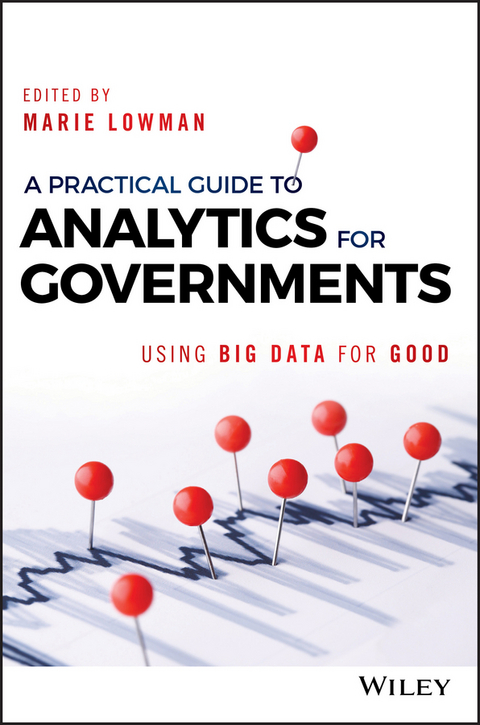
A Practical Guide to Analytics for Governments (eBook)
224 Seiten
Wiley (Verlag)
978-1-119-36285-2 (ISBN)
A Practical Guide to Analytics for Governments provides demonstrations of real-world analytics applications for legislators, policy-makers, and support staff at the federal, state, and local levels. Big data and analytics are transforming industries across the board, and government can reap many of those same benefits by applying analytics to processes and programs already in place. From healthcare delivery and child well-being, to crime and program fraud, analytics can-in fact, already does-transform the way government works. This book shows you how analytics can be implemented in your own milieu: What is the downstream impact of new legislation? How can we make programs more efficient? Is it possible to predict policy outcomes without analytics? How do I get started building analytics into my government organization? The answers are all here, with accessible explanations and useful advice from an expert in the field.
Analytics allows you to mine your data to create a holistic picture of your constituents; this model helps you tailor programs, fine-tune legislation, and serve the populace more effectively. This book walks you through analytics as applied to government, and shows you how to reap Big data's benefits at whatever level necessary.
- Learn how analytics is already transforming government service delivery
- Delve into the digital healthcare revolution
- Use analytics to improve education, juvenile justice, and other child-focused areas
- Apply analytics to transportation, criminal justice, fraud, and much more
Legislators and policy makers have plenty of great ideas-but how do they put those ideas into play? Analytics can play a crucial role in getting the job done well. A Practical Guide to Analytics for Governments provides advice, perspective, and real-world guidance for public servants everywhere.
MARIE LOWMAN is a principal industry consultant-government at SAS Institute. For more than two decades, she has overseen SAS's commitment to helping government organizations provide high-quality services to their constituents, while maximizing resources and budgets.
MARIE LOWMAN is a principal industry consultant-government at SAS Institute. For more than two decades, she has overseen SAS's commitment to helping government organizations provide high-quality services to their constituents, while maximizing resources and budgets.
Foreword xi
Acknowledgments xv
Chapter 1 Introduction 1
Marie Lowman
Child Welfare 4
Education 5
Healthcare 5
Prescription Drug Abuse 6
Criminal Justice and Public Safety 6
Smart Cities 7
Transportation 7
Fraud, Waste, and Abuse 8
Establishing a Center of Analytics 8
Chapter 2 Child Well-Being 11
Will Jones
Introduction 12
Data-Driven Culture 13
Data Sharing 16
Data Quality 18
Assessing Risk 22
Addressing the Perceived Limits of Analytics Pertaining to
Assessing Risk 25
Impact on Workforce 29
Notes 32
Chapter 3 Education 35
Nadja Young
Introduction 36
Build Your Engine--Build the Education Data
System Infrastructure 40
Use the Dashboard to Measure What Matters Most--Student
Learning Growth 42
Use the Navigation System to Guide Education Policy 47
Look through the Windshield with Predictive Analytics 56
Drive the Car and Use the Data 62
Notes 64
Chapter 4 Healthcare 67
Jeremy Racine
Role of the Government 68
The Challenge 72
Value-Based Care 89
Conclusion 96
Notes 97
Chapter 5 Prescription Drug Abuse 99
Steve Kearney
Introduction 100
National Initiatives 103
Prescription Drug Monitoring Programs 106
Advanced Analytics 107
Health Outcomes 109
Notes 111
Chapter 6 Criminal Justice and Public Safety 113
David Kennedy
Improving Data Access and Data Quality 117
Analytics throughout the Justice and Public Safety
System 121
Conclusion 126
Notes 127
Chapter 7 Brilliant Analytics for Smart Cities 129
Jennifer Robinson
Smart Cities 131
Technologies in Smart City Solutions 133
Data Management 136
Analytics 137
Notes 150
Chapter 8 Transportation 151
Jim Trogdon
Connected and Autonomous Vehicles (CAVs) 152
The Role of Data and Analytics 154
Benefi ts of Connected and Autonomous Vehicles 155
National Focus on Adoption of Performance Measures 156
Safety Performance Measures 157
System Performance Measures 157
The Role of Data and Analytics 159
Benefi ts of Transportation Performance Management and
Improved Measures 162
Notes 163
Chapter 9 Fraud, Waste, and Abuse 165
Carl Hammersburg
Healthcare 167
Tax and the Underground Economy 170
Benefi ts Programs 172
Recommendations 174
Notes 177
Chapter 10 Center of Analytics 179
Kay Meyer
Why a Center of Analytics? 183
What Makes a Center of Analytics? 184
Building a Center of Analytics? 188
Notes 190
Appendix 191
Index 193
CHAPTER 1
Introduction
Marie Lowman
The genius of big data is not only in the great number of new insights introduced, but even more in the new ideas for betterment these insights spawn. This paraphrase of Alexis de’Tocqueville’s nineteenth-century observation of our democracy is still applicable today. Our government is expected to act as an honorable steward of our information and tax dollars. Stewardship, the responsible and careful management of something entrusted in one’s care, demands that government demonstrate the effective and proper application of tax dollars to services and programs that provide the greatest benefit to its citizens.
Throughout my 21 years in the tech industry and eight-plus years serving in the public sector as an elected city council member and appointed commissioner, I have witnessed the increasing volume and velocity of data sources, and their overwhelming effect on government organizations—at times for the better, and at times, for the worse. The worse is when governments have no idea how to harness this data and use it for good. They make decisions with very little context, sometimes simply rendering a decision based on gut feelings alone. The better is when data is used as a catalyst to drive informed decision making, like the early identification of an at-risk child so a safe place can be provided for that child to stay while offering effective programs to support that child’s growth to achieve their potential.
At every point of intersection between government and people, data is created. This data is being generated at an unprecedented rate, from an unprecedented number of sources. Data comes in all shapes and sizes: from citizens, law enforcement communities, businesses, other government entities, hospitals, utilities, roads, courts, prisons, and so on. Collecting this voluminous data enables government entities to better serve its citizens. The rate of data generated and collected daily has long since eclipsed humans’ ability to analyze it, let alone identify and make use of relevant information. As governments confront the multitude of challenges around collecting and storing data, many are also grappling with how to extract meaningful insight from the data at their disposal.
Empowering government entities to collect meaningful data and then analyze and understand it in order to make better decisions is what I do for a living. It is a passion of mine. Governments must be able to separate the relevant from the insignificant, and the public from the confidential to ensure effectiveness and excellent stewardship. Analytics is the key to unlocking the true value hidden in this ever-growing data.
Committed government leaders dream of making their communities stronger, more economically viable, safer, and better places to live and work. For some, leveraging analytics is making this dream a reality. Changing the way government views information technology (IT) and analytics requires dedication and persistent engagement. To make the case for analytics—and convince government and citizens of the need to change traditional business models, share data, and update IT infrastructures—government leaders must be able to show tangible beneficial evidence. They must be able to explain exactly how and why investment in analytics can save money, improve lives, avoid unnecessary future costs, and enhance operational efficiency and compliance. Many states have proven that the proper application and use of analytics can make governing more effective—by strengthening fraud detection, enhancing child welfare services, and improving health outcomes. They have shown that by applying analytics strategically, citizen services can be delivered faster and more cost effectively. See the graphic in the appendix to this book, Holistic Citizen Insight.
With sophisticated analytics, government leaders can pinpoint the underlying value in all their data. By bringing data together in a unified fashion they can see connections across agencies to better serve citizens. They can get an eye-opening, big-picture view that crosses cultural and political boundaries. They can understand not just what happened in the past, but why it happened and what is likely to happen next. Government leaders can begin to see what they need to do to make it happen again (if it was positive) or to prevent it (if it was negative).
The following chapters touch on several areas of government where analytics can make, and are making, a significant impact in the way governments operate. We highlight how putting analytics in play offers decision makers a holistic view from which they can make sound decisions—from one’s childhood through their entire citizen lifecycle. Insights gleaned from early childhood into adulthood and from a broad range of government social and policy areas, offer a clearer picture of the many touch points government has with its citizens. This provides the ability to understand how our earliest encounters with a child can change trajectories and influence that child’s future. Analytics enables insight about the interaction and interrelatedness of government programs to provide clear guidance around effective program performance, efficient government operations, and improved citizen quality of life. The following pages will take you on a journey from the very beginning.
CHILD WELFARE
Our future begins with our children. We must protect, teach, and guide in an environment that will maximize every child’s potential. Every child deserves a safe environment in which to grow. In many instances of child abuse or neglect, information is available that could help identify high-risk situations before tragedies occur. Analytics enable a broader, more comprehensive understanding of a child. Having a holistic view of a child enables better decision making about that individual child, and can help ensure he/she receives the best available services and care.
Analytics in play allows a practitioner to go beyond traditional risk assessment tools by incorporating quantitative capabilities that can help improve child safety. Important child-related information can be continually monitored and updated, and automated alerts can notify overworked and overburdened caseworkers whenever established thresholds are breached so they can intervene promptly to help keep children safe.
Valuable, timely information provided to caseworkers and managers enables them to proactively improve other program outcomes as well. Analytic insight can reduce child-support delinquencies, increase collections, and more efficiently manage hundreds of thousands of cases every year. Gaining a holistic view of a child offers his/her caregivers and service providers the ability to truly assist the child in reaching his/her potential. The establishment of a safe environment to grow is the foundation from which a child will learn. Through analytics our education system is gleaning vast insight to ensure every child’s potential is realized.
EDUCATION
Public schools are not only the foundation for a thriving economy, they are paramount to developing our greatest resource—human capital. How can we ensure a sustainable future of economic vitality and competitiveness in the purview of today’s global society? Perhaps the most influential factor in the future of our economy is public education. Maintaining a globally competitive workforce begins in the classroom and educators must work creatively and effectively for impact. If our citizens and economies are to remain competitive, state leaders must implement policies and allocate resources to improve the effectiveness of the educational framework in public schools.
A successful education system flourishes in the harmonization of all factors that influence learning. Educators, environments, family backgrounds, health and other determinants all have a vital part to play in the success of a single student’s education.
Transforming our nation’s educational system requires accurate information to more precisely measure the impact of schools, programs, interventions, and teachers on student learning. Using data to understand both students’ and teachers’ strengths and weaknesses can guide implementing strategies that maximize the potential of both parties. The impact of this effort will lead our nation’s schools toward real education transformation, and ultimately help establish the necessary foundation to boost our nation’s economic prosperity. Like education, which lays the foundation for a vibrant economy, healthcare and the well-being of our citizens ensures their quality of life—but also represents one of the greatest challenges in terms of cost and service delivery.
HEALTHCARE
Analytics have become a vital underpinning to Medicaid managed care policy and program administration. In April 2016, the Centers for Medicare and Medicaid Services (CMS) released the first major update to Medicaid managed care in more than 10 years. A decade can bring about a lot of change. A unique opportunity for more comprehensive, advanced analytics for quality of care improvement, value-based care, program and fiscal integrity, and better management of the Medicaid managed care program is upon us. There are many factors contributing to the breakneck speed with which healthcare costs are rising. Using analytics to identify critical factors offers a mechanism for putting the...
| Erscheint lt. Verlag | 5.5.2017 |
|---|---|
| Reihe/Serie | SAS Institute Inc | SAS Institute Inc |
| Sprache | englisch |
| Themenwelt | Sozialwissenschaften ► Politik / Verwaltung ► Staat / Verwaltung |
| Wirtschaft ► Betriebswirtschaft / Management ► Unternehmensführung / Management | |
| Schlagworte | Big Data • Business & Management • Organisations- u. Managementtheorie • Organization & Management Theory • Regierung • Verwaltung • Wirtschaft u. Management |
| ISBN-10 | 1-119-36285-7 / 1119362857 |
| ISBN-13 | 978-1-119-36285-2 / 9781119362852 |
| Informationen gemäß Produktsicherheitsverordnung (GPSR) | |
| Haben Sie eine Frage zum Produkt? |
 EPUB (Adobe DRM)
Kopierschutz: Adobe-DRM
Adobe-DRM ist ein Kopierschutz, der das eBook vor Mißbrauch schützen soll. Dabei wird das eBook bereits beim Download auf Ihre persönliche Adobe-ID autorisiert. Lesen können Sie das eBook dann nur auf den Geräten, welche ebenfalls auf Ihre Adobe-ID registriert sind.
Details zum Adobe-DRM
Dateiformat: EPUB (Electronic Publication)
EPUB ist ein offener Standard für eBooks und eignet sich besonders zur Darstellung von Belletristik und Sachbüchern. Der Fließtext wird dynamisch an die Display- und Schriftgröße angepasst. Auch für mobile Lesegeräte ist EPUB daher gut geeignet.
Systemvoraussetzungen:
PC/Mac: Mit einem PC oder Mac können Sie dieses eBook lesen. Sie benötigen eine
eReader: Dieses eBook kann mit (fast) allen eBook-Readern gelesen werden. Mit dem amazon-Kindle ist es aber nicht kompatibel.
Smartphone/Tablet: Egal ob Apple oder Android, dieses eBook können Sie lesen. Sie benötigen eine
Geräteliste und zusätzliche Hinweise
Buying eBooks from abroad
For tax law reasons we can sell eBooks just within Germany and Switzerland. Regrettably we cannot fulfill eBook-orders from other countries.
aus dem Bereich